

Table of contents
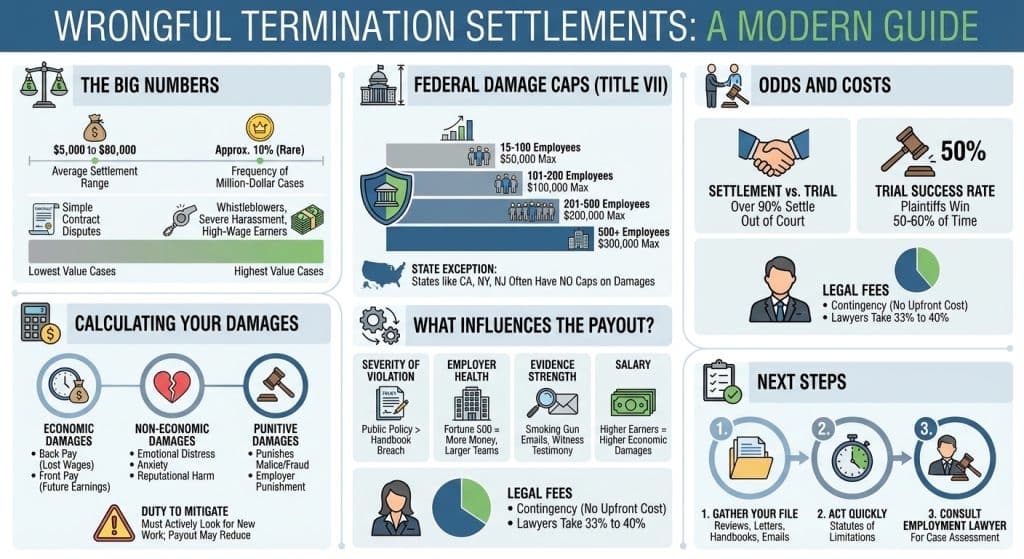
Most wrongful termination settlements fall between $5,000 and $80,000. However, court verdicts can exceed $1 million in cases involving severe discrimination or whistleblower retaliation. Final amounts depend on lost wages, emotional distress, and federal damage caps based on company size.
How Much Can You Sue for Wrongful Termination? (Real Payout Data)
When asking how much can you sue for wrongful termination, it is vital to distinguish between what you can demand in a lawsuit and what you will likely receive. While headlines often feature multi-million dollar verdicts, the reality for most plaintiffs is more modest.
The short answer: Average settlement ranges ($5,000 to $80,000)
According to legal data and settlement trends, the majority of wrongful termination cases settle for between $5,000 and $80,000. This amount typically covers lost wages for the period you were unemployed and a small amount for emotional distress.
Settlement vs. Court Verdict: Understanding the difference
A settlement is a guaranteed payout negotiated before a trial, whereas a court verdict is a decision made by a jury. Juries tend to award higher sums—sometimes significantly higher—but taking a case to trial is risky, expensive, and public. Most attorneys recommend settling to avoid the “all-or-nothing” nature of a trial.
Why million-dollar headlines are the exception, not the rule
Cases that result in seven-figure payouts usually involve egregious conduct, such as severe sexual harassment, high-level executive whistleblowing, or systemic discrimination. For a standard wrongful termination claim based on a contract dispute or minor policy violation, damages are strictly tied to your actual financial losses.
The 3 Main Types of Damages That Determine Case Value
The total value of your lawsuit is calculated by adding up three specific categories of damages.
1. Economic Damages: Lost wages, benefits, and front pay
This is the most objective part of your claim. It includes:
- Back Pay: Wages and benefits (health insurance, 401k matches) lost from the date of firing until the date of the verdict or settlement.
- Front Pay: Projected future earnings if you cannot reasonably find a new job quickly, though courts often limit this duration.
2. Non-Economic Damages: Emotional distress and pain and suffering
You can sue for the psychological impact of the firing, such as anxiety, depression, or loss of reputation. These are subjective and require strong evidence, often including testimony from mental health professionals.
3. Punitive Damages: When the employer’s conduct is malicious
Punitive damages are not designed to compensate you, but to punish the employer. Courts reserve these for cases where the employer acted with malice or reckless indifference to your rights.
The ‘Duty to Mitigate’: Why You Can’t Just Wait for a Payout
A common misconception is that you can stay unemployed while waiting for your lawsuit to conclude to maximize your “lost wages.” This is incorrect due to the duty to mitigate damages.
How finding a new job affects your potential settlement
The law requires you to actively look for new employment. If you find a job that pays the same or more than your previous role, your accumulation of economic damages stops. While this reduces the potential payout, failing to look for work can destroy your case entirely.
What happens if you refuse comparable employment
If the defense can prove that you turned down a reasonable job offer or stopped applying for jobs, the court may cut off your back pay damages from that point forward.
Federal Caps on Damages Based on Company Size
Under federal laws (specifically Title VII of the Civil Rights Act), there are strict limits (caps) on the combined amount of compensatory and punitive damages you can receive. These caps are based on the size of the employer:
| Number of Employees | Federal Damage Cap |
|---|---|
| 15 – 100 employees | $50,000 |
| 101 – 200 employees | $100,000 |
| 201 – 500 employees | $200,000 |
| 500+ employees | $300,000 |
Note: These caps apply to federal claims. Some state laws (such as those in California or New York) may offer uncapped damages for discrimination or retaliation, allowing for significantly higher verdicts.
Is a wrongful termination lawsuit worth it?
Deciding whether to sue involves weighing the potential financial gain against the emotional and professional costs.
- Financial vs. Emotional Cost: Lawsuits can drag on for years. The stress of depositions and having your work history scrutinized can be overwhelming.
- Future Employment: Future employers may view you as a liability if a lawsuit appears in public records, potentially making it harder to get hired.
- Severance Negotiation: Often, a skilled attorney can negotiate an enhanced severance package without ever filing a lawsuit. This provides a faster payout and keeps the dispute private.
What are the odds of winning a wrongful termination lawsuit?
Winning a wrongful termination suit is statistically difficult because most employment in the U.S. is “at-will,” meaning employers can fire you for almost any reason.
- Private vs. Government: Government employees often have more protections than private-sector workers.
- Settlement Rates: Approximately 90% to 95% of cases settle out of court. This is often considered a “win” for the plaintiff, even if they don’t get a jury verdict.
- Evidence is Key: Success depends entirely on documentation—emails, performance reviews, and witness statements that prove the firing was illegal (e.g., discriminatory) rather than just unfair.
Is it expensive to sue for wrongful termination?
For most plaintiffs, the upfront cost is low, but the final cost comes out of the settlement.
- Contingency Fees: Most employment lawyers work on a “no win, no fee” basis. If you win, they take a percentage of the settlement.
- Typical Percentages: Lawyers typically take 33% to 40% of the total recovery.
- Hidden Costs: Even with contingency fees, you may be responsible for court filing fees, deposition transcripts, and expert witness fees, which can run into the thousands.
What is the highest payout for wrongful termination?
While rare, the highest payouts for wrongful termination have reached into the tens of millions of dollars. These outliers almost always involve:
- Whistleblower Retaliation: Where an employee exposed massive corporate fraud or safety violations.
- Class-Action Lawsuits: Where hundreds of employees sue for systemic discrimination.
- Egregious Harassment: Cases involving physical assault or severe, prolonged harassment that the company ignored.
FAQs
What is the highest payout for wrongful termination?
The highest payouts for wrongful termination can exceed $10 million, typically in cases involving corporate whistleblowers or class-action discrimination suits. However, these are rare outliers. Most high-value individual cases cap out in the low millions due to federal limits on punitive and compensatory damages.
Is a wrongful termination lawsuit worth it?
It depends on your goals. If you have significant financial losses and strong evidence, a lawsuit can recover lost wages and clear your name. However, for many, the stress, time (1–3 years), and risk of blacklisting make a negotiated severance package a better option than a public trial.
What are the odds of winning a wrongful termination lawsuit?
Statistically, about 90–95% of wrongful termination cases settle out of court rather than going to trial. Of the few that go to trial, plaintiffs win roughly 50% of the time. Success relies heavily on having concrete documentation that proves the termination violated a specific law.
Is it expensive to sue for wrongful termination?
Upfront costs are usually low because most employment lawyers work on a contingency fee basis, meaning they only get paid if you win (typically 33–40% of the settlement). However, you may still be liable for court costs and deposition fees, which are deducted from your final payout.