
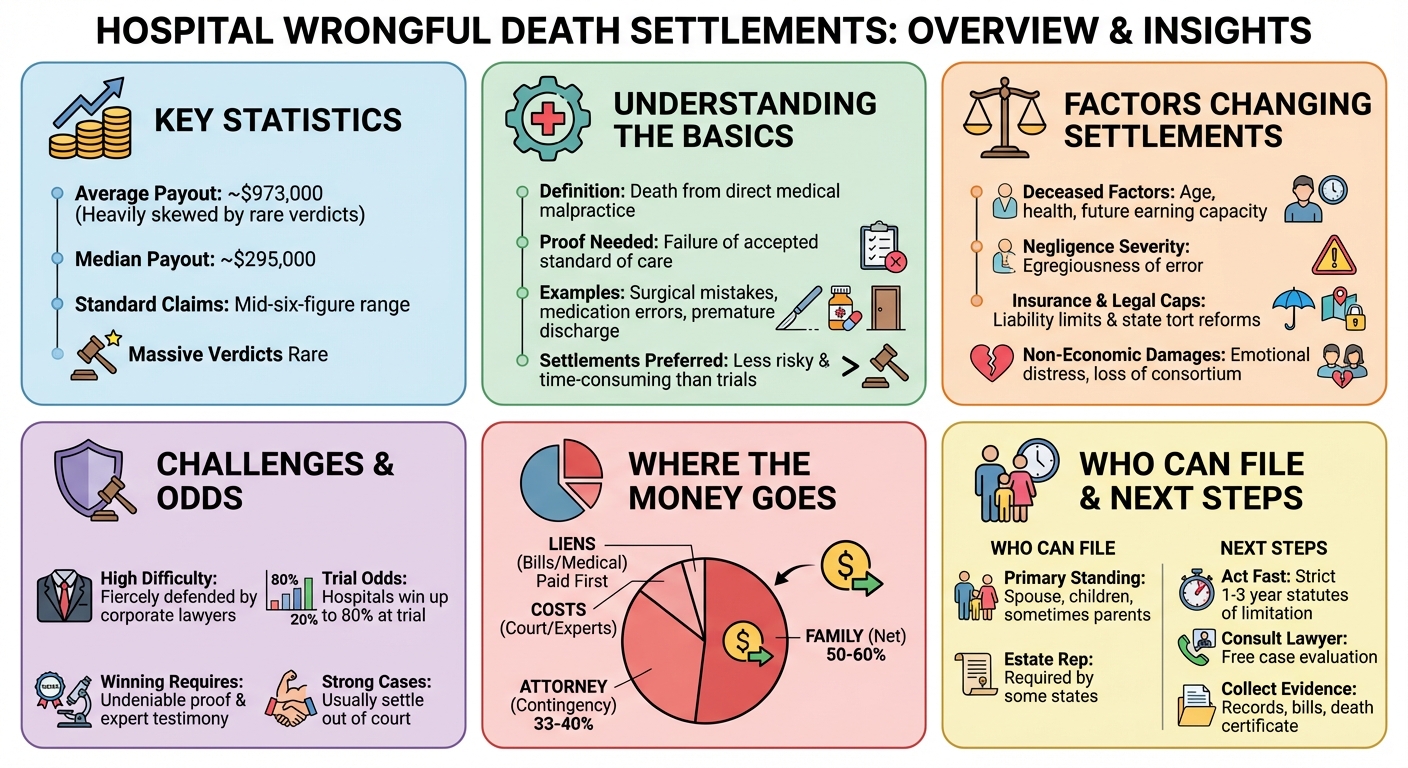
The average hospital wrongful death settlement is approximately $973,000, with median payouts around $295,000. However, settlement amounts vary widely based on the deceased’s age, earning capacity, and state damage caps. Cases involving egregious medical negligence or significant economic losses frequently result in multi-million dollar settlements.
1. Understanding Hospital Wrongful Death Lawsuit Settlements
Losing a loved one is devastating, and when that loss occurs due to a hospital’s negligence, families are often left seeking justice and financial stability. A hospital wrongful death lawsuit settlement provides a legal pathway to hold healthcare facilities accountable without the unpredictability of a trial.
What constitutes wrongful death in a hospital setting?
Wrongful death in a hospital occurs when a patient dies as a direct result of medical malpractice. This means a doctor, nurse, or hospital staff member failed to provide the accepted standard of care. Common examples include fatal surgical errors, administering the wrong medication, or discharging a patient prematurely from the emergency room.
Why families choose to pursue settlement over trial
Litigation is emotionally draining and time-consuming. Families typically prefer settlements because they offer guaranteed compensation, resolve the case years faster than a trial, and provide a private resolution that helps them find closure without enduring a public court battle.
2. What is the average payout for medical negligence resulting in death?
The average payout for medical negligence resulting in death is approximately $973,000, while the median settlement sits closer to $295,000. However, compensation varies drastically based on the victim’s age, lost earning capacity, the severity of the hospital’s negligence, and whether your state imposes caps on non-economic damages.
National average vs. median settlement amounts
While the national average nears $1 million, the median is significantly lower. This discrepancy exists because a small number of multi-million dollar verdicts heavily skew the average. Most standard medical malpractice wrongful death claims settle in the mid-six-figure range.
Economic vs. non-economic damages in medical malpractice
- Economic Damages: Quantifiable financial losses, including the deceased’s future lost wages, medical bills incurred prior to death, and funeral expenses.
- Non-Economic Damages: Compensation for intangible losses, such as the family’s grief, loss of companionship, and the deceased’s pain and suffering before passing.
How state damage caps impact maximum payouts
Many states have enacted tort reform laws that place strict caps on non-economic damages in medical malpractice cases. Even if a jury awards $5 million for emotional distress, a state cap might reduce that portion of the payout to $250,000 or $500,000, significantly lowering the final settlement.
3. Key Factors That Determine Your Settlement Amount
No two wrongful death cases are identical. Insurance companies and defense attorneys evaluate several specific factors when calculating a settlement offer.
Age, health, and earning capacity of the deceased
The financial impact of the loss is a primary driver of settlement value. The death of a 35-year-old primary breadwinner with a high-paying career will generally result in a higher economic damage calculation than the death of an elderly patient with pre-existing terminal conditions.
The egregiousness of the hospital’s negligence
If the hospital’s actions were exceptionally reckless—such as a surgeon operating under the influence or staff intentionally ignoring critical alarms—the settlement value increases. In rare cases, this can open the door to punitive damages.
Available insurance policy limits of the hospital and staff
Hospitals carry massive commercial liability policies, often in the tens of millions. However, individual doctors may carry policies with limits of $1 million to $3 million. The total available insurance coverage often acts as a ceiling for the settlement amount.
Loss of consortium and emotional distress claims
Spouses and children can claim loss of consortium, which compensates for the loss of love, guidance, and intimate relations. The strength of family ties and the emotional impact of the sudden loss play a significant role in negotiations.
4. How hard is it to sue a hospital for wrongful death?
Suing a hospital for wrongful death is notoriously difficult because you must definitively prove that a medical professional breached the accepted standard of care. This requires securing testimony from independent medical experts, navigating complex state malpractice laws, and fighting well-funded corporate legal defense teams.
Proving the breach of the standard of care
You cannot sue simply because a patient died; you must prove negligence. This requires demonstrating that a reasonably competent healthcare provider in the same situation would have acted differently, and that this specific failure directly caused the death.
The necessity of independent medical expert testimony
Medical malpractice claims cannot proceed without expert witnesses. Your legal team must hire specialized doctors to review the medical records, identify the exact errors, and testify against the hospital’s actions.
Navigating hospital legal defense teams and corporate shields
Hospitals are protected by aggressive risk management departments and top-tier defense law firms. They often attempt to shift blame to pre-existing conditions or argue that the attending physician was an independent contractor, not a hospital employee.
5. What are the odds of winning a lawsuit against a hospital?
The odds of winning a medical malpractice lawsuit at trial are historically low, with hospitals winning up to 80% of jury verdicts. However, your overall odds of receiving compensation are much higher if you have strong medical expert testimony, as hospitals typically prefer to settle clear-cut cases out of court.
Statistical success rates for medical malpractice claims
Data consistently shows that plaintiffs face an uphill battle in the courtroom. Juries tend to give doctors the benefit of the doubt in complex medical situations. This makes securing a pre-trial settlement the most reliable strategy.
Why strong cases usually settle out of court
When a plaintiff’s attorney presents undeniable evidence of negligence—backed by credible medical experts—the hospital’s insurance company will usually offer a settlement. They do this to avoid the risk of a massive, unpredictable jury verdict and negative public relations.
The risks of taking a hospital wrongful death case to trial
Going to trial means risking everything. If the jury sides with the hospital, the family receives nothing. Trials also add years to the legal process and significantly increase case expenses, which are deducted from any potential winnings.
6. How much would I get out of $100,000 settlement?
Out of a $100,000 settlement, you would typically receive between $50,000 and $60,000. First, your attorney deducts their contingency fee, usually 33% to 40% ($33,000 to $40,000). Then, case expenses, expert witness fees, and any outstanding medical liens are paid before the final net amount is disbursed to your family.
Understanding contingency fees
Most medical malpractice attorneys work on a contingency fee basis, meaning they only get paid if you win. While the standard fee is 33.3%, it can increase to 40% if the case goes to trial due to the increased workload.
Deducting case expenses and expert witness fees
Building a wrongful death case is expensive. Your attorney will advance costs for obtaining medical records, filing court documents, and hiring medical experts (who can charge thousands of dollars per hour). These costs are reimbursed from the settlement.
Resolving medical liens and outstanding hospital bills
If the deceased received medical care before passing, health insurance companies or Medicare/Medicaid may place a lien on your settlement to recover what they paid. Your attorney will negotiate these liens down to maximize your payout.
Calculating the final net payout to the family
| Gross Settlement Amount | $100,000 |
| Attorney Contingency Fee (est. 33.3%) | -$33,300 |
| Case Expenses & Expert Fees (est.) | -$7,000 |
| Medical Liens (est.) | -$5,000 |
| Estimated Net Payout to Family | $54,700 |
7. Examples of Hospital Wrongful Death Settlements and Verdicts
Looking at past case examples can provide context for how different types of negligence are valued in the legal system.
Surgical errors and anesthesia mistakes
Cases involving anesthesia overdoses or severe surgical errors (such as nicking a major artery) often result in settlements ranging from $1 million to $3 million, as the negligence is usually clear and the death sudden.
Failure to diagnose or misdiagnosis resulting in death
When a hospital fails to diagnose a fatal condition like a heart attack, stroke, or aggressive cancer, settlements depend heavily on whether a timely diagnosis would have realistically saved the patient’s life.
Medication errors and emergency room negligence
Administering the wrong medication or ignoring a patient in the ER until it is too late are common grounds for lawsuits. These cases frequently settle for mid-six figures, depending on the patient’s age and state damage caps.
8. Who Can File a Wrongful Death Claim Against a Hospital?
Wrongful death laws vary by state, but they universally restrict who has the legal standing to sue a healthcare provider.
Immediate family members
In almost all states, surviving spouses and biological or adopted children have the primary right to file a claim. If the deceased was a minor or unmarried, the parents typically hold this right.
The role of the estate’s personal representative
Some states require the wrongful death lawsuit to be filed by the personal representative (executor) of the deceased’s estate. The compensation is then distributed to the surviving heirs according to the deceased’s will or state intestacy laws.
Statute of limitations for filing a medical malpractice claim
You have a limited window to file a lawsuit. Most states enforce a statute of limitations of one to three years from the date of death. Missing this deadline permanently bars your family from recovering compensation.
9. Next Steps: Consulting a Medical Malpractice Attorney
If you suspect your loved one died due to hospital negligence, taking swift legal action is vital to preserving evidence.
How to request a free case evaluation
Reputable medical malpractice law firms offer free, confidential consultations. During this evaluation, an attorney will listen to your story, assess the basic facts, and determine if you have a viable claim.
What documents to gather
To speed up the evaluation process, gather the deceased’s death certificate, all available medical records, hospital bills, and any correspondence you have had with hospital administrators or insurance companies.
Why specialized legal representation is critical for maximum compensation
Medical malpractice is one of the most complex areas of personal injury law. Hiring an attorney with a proven track record against hospitals ensures that you have the resources to hire top medical experts, negotiate aggressively, and secure the maximum possible settlement for your family’s future.
 Call (713) 747-7777