
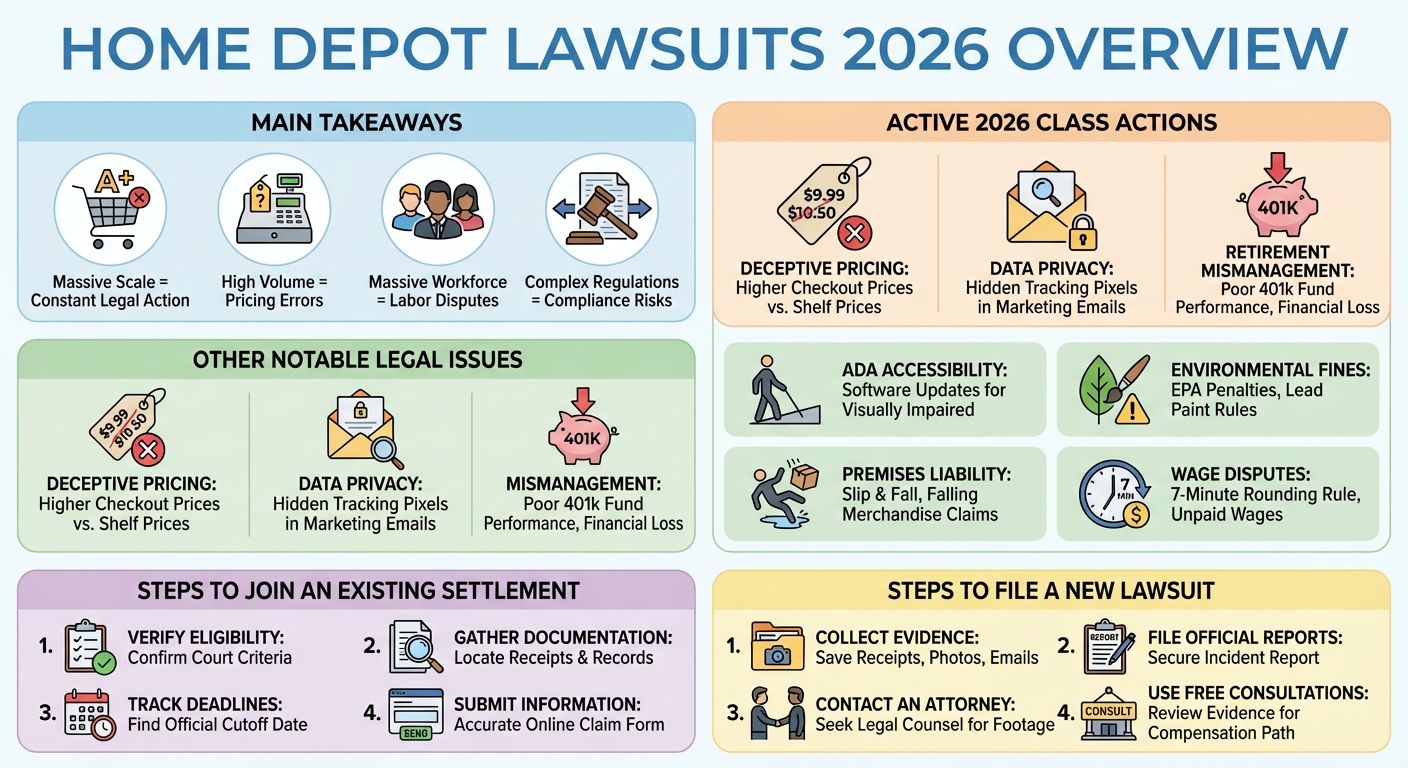
Currently, Home Depot is facing multiple lawsuits, including a 2026 class action for allegedly charging higher prices at checkout than advertised on shelves. Other recent lawsuits involve data privacy violations, ERISA 401(k) mismanagement, and premises liability claims for in-store injuries.
Home Depot Lawsuits: 2026 Updates, Settlements, and Active Class Actions
As one of the largest home improvement retailers in the world, Home Depot frequently faces legal action ranging from consumer class actions to personal injury claims. In 2026, litigation against the retail giant includes allegations of deceptive pricing, data privacy violations, and employee retirement plan mismanagement.
Overview of Recent Litigation Against Home Depot
Recent lawsuits highlight a growing trend of consumer protection and corporate accountability cases. Notably, a 2026 class action accuses the company of charging higher prices at the register than those advertised on store shelves. Other significant legal battles involve ERISA violations regarding employee 401(k) plans, ADA accessibility issues, and environmental compliance fines.
How to Navigate This Lawsuit Tracker
This page serves as a comprehensive legal hub for ongoing and resolved litigation involving Home Depot. Below, you will find breakdowns of specific case types, eligibility requirements for active settlements, and guidance on how to pursue a claim if you have been harmed financially or physically.
Is there a class action lawsuit against Home Depot?
Yes, there are multiple active class action lawsuits against Home Depot in 2026. Recent cases involve allegations of overcharging customers at checkout compared to advertised shelf prices, data privacy violations regarding email tracking technology, and ERISA violations concerning the mismanagement of employee 401(k) retirement plans.
Current Active Class Actions in 2026
- False Advertising & Pricing: A major 2026 lawsuit alleges the retailer systematically charges more at the point of sale than the price listed on the shelf.
- Data Privacy: Plaintiffs claim Home Depot embedded tracking pixels in marketing emails to harvest private consumer data without explicit consent.
Recently Settled Class Actions
Home Depot recently settled a significant ADA violation class action, resulting in updated, accessible software for blind and visually impaired customers. Additionally, they reached a $1.7 million settlement in late 2024 regarding overcharging and false advertising claims brought by California prosecutors.
Major Home Depot Lawsuits and Settlements
Overcharging and False Advertised Prices (2024-2026)
Pricing discrepancies have been a recurring legal issue for Home Depot. Following a $1.7 million civil penalty settlement in September 2024 for unlawfully charging customers higher prices than advertised, a new consumer class action was filed in March 2026 echoing similar complaints of deceptive checkout practices.
Data Privacy and Email Tracking Technology
A recent class action alleges that Home Depot violated consumer privacy laws by utilizing hidden tracking technology. The lawsuit claims the company embedded trackers into marketing emails to secretly collect recipients’ private data, including when and where emails were opened, without obtaining proper consent.
ERISA 401(k) Retirement Plan Mismanagement
The U.S. Department of Labor and plan participants have pursued litigation against Home Depot over its FutureBuilder 401(k) defined contribution retirement plan. Plaintiffs argue the company breached its fiduciary duties under ERISA by failing to divest from poorly performing funds, costing employees millions of dollars in retirement savings.
ADA Violations and Accessibility Settlements
Home Depot has faced lawsuits regarding the accessibility of its digital and physical infrastructure. A recent settlement addressed ADA violations by requiring the retailer to implement updated software systems that are fully accessible to blind and visually impaired individuals.
EPA Violations and Lead Paint Fines
The Environmental Protection Agency (EPA) previously discovered violations through customer complaints in states like Illinois, Maine, Michigan, Minnesota, and Wisconsin. Home Depot faced fines and settlements for failing to ensure that contractors performing renovations complied with lead-safe work practices.
Personal Injury and Premises Liability Claims
Due to the warehouse-style layout of its stores, Home Depot regularly defends against premises liability lawsuits. Common claims include slip-and-fall injuries, accidents caused by falling merchandise, and injuries occurring in parking lots or store entrances.
Can I still join the class action lawsuit?
Whether you can still join a Home Depot class action lawsuit depends on the specific case and its current legal status. For active settlements, you must meet the defined class criteria and submit a valid claim form before the court-appointed deadline. Always check official settlement websites for exact dates.
Eligibility Requirements for Active Settlements
Eligibility is strictly defined by the court. For example, in a pricing discrepancy lawsuit, you may need to provide receipts showing you purchased specific items during the class period. For employee-related lawsuits, you must have been employed or enrolled in the relevant benefits program during the specified timeframe.
Deadlines to File a Claim
Every class action settlement has a strict claims deadline. If you miss this date, you forfeit your right to financial compensation. Deadlines are typically published on the official settlement administrator’s website and sent via mail or email to known class members.
How to Submit Your Information
To submit a claim, you generally need to visit the settlement website, fill out an online claim form, and provide any required documentation (such as purchase receipts or employment records). Ensure all contact information is accurate to avoid delays in receiving your settlement check.
Why does Home Depot get sued so much?
Home Depot faces frequent lawsuits due to its massive operational scale, processing millions of daily transactions across thousands of retail locations. This high volume naturally increases the likelihood of pricing errors, premises liability incidents like slip-and-falls, complex employment disputes, and challenges maintaining strict regulatory compliance across different states.
High Volume of Daily Customers and Transactions
With massive daily foot traffic, the statistical probability of in-store accidents, checkout errors, and customer service disputes is exceptionally high. Even a minor software glitch in pricing can affect thousands of customers, instantly triggering class action litigation.
Complex Corporate and Employment Structures
Employing hundreds of thousands of workers leads to inevitable labor disputes. Wage and hour claims, discrimination lawsuits, and ERISA retirement plan mismanagement cases are common side effects of managing such a massive workforce.
Strict Regulatory Compliance Requirements
As a retailer handling hazardous materials, construction contracts, and consumer data, Home Depot must navigate a labyrinth of federal and state regulations. Lapses in EPA lead paint rules, ADA accessibility standards, or digital privacy laws frequently result in regulatory fines and consumer lawsuits.
What’s the 7 minute rule at Home Depot?
The 7-minute rule at Home Depot refers to a corporate timekeeping practice where employee clock-ins and clock-outs are rounded to the nearest quarter-hour. If an employee clocks in within seven minutes of their scheduled shift, it rounds down. This rounding policy has historically sparked wage and hour lawsuits.
Explanation of the 7-Minute Grace Period
Under this policy, if a shift starts at 8:00 AM and an employee clocks in at 8:07 AM, their time is rounded back to 8:00 AM. However, if they clock in at 8:08 AM, it rounds forward to 8:15 AM. While intended to simplify payroll, it can lead to discrepancies in actual time worked.
How It Relates to Wage and Hour Lawsuits
Plaintiffs in wage and hour lawsuits argue that rounding policies like the 7-minute rule disproportionately favor the employer, resulting in unpaid wages for time actually worked. These lawsuits claim that over time, employees lose significant compensation, violating the Fair Labor Standards Act (FLSA) and state labor laws.
How to File a Claim or Lawsuit Against Home Depot
Gathering Evidence and Documentation
If you intend to sue Home Depot for a personal injury or consumer violation, evidence is critical. For injuries, secure medical records, photos of the hazard, and an official incident report from the store manager. For consumer fraud, retain all receipts, emails, and bank statements.
When to Contact a Personal Injury or Class Action Lawyer
You should contact an attorney immediately if you suffered a severe injury on Home Depot property or if you believe you are a victim of widespread corporate fraud. An experienced lawyer can help preserve security footage, negotiate with corporate insurance adjusters, and determine if your case qualifies for an existing class action.
Free Legal Consultations
Most personal injury and class action law firms offer free, no-obligation consultations. During this evaluation, an attorney will review your evidence, explain your legal rights, and outline the best path forward to secure compensation for your damages.
 Call (713) 747-7777