

Table of contents
Yes, you can sue for slander in Houston, Texas, provided you file the lawsuit within the **one-year statute of limitations**. You must prove the defendant made a false oral statement to a third party that caused you financial or reputational harm. If the statement accuses you of a crime or professional incompetence, damages may be assumed (slander per se).
Can You Sue Someone for Slander in Houston?
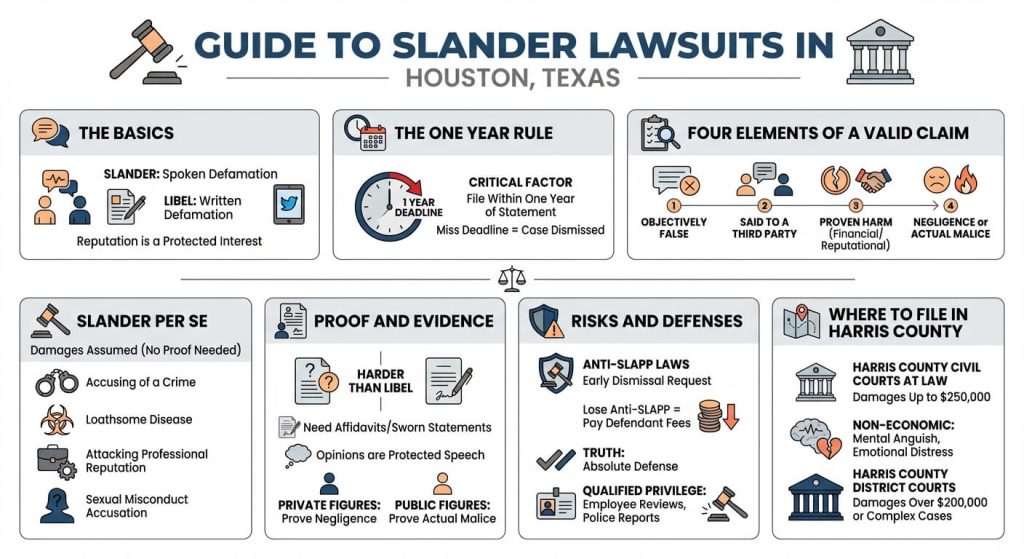
Yes, you can sue someone for slander in Houston, provided you act quickly and have evidence that the statement caused you harm. Slander is a specific type of defamation that refers to spoken or oral statements, whereas libel refers to written or published statements.
In Texas, your reputation is considered a protected interest. If someone makes false oral claims about you to a third party—whether at a workplace in Downtown Houston, a social gathering in The Heights, or a business meeting in the Energy Corridor—you may have grounds for a civil lawsuit.
The Short Answer: Yes, But Time is Limited
The most critical factor in a Houston slander case is the clock. Texas has one of the strictest deadlines in the country for filing defamation claims. If you miss this window, your case will likely be dismissed immediately, regardless of how damaging the lies were.
Slander vs. Libel: Knowing the Difference
Before filing a lawsuit, you must categorize the defamation correctly. While both fall under the umbrella of “defamation of character,” the distinction impacts how you collect evidence.
| Type | Medium | Examples |
|---|---|---|
| Slander | Spoken / Oral | Gossip, speeches, podcast audio, watercooler talk. |
| Libel | Written / Permanent | Social media posts, emails, newspaper articles, reviews. |
Can I Sue Someone for Slander in Texas?
Yes, you can sue for slander in Texas if the spoken statement meets specific legal criteria. Defamation is not a federal crime; it is a civil tort handled at the state level. In Texas, the legal framework is governed largely by common law and the Texas Civil Practice and Remedies Code.
Legal Requirements for a Valid Claim
To successfully sue, you generally need to prove the following elements:
- The statement was false: Truth is an absolute defense. If the negative statement is true, it is not slander.
- It was published to a third party: The person must have said it to someone other than you.
- It caused harm: You must usually show that your reputation or finances suffered as a result.
- The speaker was at fault: They acted with negligence (if you are a private figure) or actual malice (if you are a public figure).
What Proof Is Needed for Slander?
Because slander is spoken, it is often harder to prove than libel. The “he said, she said” nature of oral defamation requires substantial evidence to survive a motion to dismiss.
Proving the Statement Was False
The burden of proof falls on the plaintiff (you). You must demonstrate that the statement is objectively false. Opinions—no matter how insulting—are generally protected by the First Amendment. For example, calling someone a “bad manager” is likely an opinion; stating “he stole $5,000 from the register” is a fact capable of being proven false.
Proving Publication to a Third Party
You must have witnesses. Affidavits (sworn statements) from people who heard the slander are essential. If the defendant only said the insult to your face with no one else around, it does not qualify as defamation because your reputation with others remained intact.
Establishing Fault: Negligence vs. Actual Malice
Texas law distinguishes between private citizens and public figures:
- Private Individuals: Must prove the defendant was negligent (careless) in verifying the truth.
- Public Figures: Must prove actual malice—that the defendant knew the statement was false or acted with reckless disregard for the truth.
Slander Per Se: When Damages Are Assumed
In some cases, the statement is so inherently damaging that Texas law assumes you suffered harm without you needing to prove financial loss. This is called Slander Per Se. Examples include:
- Accusing someone of a crime.
- Claiming someone has a loathsome disease.
- Statements that injure a person’s professional reputation (e.g., accusing a doctor of malpractice).
- Accusing a person of sexual misconduct.
The Houston Legal Process: Where and When to File
Statute of Limitations: The Strict 1-Year Rule
Under Texas Civil Practice and Remedies Code § 16.002, you have exactly one year from the date the slanderous statement was made to file a lawsuit. This is shorter than the two-year limit for most personal injury claims. If you wait 13 months, your case is dead.
Harris County District Courts vs. County Civil Courts at Law
In Houston, defamation lawsuits are typically filed in Harris County. Depending on the amount of damages you are seeking, you will file in either:
- Harris County Civil Courts at Law: Generally for disputes involving smaller monetary amounts (up to $250,000).
- Harris County District Courts: For cases involving damages exceeding $200,000 or complex litigation.
Is It Worth Suing for Slander?
Deciding whether to sue requires a cost-benefit analysis. While defending your reputation is important, litigation is expensive and risky.
The Risk of the Texas Anti-SLAPP (TCPA) Motion
Texas has a strong Anti-SLAPP law (Texas Citizens Participation Act). If a defendant can argue they were exercising their right to free speech on a matter of public concern, they can file a motion to dismiss your case early. If they win, you may be ordered to pay their attorney’s fees. This makes filing a weak slander case financially dangerous.
Collectability: Does the Defendant Have Assets?
Even if you win a million-dollar judgment, you cannot collect blood from a stone. If the person slandering you has no assets, insurance, or steady income, you may spend thousands on legal fees to win a “paper judgment” that is never paid.
How Much Is a Slander Lawsuit Worth?
The value of a slander lawsuit varies wildly based on the severity of the lie and the depth of the financial damage caused. There is no “average” settlement calculator.
Economic Damages
These are quantifiable losses. If the slander caused you to lose a job, a contract, or a client, you can sue for those specific lost wages and future earnings. You will need tax returns and employment records to prove these numbers.
Non-Economic Damages
These cover intangible harm, such as mental anguish, emotional distress, and loss of reputation in the community. In Houston courts, juries determine the monetary value of this suffering.
Exemplary (Punitive) Damages
If you can prove the defendant acted with malice (specific intent to harm you), a Texas court may award punitive damages to punish the wrongdoer. These are capped by state law but can significantly increase the total payout.
Common Defenses You Will Face
Defendants in Houston defamation cases often rely on three main defenses:
- Substantial Truth: If the gist of the statement is true, minor inaccuracies do not make it slander.
- Qualified Privilege: Statements made in certain contexts (like employee performance reviews or police reports) are often protected unless made with malice.
- Opinion: Statements that cannot be proven true or false are generally protected speech.
Consulting a Houston Defamation Attorney
Defamation law in Texas is complex, particularly due to the Anti-SLAPP statutes and the high burden of proof for oral statements. A local attorney familiar with the Harris County court system can help you evaluate if your evidence is strong enough to survive a motion to dismiss.
Before consulting a lawyer, gather witness contact information, a timeline of events, and any proof of financial loss. This will allow for a clear assessment of your case’s viability.
FAQs
Can I sue someone for slander in Texas?
Yes, you can sue for slander in Texas if you can prove that a false or defamatory statement of fact was spoken to a third party, and this statement caused you to suffer damages (such as lost wages or harm to your reputation).
What proof is needed for slander?
To prove slander, you need evidence that the statement was false, that the speaker was at least negligent in making it, that the statement was published (heard by a third party), and that you suffered actual damages as a result.
Is it worth suing for slander?
It depends on the defendant’s ability to pay and the strength of your evidence of financial loss. Slander cases are often difficult and expensive to prove. It is typically only “worth it” if the damages (lost business, lost job) are substantial.
How much is a slander lawsuit worth?
The value depends on your economic losses (lost wages, business revenue) and the severity of emotional distress. Texas law also allows for punitive damages if the slander was committed with malice or a high degree of recklessness.
What is the difference between libel and slander?
In Texas, libel refers to written or published defamation (like social media posts, newspapers, emails). Slander refers to spoken defamation (verbal remarks). The legal standards for both are very similar.