

Table of contents
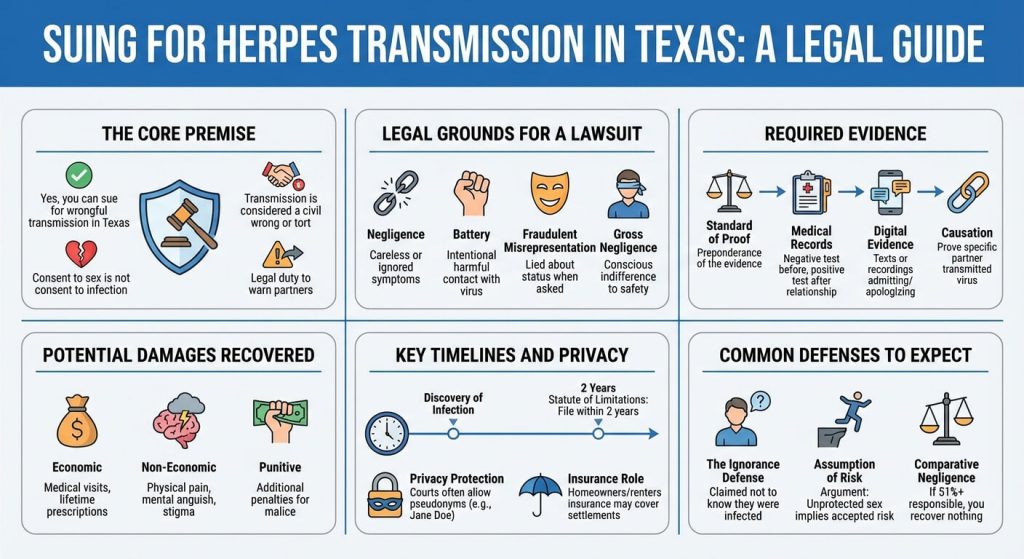
Yes, you can sue someone in Texas for giving you herpes if they knew or should have known about their infection and failed to warn you. Legal grounds typically include negligence, battery, or fraudulent misrepresentation. Successful plaintiffs can recover damages for medical expenses, emotional distress, and pain and suffering.
Can You Sue Someone for Giving You Herpes in Houston?
Yes, you can sue someone for giving you herpes in Houston. Under Texas personal injury law, transmitting a sexually transmitted disease (STD) like herpes simplex virus (HSV-1 or HSV-2) to a partner without their knowledge is considered a civil wrong, or “tort.”
The legal foundation for these lawsuits rests on the duty to warn. In Texas, individuals who know (or reasonably should know) they are infected with a contagious disease have a legal obligation to disclose this status to sexual partners before intimate contact. Failing to do so deprives the partner of informed consent regarding their health and safety.
Can you sue someone for giving you herpes in Texas?
You can sue someone for giving you herpes in Texas if you can prove they transmitted the virus to you through wrongful conduct. While sexual intercourse is usually consensual, consent to sex is not consent to infection. If a partner withholds the fact that they have herpes, your consent to the sexual act may be considered vitiated (invalid) because it was based on incomplete or fraudulent information.
Texas courts generally categorize these lawsuits under two main umbrellas:
- Negligence: The partner was careless (e.g., they didn’t know for sure but had symptoms they ignored).
- Intentional Torts: The partner knew they had herpes and deliberately chose not to tell you.
Legal Grounds for STD Lawsuits in Texas
To win a herpes transmission lawsuit in Houston, your attorney will typically file under one or more of the following causes of action:
Negligence: Failure to Exercise Reasonable Care
This is the most common claim. You must prove that a reasonable person in the defendant’s position would have either abstained from sex or warned their partner. If the defendant had prior outbreaks or a diagnosis and failed to use protection or disclose their status, they breached their duty of care.
Battery: Harmful or Offensive Contact
Battery is an intentional tort. In the context of an STD, the “harmful or offensive contact” is the transmission of the virus itself. Even if you agreed to the physical act of sex, you did not agree to the contact with the virus.
Fraudulent Misrepresentation
If your partner explicitly lied to you—for example, if you asked, “Are you clean?” and they said “Yes” despite knowing they had herpes—this constitutes fraud. Text messages proving these lies can be powerful evidence in Texas courts.
Gross Negligence
This applies if the defendant showed a conscious indifference to your rights, safety, or welfare. Proving gross negligence is difficult but important, as it opens the door to punitive damages.
How hard is it to sue someone for giving you an STD?
Suing for an STD transmission is challenging but legally viable if you have the right evidence. The standard of proof in a civil case is a “preponderance of the evidence,” meaning you must show it is “more likely than not” that the defendant is responsible.
The biggest hurdles include:
- Establishing Causation: You must prove the defendant is the specific person who infected you. If you have had multiple partners recently, the defense will use the “Empty Chair” defense, suggesting someone else could be responsible.
- Medical Evidence: You will need medical records showing a negative test prior to the relationship and a positive test afterward. Genetic sequencing (though expensive) can sometimes link viral strains.
- Digital Evidence: Texts, emails, or recordings where the defendant admits to having the virus or apologizes for not telling you are often the “smoking gun” in these cases.
Potential Damages: What Can You Recover?
In Houston, victims of wrongful STD transmission can seek compensation for the lifelong impact of the virus.
- Economic Damages: Reimbursement for medical visits, testing, and lifetime prescription costs for antivirals like Valtrex or Acyclovir.
- Non-Economic Damages: Compensation for physical pain, mental anguish, loss of enjoyment of life, and the stigma associated with the diagnosis.
- Punitive Damages: If you can prove the defendant acted with malice or gross negligence (e.g., they wanted to infect you or didn’t care at all), a jury may award extra damages to punish them.
How much can you sue someone for giving you herpes?
There is no standard “calculator” for herpes settlements in Texas. Verdicts and settlements can range from tens of thousands to millions of dollars, but the actual payout often depends on the defendant’s ability to pay.
Factors influencing the amount include:
- Insurance Coverage: Does the defendant have homeowner’s or renter’s insurance? Some policies cover negligence claims, though many have exclusions for communicable diseases or intentional acts.
- Defendant’s Assets: If the defendant is wealthy, a lawsuit is more likely to result in a collected judgment.
- Severity of Symptoms: Plaintiffs who suffer severe, frequent outbreaks or complications generally receive higher pain and suffering awards.
Criminal vs. Civil Liability in Texas
Can you legally get in trouble for giving someone herpes?
Yes, you can legally get in trouble for giving someone herpes in Texas. While civil lawsuits are more common, criminal charges are possible under the Texas Penal Code.
Intentionally or recklessly transmitting an STD can be prosecuted as Assault. If the transmission causes “serious bodily injury,” the charges can be elevated. However, criminal cases require proof “beyond a reasonable doubt,” which is a much higher bar than civil lawsuits. Consequently, most victims prefer the civil route to secure financial compensation rather than relying on a prosecutor to secure jail time.
Filing a Herpes Lawsuit in Houston (Harris County)
If you decide to proceed, you must act within the legal time limits.
- Statute of Limitations: In Texas, you generally have two years from the date you discovered (or should have discovered) the injury to file a personal injury lawsuit.
- Filing as “Jane Doe”: To protect your privacy, your attorney can file a motion to use a pseudonym (like Jane Doe or John Doe) in public court records. Harris County courts frequently grant this in STD cases to prevent public embarrassment.
- The Role of Insurance: Your lawyer will investigate the defendant’s insurance policies. Homeowner’s insurance is often the primary source of settlement funds in negligence cases.
Common Defenses You Must Be Ready For
Defendants rarely admit fault immediately. Expect them to use these defenses:
- The “I Didn’t Know” Defense: They may claim they were asymptomatic and unaware of their status. This is why proving they had a prior diagnosis or prescription history is vital.
- Assumption of Risk: The defense may argue that by having unprotected sex, you assumed the risk of contracting an STD.
- Comparative Negligence: Texas follows a “proportionate responsibility” rule. If a jury finds you were 51% or more responsible (e.g., you refused to use a condom despite a warning), you may be barred from recovering damages.
FAQs
Can you sue someone for giving you herpes in Texas?
Yes, under Texas law, you can sue a partner for transmitting herpes based on battery (if there was non-consensual contact when they knew they were infected) or negligence (failure to inform you of their infection status).
How much can you sue someone for giving you herpes?
There is no fixed settlement amount for herpes lawsuits. Compensation is sought for medical expenses, pain and suffering, emotional distress, and the costs associated with lifetime management of the condition.
Can you legally get in trouble for giving someone herpes in Texas?
Yes, in Texas, transmitting an STD intentionally or recklessly can technically lead to criminal charges, such as Reckless Conduct or Aggravated Assault, depending on the specific circumstances and proof of intent.
How hard is it to sue someone for giving me herpes?
It can be difficult due to the need to prove causation. You must demonstrate that the defendant knew they were infected, failed to warn you, and that they were the source of your infection, often requiring complex medical documentation.