

Table of contents
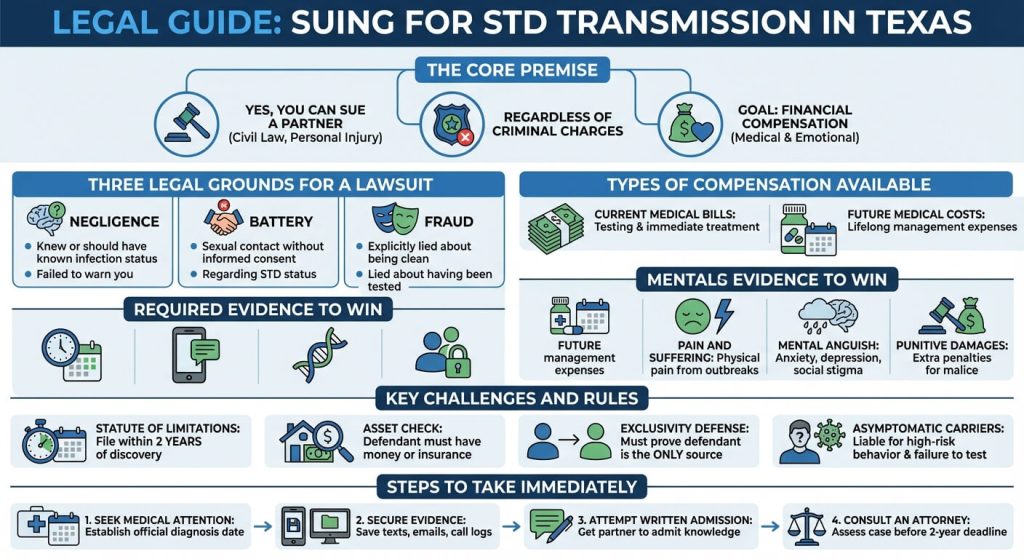
Yes, you can sue someone for giving you an STD in Texas under legal theories of negligence, battery, or fraud. If a partner knew or should have known they were infected and failed to warn you, you may be entitled to compensation for medical expenses, emotional distress, and pain and suffering.
Can You Sue Someone for Giving You an STD in Houston, Texas?
Yes, you can sue someone for giving you an STD in Houston, Texas. Under Texas civil law, transmitting a sexually transmitted disease—whether intentionally or through negligence—is considered a personal injury. Victims have the right to seek financial compensation for medical expenses, pain and suffering, and emotional distress.
While the emotional toll of an STD diagnosis is heavy, the legal system provides a pathway to hold the responsible party accountable. In Houston, these cases are typically filed in civil court, separate from any criminal charges the state might pursue. However, winning these lawsuits requires a clear understanding of legal theories like negligence, battery, and fraud.
Understanding Your Civil Rights Under Texas Law
Texas law does not require you to prove that your partner wanted to infect you. You only need to prove that they failed in their duty of care toward you. If a person knows (or reasonably should have known) they carry an infectious disease and fails to warn their partner or take precautions, they can be held liable for the damages that result.
The Difference Between Civil Lawsuits and Criminal Charges
It is important to distinguish between a civil lawsuit and a criminal case:
- Civil Lawsuit: You (the plaintiff) sue the offender (the defendant) for money. The burden of proof is “a preponderance of the evidence” (more likely than not).
- Criminal Charges: The State of Texas prosecutes the offender for breaking the law (e.g., assault). The burden of proof is “beyond a reasonable doubt.”
You can pursue a civil lawsuit even if the police decline to file criminal charges.
Legal Grounds for STD Lawsuits in Texas
To win a settlement or verdict in Houston, your attorney will typically structure your case around one of three legal theories.
Negligence: Failure to Warn a Partner
Negligence is the most common ground for STD lawsuits. To prove negligence, you must show:
- The defendant had a duty to protect you (e.g., by disclosing their status or using protection).
- They breached that duty.
- You contracted the STD as a direct result.
- You suffered actual damages (medical bills, emotional trauma).
Battery: Intentional Transmission or Contact
Battery applies if the transmission was intentional. In Texas, sexual contact without informed consent regarding STD status can be considered offensive or harmful contact. If a partner knew they were positive and had sex with you without disclosure, this invalidates the consent you gave, potentially constituting battery.
Fraud and Misrepresentation: Lying About Sexual Health Status
If you explicitly asked your partner if they were “clean” or tested, and they lied to you, you may have a claim for fraud. Misrepresentation can be a powerful tool in court because it demonstrates willful deceit rather than simple carelessness.
Can you sue someone for giving you an STD in Texas?
Yes, you can sue someone for giving you an STD in Texas. The state recognizes causes of action for negligence, battery, and fraud regarding the transmission of diseases like Herpes, HIV, Syphilis, and HPV. If you can prove the defendant knew or should have known of their infection and failed to warn you, you are entitled to seek damages for your injuries.
Proving Liability: Evidence Required in Houston Courts
Allegations alone are not enough. You must substantiate your claim with concrete evidence.
Can you prove someone gave you an STD?
Yes, you can prove someone gave you an STD through a combination of medical records and digital evidence. Attorneys often use “phylogenetic analysis” (DNA matching of the virus) in high-stakes cases to link the strain directly to the defendant. Additionally, negative test results prior to the relationship combined with a positive result shortly after sexual contact helps establish a clear timeline of infection.
Using Medical Records to Establish a Timeline
Your strongest asset is a clean medical history prior to the relationship. If you tested negative for STDs in January, began a monogamous relationship with the defendant in February, and tested positive in April, the timeline strongly suggests the defendant is the source.
Text Messages and Digital Communications as Admission
In many cases, the defendant admits guilt in text messages, emails, or recorded calls. Messages such as “I’m so sorry, I thought I was clean” or “I didn’t think you would catch it” are admissible in court and can be devastating to the defense.
The Challenge of Asymptomatic Carriers
A common defense is “I didn’t know I had it.” However, under Texas negligence laws, if a person engaged in high-risk behavior and failed to get tested, a jury may find that they should have known, holding them liable despite their lack of symptoms.
Challenges in STD Litigation
While the law is on your side, these cases come with specific hurdles that a Houston personal injury lawyer must navigate.
How hard is it to sue someone for giving you an STD?
It can be challenging to sue someone for giving you an STD if you cannot prove exclusivity. The defense will often argue that you could have contracted the infection from a previous or concurrent partner. To overcome this, you must provide a credible history of monogamy and medical testing that rules out other potential sources.
The ‘Assumption of Risk’ Defense
Defendants often argue that by engaging in unprotected sex, you assumed the risk of infection. However, this defense usually fails if the defendant lied about their status. Consent to sex is not consent to an infection.
Texas Statute of Limitations (2-Year Rule)
In Texas, the statute of limitations for personal injury is generally two years. This clock usually starts ticking on the date you discovered (or should have discovered) the infection. If you wait too long, your case will be dismissed regardless of the evidence.
Collectability: Does the Defendant Have Assets?
A lawsuit is only successful if you can collect the judgment. Most standard health insurance policies do not cover legal liability for STDs. However, some homeowners or renters insurance policies may cover negligent transmission (accidental), though they almost always exclude intentional acts. An attorney will run an asset check to see if the defendant has the means to pay.
Criminal Consequences for STD Transmission in Texas
Beyond civil liability, transmitting an STD can lead to serious criminal penalties in Texas.
Can you go to jail for giving someone an STD?
Yes, you can go to jail for giving someone an STD in Texas. While Texas does not have a specific “STD transmission” statute, prosecutors often charge offenders with Assault (Texas Penal Code § 22.01). If the transmission causes serious long-term health issues, it may be elevated to Aggravated Assault, which is a felony carrying significant prison time.
How a Criminal Conviction Supports Your Civil Case
If the defendant is convicted of a crime related to the transmission (or pleads no contest), this can often be used as negligence per se in your civil lawsuit. This means the court accepts their liability as a fact, and the trial focuses solely on how much money they owe you.
Potential Damages: What is Your Case Worth?
In Houston, victims of wrongful STD transmission can recover various types of damages:
- Medical Expenses: Reimbursement for testing, doctor visits, and prescription medications (e.g., antivirals for Herpes or HIV management).
- Future Medical Costs: Estimated costs for lifelong management of incurable conditions.
- Pain and Suffering: Compensation for the physical pain of outbreaks and symptoms.
- Mental Anguish: Damages for anxiety, depression, loss of romantic confidence, and the stigma associated with the diagnosis.
- Punitive Damages: If the defendant acted with malice or gross negligence (e.g., they knew they were positive and lied), a jury may award extra damages to punish them.
Steps to Take If You Have Been Infected
If you suspect a partner has transmitted an STD to you in Houston, protect your health and your legal rights immediately:
- Seek Medical Attention: Get tested immediately to confirm the diagnosis and establish a medical record date.
- Cease Communication (Strategically): Do not confront them in a way that allows them to destroy evidence. However, try to get them to admit knowledge of their status in writing (text or email) before cutting ties.
- Consult an Attorney: Contact a Houston personal injury lawyer before the two-year statute of limitations expires. They can help preserve evidence and determine if the defendant has assets or insurance coverage.
FAQs
Can you sue someone for giving you an STD in Texas?
Yes, Texas law permits civil lawsuits for STD transmission based on negligence, battery, or fraud. You must prove the defendant knew or should have known they had the STD and failed to disclose it or take reasonable precautions, and that their action (or inaction) was the direct cause of your infection.
How hard is it to sue someone for giving me an STD?
Suing for an STD can be difficult due to the burden of proof. You must prove two key elements: 1) the defendant was infected at the time of transmission, and 2) the defendant was the source of your infection, often requiring complex medical and expert testimony.
Can you go to jail for giving someone an STD?
Yes, in Texas, transmitting an STD can result in criminal charges, typically classified as Reckless Endangerment or Assault if the transmission was intentional or criminally negligent. However, civil lawsuits are separate and only result in monetary damages, not jail time.
Can you prove someone gave you an STD?
Yes, proof is established through medical records showing a negative status before the encounter and a positive status shortly after, combined with evidence showing the defendant’s prior knowledge of their condition. The legal process can also compel the defendant to provide their medical records.
What is the statute of limitations for an STD lawsuit in Texas?
In Texas, the statute of limitations for personal injury claims, including those involving STD transmission, is two years from the date the injury (the diagnosis) occurred.