
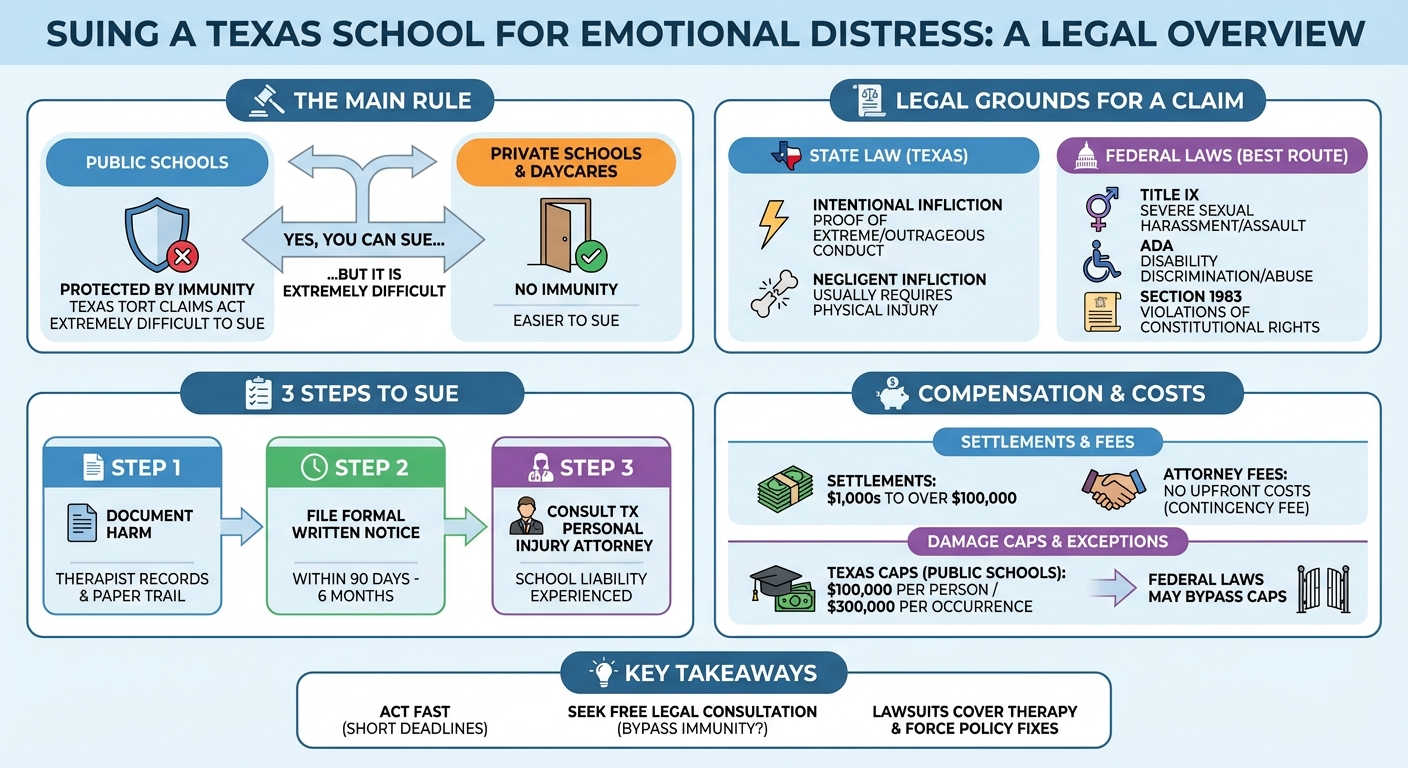
Yes, you can sue a school for emotional distress in Texas, but it is extremely difficult. Public schools are protected by sovereign immunity under the Texas Tort Claims Act. To succeed, you typically must prove intentional infliction of emotional distress, show accompanying physical injuries, or file under federal civil rights laws like Title IX.
Can You Sue a School for Emotional Distress in Texas?
The Short Answer: Yes, but with strict limitations.
If your child has suffered severe psychological trauma at the hands of a teacher, staff member, or due to a school’s systemic failures, you may be wondering if you have legal recourse. While it is possible to sue a school for emotional distress in Texas, the legal pathway is exceptionally narrow.
Texas law makes emotional distress claims against schools uniquely challenging for two main reasons: the high legal threshold required to prove emotional distress, and the powerful legal shield known as sovereign immunity that protects public government entities.
Public vs. Private Schools: The Role of Sovereign Immunity
The type of school involved dictates your legal options. Texas law treats public school districts and private institutions very differently.
Texas Tort Claims Act and Public School Districts
Public schools, including Independent School Districts (ISDs) and charter schools, are considered government entities. Under the Texas Tort Claims Act (TTCA), they are protected by sovereign immunity. This means you generally cannot sue a public school for negligence. The TTCA only waives this immunity in very specific circumstances—most notably, injuries involving a motor vehicle (like a school bus accident). Suing a public school purely for emotional distress under state law is nearly impossible without invoking specific federal exceptions.
Why Private Schools and Daycares Face Different Liability Rules
Private schools, religious academies, and independent daycares do not enjoy sovereign immunity. They are treated like private businesses under Texas law. If a private school’s staff acts negligently or intentionally causes psychological harm to a student, parents have a much clearer path to file a lawsuit for intentional or negligent infliction of emotional distress.
Is it hard to sue a school district in Texas?
Yes, it is extremely hard to sue a public school district in Texas due to sovereign immunity under the Texas Tort Claims Act. Public schools are generally shielded from liability for most personal injury and emotional distress claims unless the injury involves a motor vehicle or falls under specific federal civil rights exceptions.
Legal Grounds for Emotional Distress Claims Against Schools
If you are pursuing a claim, your case will likely fall into one of the following legal categories:
Intentional Infliction of Emotional Distress (IIED)
To win an IIED claim in Texas, you must prove that a school employee acted intentionally or recklessly, their conduct was “extreme and outrageous,” and it caused severe emotional distress. This is a high bar; standard bullying or poor teaching methods do not qualify. It typically requires egregious abuse or harassment.
Negligent Infliction of Emotional Distress (NIED) and the Physical Injury Requirement
Texas generally does not recognize Negligent Infliction of Emotional Distress as a standalone claim. To recover damages for emotional distress caused by negligence, the victim usually must have suffered an accompanying physical injury. For example, if a child was physically assaulted due to negligent security, the resulting emotional trauma could be compensated alongside the physical harm.
Federal Civil Rights Exceptions: Title IX, ADA, and Section 1983
Because Texas state law heavily protects public schools, the most viable route for holding an ISD accountable for emotional distress is often through federal law:
- Title IX: Allows lawsuits if a school is deliberately indifferent to severe sexual harassment or assault.
- Americans with Disabilities Act (ADA) / Section 504: Protects students from discrimination and abuse based on their disabilities.
- Section 1983: Allows lawsuits if a school official violates a student’s constitutional rights.
How to sue a school for emotional distress?
To sue a school for emotional distress, you must first document the psychological harm with medical records and gather evidence of the school’s actions. Next, you must file a formal notice of claim—often within six months for Texas public schools—before officially filing a lawsuit with the help of an attorney.
Step 1: Documenting the psychological harm and incidents
Courts require tangible proof of emotional distress. You must gather medical records from therapists, psychiatrists, or counselors detailing the child’s diagnosis (e.g., PTSD, severe anxiety). Additionally, keep a paper trail of all communications with the school regarding the incidents.
Step 2: Filing a formal notice of claim (The 6-month rule)
If suing a public school, the Texas Tort Claims Act requires you to provide formal written notice to the government entity within six months of the incident. Some local school districts have bylaws shortening this window to as little as 90 days. Failing to file this notice bars you from suing.
Step 3: Consulting a Texas school liability attorney
Because navigating sovereign immunity and federal civil rights law is incredibly complex, hiring a personal injury lawyer with specific experience in school liability is critical to building a viable case.
Understanding Compensation and Damages
How much is an emotional distress settlement in Texas?
An emotional distress settlement in Texas varies widely, ranging from a few thousand dollars to over $100,000, depending on the severity of the psychological trauma, the cost of psychiatric care, and whether the distress is accompanied by physical injuries or egregious civil rights violations.
How much money is it to sue a school?
Suing a school typically costs you nothing upfront if you hire a personal injury lawyer on a contingency fee basis. The lawyer covers court filing fees, expert witness costs, and investigation expenses, taking a percentage (usually 33% to 40%) only if you win a settlement or verdict.
Damage caps under Texas law
If you successfully sue a public school under the Texas Tort Claims Act, state law caps the damages you can recover. The maximum payout is generally limited to $100,000 per person and $300,000 per occurrence. However, if the lawsuit is filed under federal civil rights laws (like Title IX), these state-level damage caps may not apply.
When to Contact a Texas Personal Injury Lawyer
Evaluating your case for free
Because the laws protecting schools are so robust, it is essential to have your case evaluated by a legal professional immediately. Most Texas personal injury attorneys offer free, confidential consultations to determine if your situation meets the strict legal criteria to bypass sovereign immunity.
Protecting your child’s rights and future
Emotional distress can derail a child’s education and well-being. Taking legal action not only seeks compensation for expensive therapy and medical care but can also force schools to change dangerous policies, protecting other students from facing the same trauma.
 Call (713) 747-7777