

Table of contents
Yes, you can sue a restaurant for food poisoning in Houston if you can prove the establishment served contaminated food that directly caused your illness. Successful claims typically require medical evidence (such as a positive stool sample), proof of negligence or strict liability under Texas law, and documentation of damages like medical bills.
Can You Sue a Restaurant for Food Poisoning in Houston?
Yes, you can sue a restaurant for food poisoning in Houston, but winning the case requires more than just feeling ill after a meal. Under Texas law, food poisoning cases are treated as personal injury claims, typically falling under product liability or negligence.
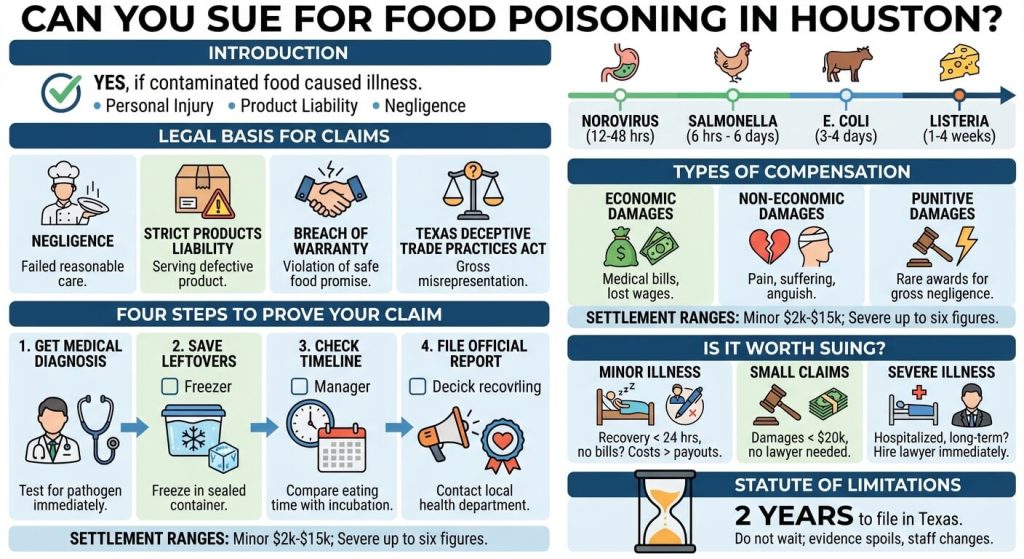
To successfully hold a Houston establishment liable, your attorney will generally pursue one of three legal theories:
- Negligence: Proving the restaurant failed to exercise reasonable care (e.g., undercooking chicken or cross-contaminating surfaces).
- Strict Products Liability: In Texas, restaurants are considered manufacturers of the food they serve. If they sell a “defective” (contaminated) product that causes injury, they can be held liable regardless of how careful they were.
- Breach of Warranty: When you purchase a meal, there is an implied warranty that the food is safe to eat. Serving contaminated food breaches this warranty.
While Texas law provides these avenues for justice, the burden of proof lies entirely with you. You must demonstrate a direct link between the food served and the specific pathogen that made you sick.
Can You Sue a Restaurant for Food Poisoning in Texas?
Yes, under the Texas Civil Practice & Remedies Code, you have the right to file a lawsuit against a restaurant if their food caused you harm. Food poisoning is legally viewed as a “toxic tort” or defective product case.
However, the primary requirement is establishing causation. You cannot simply claim that a meal “didn’t sit right.” You must prove, usually through medical and scientific evidence, that the specific food item served by the defendant contained the pathogen that caused your illness.
In rare instances involving gross misrepresentation—such as a restaurant claiming a dish is allergen-free when it is not—you might also have a claim under the Texas Deceptive Trade Practices Act (DTPA), which can sometimes allow for triple damages if the conduct was intentional.
How Do I Prove a Restaurant Gave Me Food Poisoning?
Proving a food poisoning claim is the most challenging aspect of the legal process. The defense will often argue that your illness was caused by a stomach virus or food consumed elsewhere.
The ‘Causation’ Challenge
Feeling sick immediately after eating is often misleading. Many pathogens take days to incubate. To overcome the “causation” hurdle, you need concrete evidence:
- Step 1: Medical Diagnosis: You must see a doctor and get a stool sample or blood test. This is non-negotiable. The test must identify the specific bacteria (e.g., Salmonella, E. coli) or virus. Without a confirmed pathogen, you have no case.
- Step 2: The Leftovers: If you took food home, do not eat it or throw it away. Place it in a sealed container in your freezer. A lab can test this sample for the same pathogen found in your medical tests.
- Step 3: The Timeline: Once the pathogen is identified, you can compare its incubation period to your dining history. If you have Salmonella (which takes 6–72 hours to appear), and you ate at the restaurant 4 hours before symptoms started, that meal might not be the culprit unless it was a massive bacterial load.
- Step 4: Official Reporting: Report the illness to Harris County Public Health or the Houston Health Department. If multiple people report the same restaurant, the health department will investigate. A government report citing health code violations or an outbreak is the strongest evidence you can have.
Common Foodborne Pathogens and Incubation Periods
Understanding which pathogen you have helps pinpoint the suspect meal. Different bacteria have distinct incubation windows.
| Pathogen | Common Sources | Incubation Period |
|---|---|---|
| Salmonella | Undercooked poultry, eggs, produce | 6 hours to 6 days |
| E. Coli | Undercooked beef, unpasteurized milk | 3 to 4 days |
| Norovirus | Contaminated leafy greens, shellfish | 12 to 48 hours |
| Listeria | Deli meats, soft cheeses | 1 to 4 weeks |
If your doctor confirms you have Listeria, but you are blaming a burger you ate yesterday, the timeline does not match. This scientific data is critical for your lawyer to defend your claim against the restaurant’s insurance company.
How Much Money Can You Get From Suing a Restaurant for Food Poisoning?
Compensation in food poisoning lawsuits varies significantly based on the severity of the illness. Settlements are generally divided into three categories:
- Economic Damages: These are quantifiable financial losses. They include emergency room bills, medication costs, doctor visits, and lost wages if you missed work during recovery.
- Non-Economic Damages: This covers “pain and suffering.” Food poisoning can be excruciating, leading to dehydration, extreme cramping, and anxiety about food. In Texas, you can be compensated for this physical and mental anguish.
- Punitive Damages: These are rare and reserved for cases of gross negligence. For example, if a restaurant knew their refrigeration was broken but served the meat anyway, or if they had a history of failed health inspections that they ignored, a jury might award punitive damages to punish the business.
Average Settlement Ranges:
Minor cases (ER visit, quick recovery) often settle for $2,000 to $15,000. Severe cases involving hospitalization, kidney failure (HUS), or long-term complications can reach six or seven figures.
Is It Worth Suing a Restaurant for Food Poisoning?
Not every case of food poisoning warrants a lawsuit. You must perform a cost-benefit analysis before proceeding.
- When to Walk Away: If you suffered 24 hours of discomfort but required no medical treatment and missed no work, the cost of litigation will likely exceed the potential payout. Insurance companies rarely pay out on claims without medical records.
- Small Claims Court: For claims under $20,000 where you have medical bills but cannot find a lawyer to take the case, Texas Small Claims Court is an option. You can represent yourself to recover your direct costs.
- When to Hire a Lawyer: If you were hospitalized, required dialysis, suffered permanent organ damage, or if a loved one passed away, you should absolutely sue. The medical bills in these cases are astronomical, and the restaurant’s insurance should cover them, not you.
Steps to Take Immediately After Getting Sick in Houston
If you suspect food poisoning, your actions in the first 48 hours are critical to building a case.
- Seek Medical Attention: Go to an urgent care or ER in Houston. Ask specifically for a pathogen test (stool or blood).
- Report the Incident: Call the restaurant and inform the manager. Do not sign anything or accept a refund in exchange for a waiver. Just document that you reported it.
- File a Health Dept Report: Contact the Houston Health Department immediately. An inspection that finds the same hazard that made you sick is “smoking gun” evidence.
- Preserve Evidence: Keep receipts, credit card statements, and any leftover food.
Texas Statute of Limitations for Food Poisoning
In Texas, the statute of limitations for personal injury claims is two years from the date the illness occurred. While this sounds like a long time, you should not wait.
Evidence in food poisoning cases is perishable. Leftovers get thrown out, restaurant staff turnover is high, and health department records can become harder to access. If you wait too long, proving causation becomes nearly impossible, even if you file within the two-year legal window.
FAQs
Can you sue a restaurant for food poisoning in Houston?
Yes, under the Texas Civil Practice & Remedies Code, you can sue a restaurant for food poisoning based on product liability (unfit for human consumption) or negligence (failure to prepare food safely). Lawsuits are filed in Harris County District Courts.
How much money can you get from suing a restaurant for food poisoning?
Settlements vary by severity. Minor cases with simple medical bills may settle for thousands of dollars. Severe cases involving hospitalization, lost wages, and long-term health issues can lead to six-figure settlements.
How do I prove a restaurant gave me food poisoning?
Proof requires a medical diagnosis (stool sample) identifying the pathogen (e.g., Salmonella, E. coli), evidence that the restaurant was the source (e.g., other customers got sick, health department report), and evidence of the restaurant’s negligence.
Is it worth suing a restaurant for food poisoning?
It is worth suing if you incurred significant medical bills, were hospitalized, missed substantial time from work, or suffered a long-term medical complication. Minor, quickly resolved cases may not justify the cost of litigation.