

Table of contents
Yes, you can sue for slander in Texas if you can prove that a person made a false spoken statement of fact about you to a third party, acting with negligence or malice, which caused you reputational or financial harm. You generally have one year from the date of the statement to file a lawsuit.
Can You Sue for Slander in Houston? A Legal Guide
If a false rumor or malicious lie has damaged your reputation, career, or business in Houston, you may have grounds for a civil lawsuit. In Texas, defamation laws protect individuals and businesses from false statements that cause harm.
The short answer is yes, you can sue for slander in Houston, but the legal criteria are strict. Courts aim to balance the protection of reputation with First Amendment free speech rights. To win, you must prove that the statement was not merely an opinion or an insult, but a false assertion of fact that resulted in tangible damage.
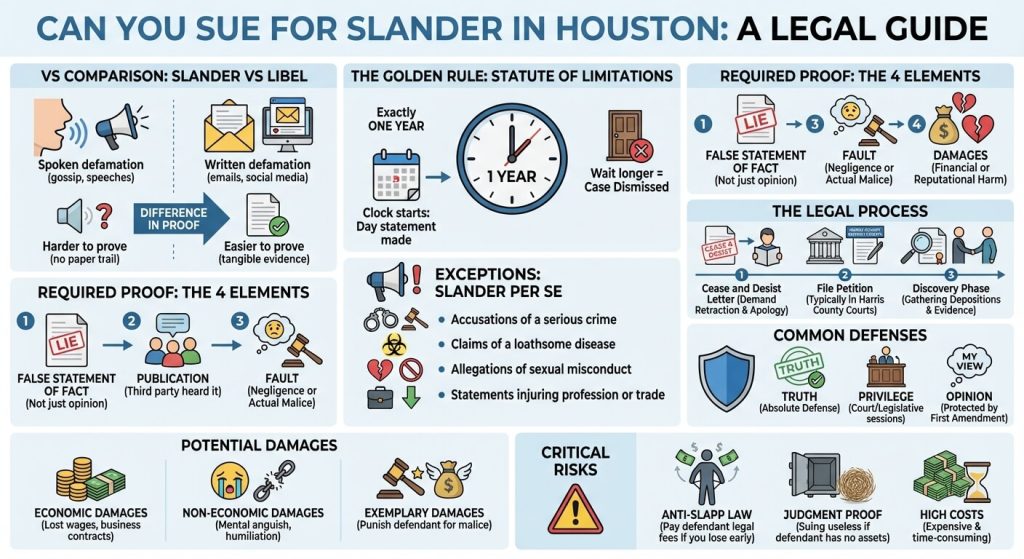
The Difference Between Slander (Spoken) and Libel (Written)
Before filing a claim, you must distinguish the type of defamation occurred:
- Slander: Defamation that is spoken (e.g., a speech, a podcast, or water-cooler gossip).
- Libel: Defamation that is written or published in a permanent form (e.g., social media posts, newspaper articles, or emails).
While both fall under the umbrella of “defamation” in Texas, the distinction matters for evidence preservation. Slander can be harder to prove because there is often no paper trail unless the statement was recorded or witnessed by credible third parties.
Can I Sue Someone for Slander in Texas?
Yes, you can sue someone for slander in Texas if you can prove the statement was false, published to a third party, and caused you harm.
Texas law does not take slander lightly, but it does not reward frivolous suits. You cannot sue simply because someone hurt your feelings. You must demonstrate that the spoken words lowered your reputation in the community or deterred others from associating with you.
The Importance of the Statute of Limitations
Time is critical. Under the Texas Civil Practice and Remedies Code section 16.002, the statute of limitations for defamation (both libel and slander) is generally one year. This clock typically starts ticking the day the defamatory statement is made. If you wait longer than one year to file your lawsuit in a Harris County court, your case will likely be dismissed immediately.
What Proof Is Needed to Sue for Slander?
To win a slander case in Houston, the burden of proof rests on the plaintiff (the person suing). You must provide evidence for the following four elements:
Element 1: A False Statement of Fact
The statement must be objectively false. Opinions are protected speech. For example, saying “John is a terrible accountant” is likely a protected opinion. Saying “John stole $5,000 from the escrow fund” is a statement of fact that can be proven true or false.
Element 2: Publication to a Third Party
“Publication” in a legal sense just means the statement was communicated to at least one person other than you. If someone insults you to your face in an empty room, it is not slander because no third party heard it.
Element 3: Fault (Negligence vs. Actual Malice)
The level of fault you must prove depends on who you are:
- Private Figures: Must prove the defendant was negligent (they didn’t bother to check if the statement was true).
- Public Figures: Must prove actual malice (the defendant knew it was false or acted with reckless disregard for the truth).
Element 4: Proof of Damages
Generally, you must prove that the slander caused you financial or reputational injury. However, there is a major exception known as Slander Per Se.
Slander Per Se: When You Don’t Need to Prove Financial Loss
In Texas, certain statements are considered so inherently harmful that the law presumes damages. If your case falls into these categories, you do not need to prove you lost money to win:
- Accusations of a crime: Falsely stating someone committed a serious crime (e.g., theft, murder).
- Imputation of a loathsome disease: Claiming someone has a sexually transmitted disease or other stigmatized illness.
- Sexual misconduct: Statements attacking a person’s chastity or alleging serious sexual misconduct.
- Injuring a person’s profession: False statements that attack a person’s skill or integrity in their specific trade or business.
How to File a Slander Lawsuit in Houston
If you have the evidence, here is the general procedural flow for a case in Houston:
Step 1: The Cease and Desist Letter
Before filing a lawsuit, a defamation attorney will typically send a formal letter demanding the defendant retract the statement and apologize. This can sometimes resolve the issue without litigation and serves as evidence that the defendant was warned.
Step 2: Filing in Harris County District Courts
If the damages exceed the limits of small claims court, your lawyer will likely file a petition in a Harris County District Court. The petition outlines the defamatory statements and the damages sought.
Step 3: The Discovery Phase
This is where you gather proof. Your attorney may depose witnesses who heard the slander, subpoena emails or recordings, and investigate the defendant’s intent.
Is It Worth Suing for Slander?
Deciding whether it is worth suing for slander often comes down to the defendant’s ability to pay and the cost of litigation.
Defamation lawsuits are expensive and time-consuming. Even if you win a $1 million judgment, it is useless if the defendant has no assets (a status known as being “judgment proof”). Before suing, your attorney should run an asset check to ensure the defendant can actually pay the damages.
The Risk of the Texas Anti-SLAPP Statute (TCPA)
Texas has a strong Anti-SLAPP law (the Texas Citizens Participation Act). If the defendant can prove they were exercising their right to free speech regarding a matter of public concern, they can file a motion to dismiss your case early. If they win this motion, you may be ordered to pay their legal fees. This makes it vital to have a watertight case before filing.
How Much Money Can You Get for Suing for Slander?
The amount of money you can get for suing for slander varies widely, ranging from nominal damages to millions of dollars, depending on the severity of the harm.
Damages in Texas defamation cases fall into three buckets:
- Economic Damages: Reimbursement for actual financial losses, such as lost wages, lost business contracts, or medical bills for therapy.
- Non-Economic Damages: Compensation for mental anguish, humiliation, and loss of reputation in the community.
- Exemplary (Punitive) Damages: If you can prove the defendant acted with malice (specific intent to harm), the court may award punitive damages to punish the wrongdoer.
Common Defenses Against Slander Claims
Defendants in Houston have several powerful defenses they can use to defeat a slander claim:
- Truth: Truth is an absolute defense. If the defendant can prove the statement was true, you cannot win, no matter how damaging it was.
- Privilege: Certain statements made in court proceedings, legislative sessions, or between employers and employees may be “privileged” and immune from lawsuits.
- Opinion: If the statement is clearly framed as a subjective opinion rather than a fact, it is protected by the First Amendment.
FAQs
Can I sue someone for slander in Texas?
Yes, you can sue for slander in Texas if you can demonstrate that the defendant made a false spoken statement of fact about you to a third party, acting with negligence or malice, which caused you reputational or financial harm. You generally have one year from the date of the statement to file a lawsuit.
Is it worth suing for slander?
It depends on the defendant’s assets. If the person who slandered you has no assets, winning a large financial judgment may be pointless because you will not be able to collect the money. It is best suited for cases involving significant, provable financial harm.
What proof is needed to sue for slander?
You need evidence of four elements: (1) a false statement of fact, (2) the statement was spoken to a third party, (3) the defendant acted with negligence or malice, and (4) the statement caused you injury or damages.
How much money can you get for suing for slander?
Compensation varies significantly based on the harm suffered. You can recover damages for economic loss (lost income), mental anguish, and in rare cases, punitive damages if the defendant acted with malice.
What is the difference between slander and libel in Texas?
The main difference is the medium. Slander refers to spoken defamation, while libel refers to written or published defamation. Both are subject to similar legal standards in Texas, though libel is often easier to document.