

Table of contents
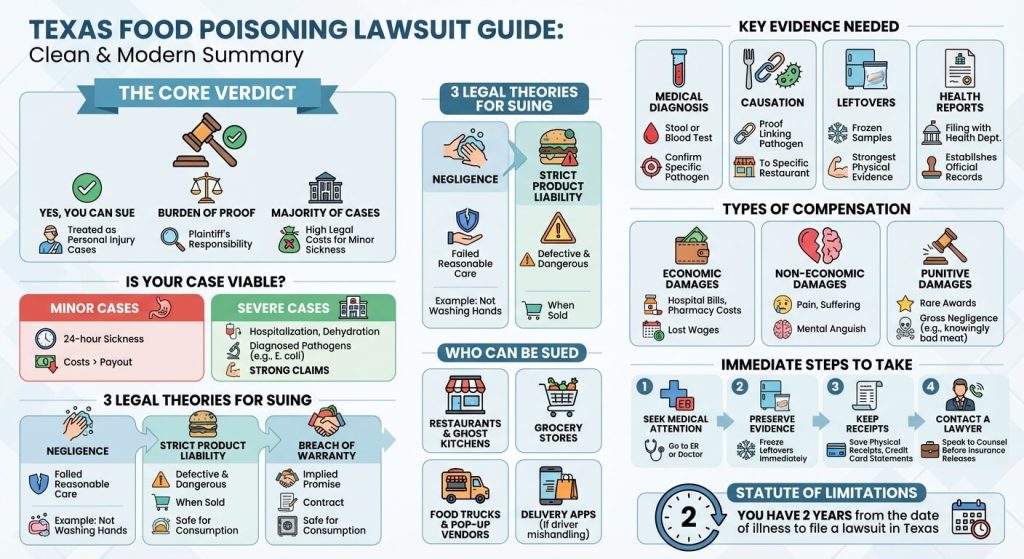
Yes, you can sue for food poisoning in Texas if you can prove the restaurant was negligent or served a defective product. To win, you typically need a medical diagnosis (like a stool sample) confirming a specific pathogen and evidence linking that pathogen to the food served by the restaurant.
Can You Sue for Food Poisoning in Houston? (Texas Legal Guide)
Yes, you can sue for food poisoning in Houston, but winning the case requires more than just proving you felt sick after a meal. In Harris County courts, foodborne illness claims are treated as personal injury cases, specifically falling under product liability or negligence.
The reality of these claims is that the burden of proof lies entirely on you, the plaintiff. You must demonstrate that the food served by the restaurant, grocery store, or vendor was contaminated and that this specific contamination directly caused your illness. Because symptoms of food poisoning (like Norovirus or Salmonella) often mimic the stomach flu, defense attorneys for Houston restaurants will aggressively argue that your illness was coincidental or caused by something else you ate.
Quick Summary: When a stomach ache becomes a lawsuit
- Minor cases: If you were sick for 24 hours and missed one day of work, the legal costs often outweigh the potential payout.
- Severe cases: If you required hospitalization, suffered dehydration requiring IV fluids, or contracted a diagnosed pathogen like E. coli or Listeria, you likely have a viable claim for significant compensation.
Can You Sue for Food Poisoning in Texas?
Yes, under Texas law, you have the right to seek compensation if a food establishment serves you unsafe food. To win a lawsuit in Texas, your attorney will typically argue one of three main legal theories found in the Texas Civil Practice & Remedies Code:
1. Negligence
This argues that the restaurant failed to exercise reasonable care. For example, if a cook in a Houston kitchen failed to wash their hands after using the restroom or if chicken was stored at an unsafe temperature, the restaurant breached its duty of care to you.
2. Strict Product Liability
Texas law holds that businesses selling food are strictly liable if the product is defective (contaminated) and unreasonably dangerous. Under this theory, you do not necessarily need to prove how the food got contaminated (e.g., who forgot to wash their hands), only that it was contaminated when it left the kitchen.
3. Breach of Warranty
When you purchase a meal, there is an “implied warranty of merchantability.” Essentially, the restaurant promises that the food is edible and safe for human consumption. Serving food laced with pathogens breaks this promise.
Can I Sue If I Get Food Poisoning?
You can sue, but the success of your claim hinges on causation. The biggest mistake victims make is assuming the last thing they ate made them sick. In reality, some pathogens (like Hepatitis A or Cyclospora) can take weeks to incubate.
The Necessity of a Medical Diagnosis
To link the germ to the meal, you generally need a stool sample or blood test confirming the specific pathogen. If you test positive for Salmonella, and the Houston Health Department finds Salmonella violations at the restaurant you visited, your case becomes very strong.
The Role of “Leftovers” in Evidence
If you took a “doggy bag” home, do not throw it away. That leftover food is the most critical piece of physical evidence you possess. Testing the leftovers can prove that the specific bacteria that made you sick was present in the food served by the restaurant.
Reporting to the Houston Health Department
Filing a report with the local health department creates an official government record. If multiple people report sickness from the same location, it establishes an “outbreak,” which makes proving causation significantly easier.
Who Can Be Held Liable in Houston?
Liability extends to any party in the chain of distribution that handled the contaminated food.
- Restaurants and Ghost Kitchens: Whether it is a sit-down establishment in The Heights or a delivery-only ghost kitchen, they are responsible for food safety.
- Grocery Stores (HEB, Kroger, Whole Foods): If you bought pre-made deli food or contaminated produce, the retailer can be liable.
- Food Trucks and Pop-up Vendors: Mobile vendors are subject to the same health codes as brick-and-mortar restaurants.
- Third-Party Delivery Apps: Suing UberEats or DoorDash is difficult because they usually claim they are merely couriers. However, if the contamination occurred due to the driver’s mishandling (e.g., leaving food in a hot car for hours), they could potentially be implicated.
How Much is a Food Poisoning Lawsuit Worth?
The value of a food poisoning lawsuit varies wildly based on the severity of the illness and the long-term impact on your health.
- Low Value: A case of mild food poisoning (nausea, vomiting for 1-2 days) with no doctor visit is typically worth very little, often settling for the cost of the meal and perhaps minor inconvenience money.
- High Value: Cases involving hospitalization, kidney failure (Hemolytic Uremic Syndrome), or reactive arthritis can be worth significantly more.
- Class Actions: These are rare for single incidents but common during widespread outbreaks (e.g., a contaminated lettuce supplier affecting hundreds of people).
How Much Compensation for Food Poisoning?
In Texas, compensation is divided into three categories. Your total settlement is a sum of these damages:
Economic Damages
This covers your quantifiable financial losses:
- Emergency room and hospital bills.
- Medication and pharmacy costs.
- Lost wages for days missed at work.
Non-Economic Damages
This compensates you for the human cost of the illness:
- Physical pain and suffering (severe cramping, dehydration).
- Mental anguish.
- Loss of enjoyment of life during recovery.
Punitive Damages
These are rare and reserved for cases of gross negligence. For example, if a restaurant manager knew the refrigeration was broken but served the meat anyway to save money, a jury might award punitive damages to punish the business.
Steps to Take Immediately After Getting Sick
- Seek Medical Attention: Go to a doctor or ER immediately. Ask for a pathogen test (stool or blood). Without a diagnosis, you have no case.
- Preserve the Evidence: If you have leftovers, place them in a sealed container or Ziploc bag and freeze them immediately. Do not eat them.
- Keep Receipts: Save the physical receipt or credit card statement proving you purchased the food at that specific time and location.
- Contact a Lawyer: Speak with a Houston food safety attorney before talking to the restaurant’s insurance company. Insurance adjusters will try to get you to sign a release for a small refund, barring you from future lawsuits.
Frequently Asked Questions
What is the statute of limitations for food poisoning in Texas?
In Texas, the statute of limitations for personal injury claims, including food poisoning, is generally two years from the date the illness occurred. If you fail to file a lawsuit within this window, you lose your right to sue.
Can I sue if I have no receipt?
Yes, you can still sue without a paper receipt if you have other proof of purchase, such as a credit card statement, bank transaction record, or witness testimony from someone who dined with you.
Does food poisoning count as a personal injury?
Yes. Legally, food poisoning is a bodily injury caused by a defective product (the food) or negligence. It is handled in civil court just like a slip-and-fall or car accident claim.
FAQs
Can you sue for food poisoning in Texas?
Yes, Texas law allows you to sue for food poisoning under theories of product liability (if the food was a ‘defective product’) or negligence (if the restaurant failed to follow proper safety procedures).
How much is a food poisoning lawsuit worth?
The value depends on severity. Minor cases may only recover medical costs and lost wages. Severe cases involving hospitalization, chronic illness, or death (wrongful death) can result in substantial settlements or jury awards.
How much compensation for food poisoning can I get?
Compensation typically includes economic damages (medical bills, lost wages, future treatment costs) and non-economic damages (pain, suffering, mental anguish).
Can I sue if I get food poisoning?
Yes, but you need more than just symptoms. You generally need a medical diagnosis that links your illness (e.g., E. coli, Salmonella) to the specific food product or restaurant. This link is often the hardest part of the case to prove.
What is the statute of limitations for food poisoning in Texas?
You generally have two years from the date of the illness to file a food poisoning lawsuit in Texas. Missing this deadline will prevent you from recovering compensation.