
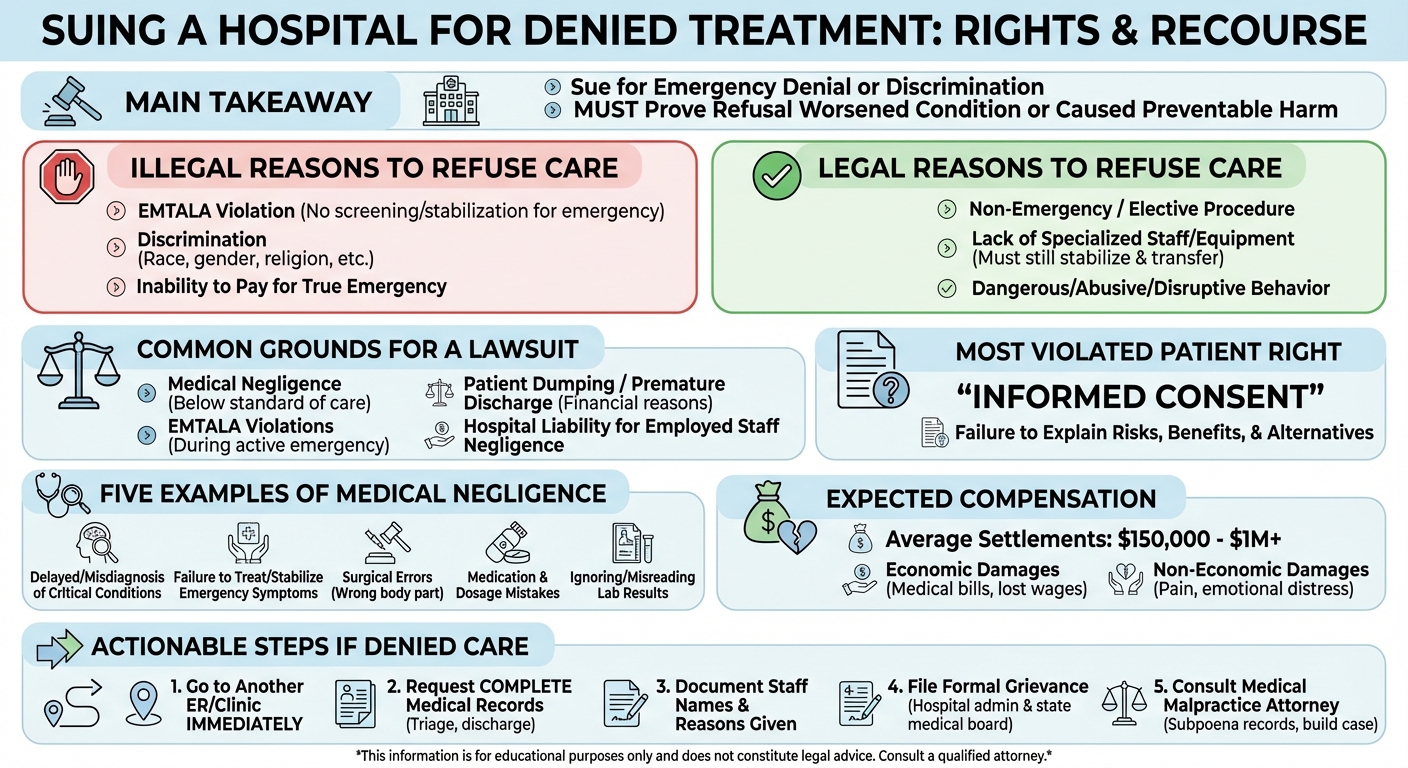
Yes, you can sue a hospital for not treating you if they violate the Emergency Medical Treatment and Labor Act (EMTALA) by denying emergency care, or if they refuse treatment based on discriminatory factors. To win, you must prove their refusal directly caused you preventable harm or worsened your condition.
Can You Sue a Hospital for Not Treating You?
The short answer is yes, but only under specific circumstances. While hospitals are not universally required to treat every person who walks through their doors, federal laws strictly prohibit them from turning away patients in life-threatening emergencies.
Understanding the difference between emergency and non-emergency care is the first step in determining if you have a valid case. If you arrive at an emergency room with a critical condition, the hospital has a legal duty to stabilize you. However, if you are seeking routine, non-emergency care, a hospital or clinic may legally decline treatment.
When Is It Illegal for a Hospital to Refuse Treatment?
The EMTALA Law Explained
The Emergency Medical Treatment and Labor Act (EMTALA) is a federal law designed to prevent “patient dumping.” Under EMTALA, any hospital with an emergency department that accepts Medicare must provide a medical screening exam to anyone who requests treatment for a medical condition. If an emergency condition exists, the hospital must stabilize the patient or safely transfer them to a facility that can.
Discrimination and Civil Rights Violations
Hospitals cannot refuse treatment based on discriminatory factors. The Civil Rights Act and other federal laws make it illegal for medical providers to deny care based on race, gender, religion, national origin, or sexual orientation. If you were turned away for any of these reasons, you have grounds for a civil rights and medical malpractice lawsuit.
Refusal Based on Inability to Pay
In a true medical emergency, it is illegal for a hospital to refuse treatment simply because you lack health insurance or cannot afford to pay. EMTALA guarantees emergency stabilization regardless of your financial status. However, this protection does not extend to elective or non-emergency procedures.
When Can a Hospital Legally Refuse to Treat a Patient?
Non-Emergency Situations and Elective Procedures
If your condition is not life-threatening, a hospital or private clinic can legally refuse to treat you. For example, if you visit a hospital for a routine checkup, a cosmetic procedure, or a minor ailment that does not require urgent intervention, the facility is not legally obligated to take you on as a patient.
Lack of Specialized Equipment or Staff
A hospital can legally turn you away if they do not have the specialized equipment or specialized medical staff required to treat your specific condition. In these cases, however, they are usually required to stabilize you as much as possible and arrange for a safe transfer to a better-equipped facility.
Disruptive, Dangerous, or Abusive Patient Behavior
Medical professionals have a right to a safe working environment. If a patient is being physically abusive, making violent threats, or exhibiting highly disruptive behavior that endangers staff or other patients, the hospital can legally refuse treatment and involve law enforcement.
What grounds can you sue a hospital on?
You can sue a hospital on several legal grounds, most notably medical malpractice, negligence, and EMTALA violations. If a hospital fails to stabilize an emergency condition, prematurely discharges you, or is vicariously liable for the careless errors of its staff, you have strong grounds to file a lawsuit for damages.
- Medical negligence and malpractice: When a hospital’s standard of care falls below acceptable medical standards, resulting in patient harm.
- EMTALA violations: Failing to provide a medical screening or stabilize a patient in an active emergency.
- Premature discharge or patient dumping: Releasing a patient before they are medically stable, often for financial reasons.
- Vicarious liability: Holding the hospital responsible for the negligent actions of its employed doctors, nurses, and support staff.
What patient right is most often violated?
The patient right most often violated is the right to informed consent. Medical professionals frequently fail to adequately communicate the risks, benefits, and alternatives of a treatment. When this lack of communication leads to a failure to treat or an unauthorized procedure, it can form the basis of a malpractice claim.
Without clear communication, patients cannot make educated decisions about their health. This breakdown often leads to situations where patients are denied necessary treatments or subjected to procedures they would have otherwise refused, both of which are actionable offenses in medical malpractice law.
What are 5 examples of medical negligence?
Five common examples of medical negligence include: misdiagnosis or delayed diagnosis, failure to treat or stabilize an emergency condition, surgical errors such as wrong-site surgery, medication and prescription mistakes, and ignoring or misreading laboratory results. Any of these errors can cause severe harm and justify a medical malpractice lawsuit.
- Misdiagnosis or delayed diagnosis: Failing to identify a life-threatening condition, such as a heart attack or stroke, in a timely manner.
- Failure to treat or stabilize: Ignoring a patient’s symptoms or refusing to provide necessary emergency interventions.
- Surgical errors: Performing surgery on the wrong body part, leaving instruments inside the patient, or operating on the wrong patient entirely.
- Medication and prescription errors: Administering the wrong drug, the wrong dosage, or ignoring known patient allergies.
- Ignoring or misreading laboratory results: Failing to act on critical lab values that indicate a worsening medical condition.
How much is a payout for medical negligence?
A payout for medical negligence varies widely, with average settlements ranging from $150,000 to over $1 million depending on the case’s severity. Compensation is influenced by economic damages like medical bills and lost wages, as well as non-economic damages such as pain, suffering, and emotional distress.
Because every case is unique, calculating exact compensation requires looking at the specific damages incurred. For a detailed breakdown of settlement averages and the factors that maximize your compensation, read our comprehensive guide on How Much Can You Sue a Hospital for Negligence?
Steps to Take If You Were Denied Medical Treatment
If you believe you were wrongfully denied medical care, taking immediate action is crucial to protecting your health and your legal rights.
- Seek immediate medical attention elsewhere: Your health is the top priority. Go to another emergency room or urgent care clinic immediately to get the treatment you need.
- Request your complete medical records: Obtain all intake forms, triage notes, and discharge papers from the hospital that refused you. These documents are vital evidence.
- Document all interactions: Write down the names of the doctors, nurses, and administrators you spoke with, along with the exact reasons they gave for refusing treatment.
- File a formal complaint: Submit a grievance with the hospital’s administration and report the incident to your state’s department of health or medical board.
Consult with a Medical Malpractice Attorney
Proving a failure to treat claim is incredibly complex. Hospitals have powerful legal teams dedicated to defending against malpractice and EMTALA violation claims. You need an experienced medical malpractice attorney who can subpoena records, consult with independent medical experts, and build a compelling case on your behalf.
If you or a loved one suffered harm because a hospital refused to provide treatment, do not wait to seek legal counsel. Contact our legal team today for a free, confidential case evaluation to discuss your options and fight for the compensation you deserve.
 Call (713) 747-7777