
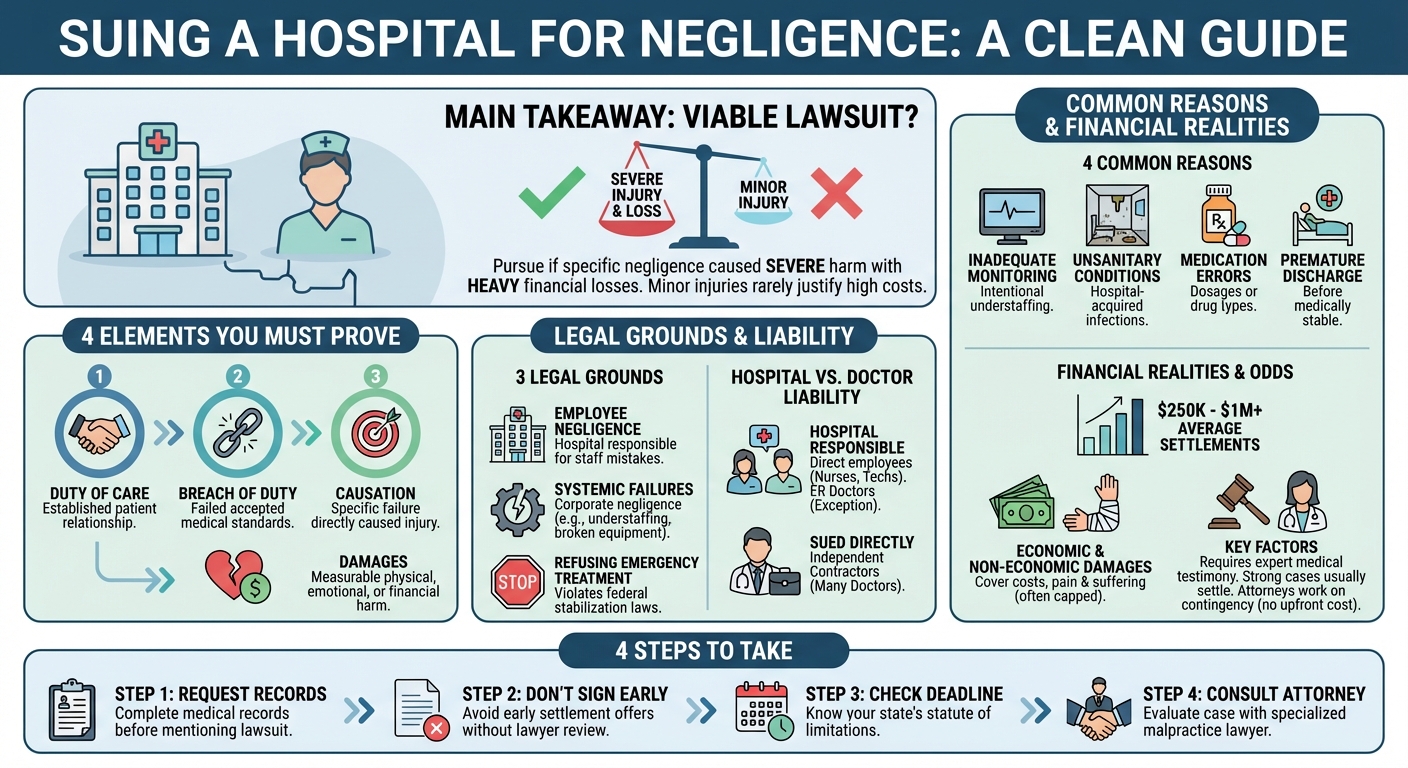
Yes, you can sue a hospital for negligence or medical malpractice. To win, you must prove that the hospital or its employees breached the standard of care, and that this breach directly resulted in your injuries and financial damages. Common grounds include nursing errors, understaffing, and emergency room negligence.
Can I Sue a Hospital? The Short Answer
Yes, you can sue a hospital for medical malpractice or negligence. If a hospital’s staff makes a preventable error or the facility fails to uphold standard safety protocols, they can be held legally responsible for your injuries. However, suing a medical facility is highly complex. You cannot sue simply because you are unhappy with the outcome of a procedure; you must prove that the hospital made a specific, negligent mistake that directly caused you harm.
The 4 Elements of a Medical Malpractice Claim
To successfully sue a hospital, your legal team must establish four critical elements:
- Duty of Care: A formal doctor-patient or hospital-patient relationship existed.
- Breach of Duty: The hospital or its staff failed to meet the accepted medical standard of care.
- Causation: This specific breach directly caused your injury.
- Damages: You suffered measurable physical, emotional, or financial harm as a result.
What Grounds Can You Sue a Hospital On?
You can sue a hospital on several legal grounds, primarily vicarious liability for employee negligence, corporate negligence for systemic failures like understaffing, and EMTALA violations for refusing emergency treatment. To succeed, you must prove the hospital’s actions directly caused your injuries and resulted in measurable damages.
Vicarious Liability (Employee Negligence)
Under the legal doctrine of respondeat superior, a hospital is legally responsible for the actions of its employees. If a nurse, medical technician, or employed physician makes a negligent error while performing their job duties, the hospital itself can be sued for the resulting harm.
Corporate Negligence (Systemic Failures)
Sometimes, the hospital itself is directly negligent. Corporate negligence occurs when the facility fails to maintain a safe environment. This includes failing to properly vet and credential doctors, keeping broken medical equipment in circulation, or severely understaffing a ward to the point of endangering patients.
EMTALA Violations (Refusing Emergency Treatment)
The Emergency Medical Treatment and Labor Act (EMTALA) is a federal law requiring hospitals with emergency departments to stabilize and treat anyone who comes in, regardless of their ability to pay. If a hospital turns you away during a medical emergency and you suffer harm as a result, you can sue them directly in federal court.
Suing the Hospital vs. Suing the Doctor: The Independent Contractor Loophole
One of the biggest hurdles in hospital lawsuits is the independent contractor loophole. Many doctors are not hospital employees; they merely have “admitting privileges.” If an independent contractor makes a mistake, you typically have to sue the doctor directly, not the hospital.
How to Know if Your Doctor is an Employee
Determining a doctor’s employment status requires looking at how much control the hospital has over them. Signs that a doctor is an employee include the hospital setting their schedule, paying them a regular salary, and determining their vacation time. If the doctor bills you directly through their own private practice, they are likely an independent contractor.
The ‘Ostensible Agency’ Exception (ER Doctors)
There is a major exception to the independent contractor rule: emergency rooms. When you go to the ER, you are seeking care from the hospital, not a specific doctor. Even if the ER physician is an independent contractor, the hospital can often be held liable under the theory of “ostensible agency” because a reasonable patient would assume the doctor works for the hospital.
Common Reasons Patients Sue Hospitals
Hospital negligence takes many forms. Below are the most frequent reasons patients file lawsuits against medical facilities.
Understaffing and Inadequate Patient Monitoring
When hospitals prioritize profits over patient safety, they often understaff nursing units. This leads to missed vitals, ignored call buttons, and a failure to notice when a patient’s condition rapidly deteriorates.
Hospital-Acquired Infections (HAIs)
While not all infections are preventable, hospitals can be sued if an infection spreads due to unsanitary conditions, unsterilized surgical tools, or staff failing to follow basic hygiene protocols like washing hands between patient visits.
Medication Errors by Nursing Staff
Nurses are typically hospital employees, meaning the hospital is liable for their mistakes. Common medication errors include administering the wrong drug, giving the incorrect dosage, or confusing two patients with similar names.
Premature Discharge
Hospitals sometimes rush to free up beds. Discharging a patient before they are medically stable can lead to severe complications, readmission, or even death, forming strong grounds for a malpractice suit.
Is It Worth Trying to Sue a Hospital?
It is worth trying to sue a hospital if you suffered severe, permanent injuries that resulted in significant financial losses, such as ongoing medical bills or lost wages. Because medical malpractice cases are expensive and time-consuming, minor injuries usually do not justify the high costs of litigation.
The Cost of Litigation vs. Potential Recovery
Medical malpractice lawsuits require hiring expensive medical experts, conducting extensive depositions, and gathering thousands of pages of records. If your damages are relatively small (e.g., a few thousand dollars), the cost of the lawsuit will likely exceed your payout. However, for catastrophic injuries, the potential recovery makes the legal battle necessary.
Why Free Consultations Mitigate Financial Risk
Most medical malpractice attorneys work on a contingency fee basis. This means they offer free initial consultations to evaluate your case and only get paid if they win your lawsuit. This setup allows you to find out if your case is viable without risking your own money upfront.
What Are the Odds of Winning a Lawsuit Against a Hospital?
The odds of winning a lawsuit against a hospital depend heavily on the strength of your medical evidence. While patients win only about 20% to 30% of cases that go to trial, the vast majority of strong medical malpractice claims are settled out of court before a trial begins.
Why Expert Testimony Makes or Breaks Your Case
You cannot win a hospital lawsuit based on your word alone. You must have a qualified medical expert—usually a doctor in the same specialty—testify that the hospital staff breached the standard of care. Without a strong expert witness, your case will likely be dismissed.
Settlement vs. Trial Success Rates
Hospitals have aggressive legal teams that fight hard to protect their reputation. However, if your evidence is overwhelming, they will usually prefer to settle out of court to avoid a public trial and an unpredictable jury verdict. Cases that actually reach the courtroom are often those where liability is highly disputed.
How Much is a Payout for Medical Negligence?
A payout for medical negligence varies widely based on the severity of the injury, but average settlements typically range between $250,000 and $1 million. Your compensation will depend on total economic losses, like medical bills, and non-economic damages, which may be limited by state damage caps.
Economic vs. Non-Economic Damages
Payouts are divided into two main categories. Economic damages cover quantifiable financial losses, such as past and future medical bills, lost wages, and rehabilitation costs. Non-economic damages compensate you for subjective losses, including pain and suffering, emotional distress, and loss of quality of life.
Damage Caps by State
Many states have enacted tort reform laws that place a strict cap on the amount of non-economic damages you can recover in a medical malpractice lawsuit. These caps vary wildly—some states limit pain and suffering damages to $250,000, while others have no caps at all. Your attorney can explain how your local laws impact your potential payout.
4 Steps to Take if You Plan to Sue a Hospital
If you suspect you are a victim of hospital negligence, taking immediate and strategic action is vital to protecting your legal rights.
Request Your Complete Medical Records
Your medical records are the foundation of your case. Request a complete copy of your chart, including doctor’s notes, nursing logs, and lab results, as soon as possible. Do this before mentioning a lawsuit to hospital staff.
Do Not Sign Early Settlement Offers
If a hospital knows they made a severe error, their risk management team might approach you with an early settlement offer. Never sign any documents or accept a payout without having an independent attorney review the offer first.
Check Your State’s Statute of Limitations
Every state has a strict deadline—known as the statute of limitations—for filing a medical malpractice lawsuit. This is typically between one and three years from the date the injury occurred or was discovered. If you miss this window, you lose your right to sue forever.
Consult a Medical Malpractice Attorney
Suing a hospital is not a DIY project. You need a specialized medical malpractice attorney who has the resources to hire top-tier medical experts and the experience to negotiate with massive hospital insurance companies.
 Call (713) 747-7777