
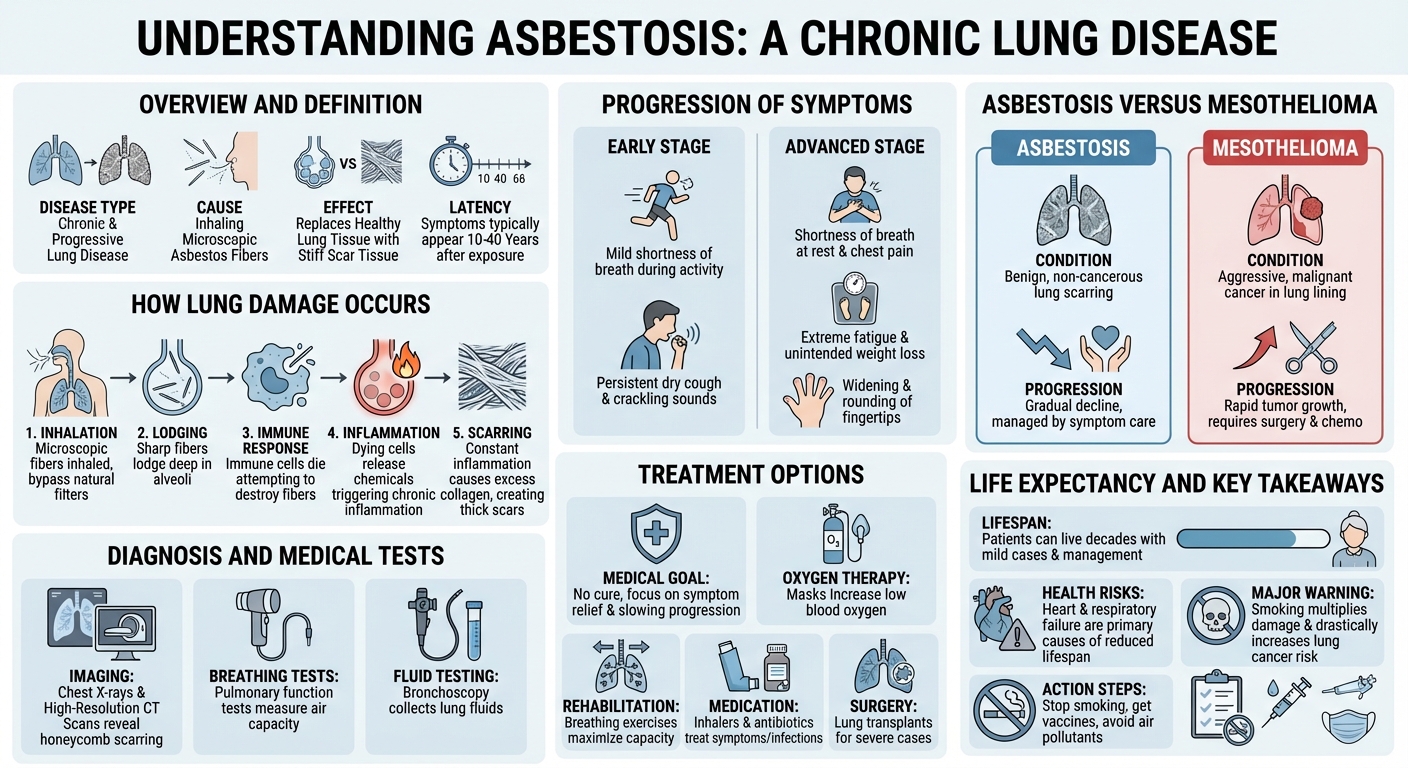
Asbestosis is a chronic, progressive lung disease caused by inhaling microscopic asbestos fibers. Prolonged exposure leads to severe pulmonary fibrosis, or scarring of the lung tissue. This scarring makes the lungs stiff, restricting breathing and preventing oxygen from properly entering the bloodstream.
What is the definition of asbestosis?
Asbestosis is a chronic, progressive lung disease caused by inhaling microscopic asbestos fibers. The disease is defined by severe pulmonary fibrosis, or scarring of the lung tissue, which restricts breathing and prevents oxygen from entering the bloodstream. It typically develops decades after prolonged occupational exposure to asbestos.
Medical Definition and Overview
In medical terms, asbestosis is classified as a type of interstitial lung disease (ILD) or pneumoconiosis. When airborne asbestos dust is inhaled, the microscopic mineral fibers bypass the body’s natural respiratory filters and lodge deep within the alveoli (tiny air sacs) of the lungs. The immune system attempts to break down these foreign bodies but fails, leading to chronic inflammation. Over time, this inflammatory response causes the healthy, elastic lung tissue to be replaced by stiff, fibrotic scar tissue.
How Asbestos Fibers Cause Pulmonary Fibrosis
The progression from asbestos exposure to pulmonary fibrosis is a slow, mechanical, and biological process. The sharp, needle-like asbestos fibers cause direct physical trauma to lung cells. Macrophages—white blood cells designed to engulf and destroy invaders—attempt to consume the fibers. Because asbestos is highly durable, the macrophages die in the process, releasing inflammatory cytokines. This continuous cycle of cell death and inflammation stimulates fibroblasts to produce excess collagen, resulting in the widespread scarring known as pulmonary fibrosis. As the scarring thickens, the lungs lose their ability to expand and contract normally.
What are the first symptoms of asbestosis?
The first symptoms of asbestosis usually include mild shortness of breath during physical activity and a persistent, dry cough. Because the disease develops slowly, these early warning signs often do not appear until 10 to 40 years after the initial exposure to asbestos fibers.
Early Warning Signs and Shortness of Breath
Because of the long latency period, individuals exposed to asbestos in the 1970s or 1980s may only now be experiencing their first symptoms. The hallmark early sign is dyspnea, or shortness of breath, initially triggered only by exertion such as climbing stairs or exercising. Patients may also notice a dry, crackling sound in their lungs when inhaling, which doctors refer to as “inspiratory crackles” or “rales.” A persistent, unproductive cough is another common early indicator that the lung tissue is becoming irritated and stiff.
Long-Term Respiratory Symptoms and Clubbing of Fingers
As the disease progresses and the scarring becomes more extensive, symptoms worsen and begin to occur even at rest. Advanced symptoms of asbestosis include:
- Severe shortness of breath during routine daily activities.
- Chest tightness or pain.
- Loss of appetite and unintended weight loss.
- Fatigue and general weakness.
- Clubbing of the fingers and toes: A condition where the tips of the fingers widen and become rounder due to chronic oxygen deprivation in the bloodstream.
What’s the difference between asbestosis and mesothelioma?
The main difference between asbestosis and mesothelioma is that asbestosis is a non-cancerous scarring of the lung tissue, while mesothelioma is a rare, aggressive cancer that forms in the lining of the lungs, abdomen, or heart. Both are caused by asbestos exposure but require vastly different treatments.
Key Differences in Pathology (Scarring vs. Cancer)
While both diseases share a common cause—asbestos exposure—their pathology is fundamentally different. Asbestosis is a fibrotic disease; it damages the internal structure of the lungs through scar tissue, making them stiff and inefficient. It does not spread to other organs. Mesothelioma, on the other hand, is a malignancy. It involves the uncontrolled mutation and division of cells in the mesothelium (the protective membrane surrounding internal organs). Mesothelioma tumors can metastasize and spread rapidly throughout the body.
Comparison Table: Asbestosis vs. Mesothelioma
| Feature | Asbestosis | Mesothelioma |
|---|---|---|
| Disease Type | Non-cancerous (benign) fibrosis | Aggressive cancer (malignant) |
| Primary Location | Inside the lung tissue (alveoli) | Lining of the lungs (pleura) or abdomen |
| Progression | Gradual worsening of lung function | Rapid tumor growth and metastasis |
| Treatment Focus | Symptom management, slowing progression | Surgery, chemotherapy, radiation |
Diagnosis and Treatment Options
Diagnosing asbestosis requires a comprehensive review of a patient’s medical and occupational history, followed by specialized imaging and breathing tests. While the damage caused by asbestosis cannot be reversed, a prompt diagnosis allows for treatments that can significantly improve quality of life.
Diagnostic Tests: Chest X-Rays and Pulmonary Function Tests
Physicians rely on several tools to confirm an asbestosis diagnosis:
- Chest X-Rays and CT Scans: These imaging tests reveal the extent of the scarring. A high-resolution CT scan is particularly effective at detecting early-stage fibrosis and the classic “honeycomb” appearance of advanced asbestosis.
- Pulmonary Function Tests (PFTs): These breathing tests measure how much air the lungs can hold and how effectively they transfer oxygen into the bloodstream.
- Bronchoscopy: In some cases, a thin tube is inserted into the lungs to collect fluid or tissue samples to rule out other conditions.
Managing Symptoms: Oxygen Therapy and Pulmonary Rehabilitation
Because there is no cure for asbestosis, treatment focuses on relieving symptoms, preventing complications, and slowing disease progression. Common management strategies include:
- Supplemental Oxygen: Delivered via a mask or nasal prongs, oxygen therapy helps patients with low blood oxygen levels breathe easier and reduces strain on the heart.
- Pulmonary Rehabilitation: A structured program of exercise, breathing techniques, and education designed to maximize remaining lung capacity.
- Medications: Inhalers may be prescribed to relax airway muscles, and antibiotics are used promptly to treat respiratory infections, which can be dangerous for asbestosis patients.
- Lung Transplant: In the most severe cases, a lung transplant may be the only option for survival.
What is the life expectancy of someone with asbestosis?
The life expectancy of someone with asbestosis varies widely depending on disease severity, age at diagnosis, and lifestyle factors. While asbestosis itself is not always fatal, it is progressive. Many patients live for decades with proper symptom management, though severe cases can significantly reduce life expectancy through respiratory failure.
Average Prognosis and Disease Progression
Because asbestosis progresses at different rates in different people, there is no single life expectancy timeline. Patients diagnosed with mild asbestosis who are removed from further asbestos exposure can often maintain a relatively normal lifespan. However, the disease gradually reduces lung function over time. The primary cause of reduced life expectancy in asbestosis patients is the development of complications such as right-sided heart failure (cor pulmonale), severe respiratory failure, or secondary lung cancers.
Lifestyle Factors That Impact Life Expectancy (e.g., Smoking)
Lifestyle choices play a critical role in the prognosis of an asbestosis patient. The most significant factor is smoking. Cigarette smoke and asbestos fibers have a synergistic effect, meaning they multiply the damage to the lungs. An asbestosis patient who smokes is at a drastically higher risk of developing lung cancer and experiencing rapid disease progression. Quitting smoking immediately, staying up-to-date on pneumococcal and influenza vaccines, and avoiding further exposure to dust and pollutants are the most effective ways to extend life expectancy and preserve lung function.
 Call (713) 747-7777