
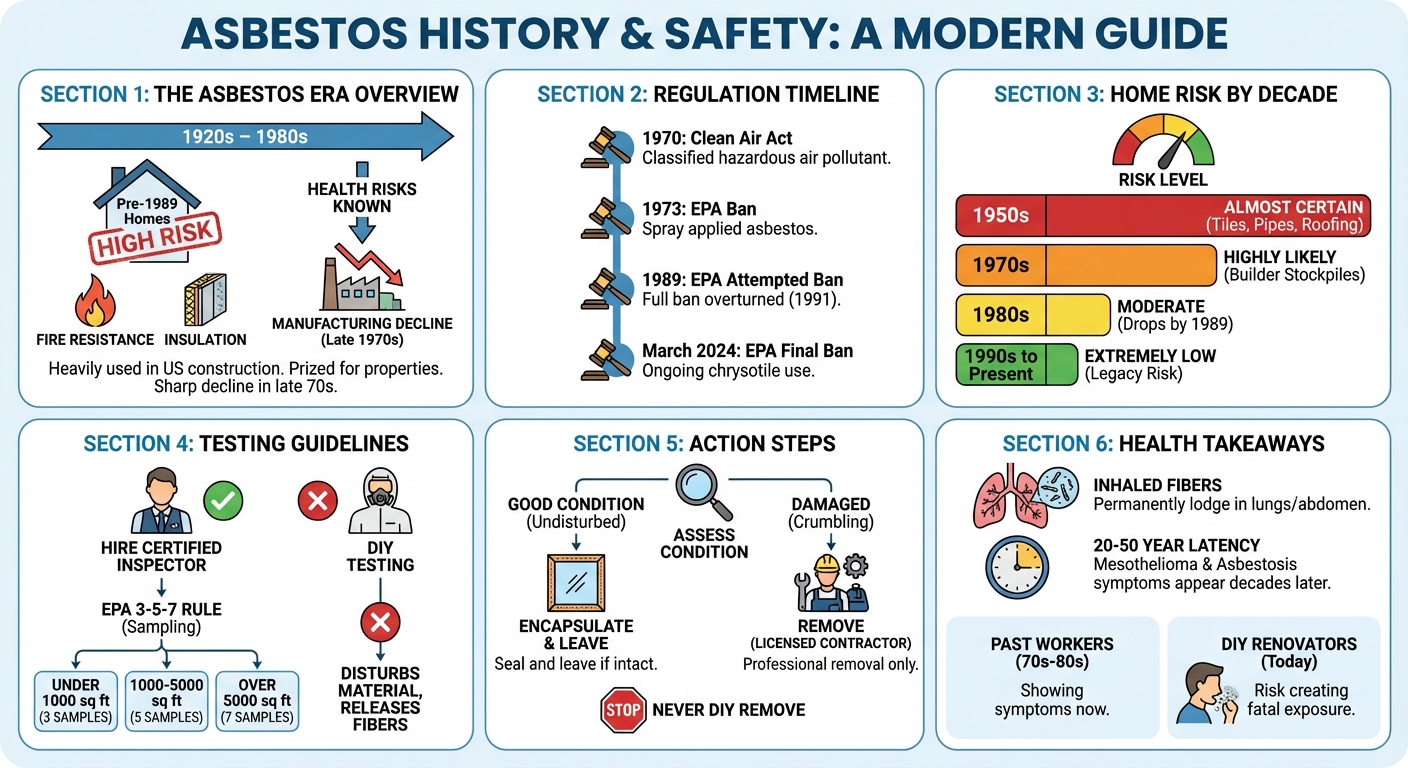
Asbestos was widely used in US construction from the early 1900s until the 1980s. While the EPA began regulating the mineral in the 1970s, a complete ban on chrysotile asbestos was not finalized until March 2024. Homes built before 1989 are highly likely to contain asbestos materials.
The Asbestos Years: A Timeline of Use and Regulation
For decades, asbestos was hailed as a ‘miracle mineral’ due to its exceptional fire resistance, durability, and insulating properties. However, the very fibers that made it so useful in construction also made it a deadly health hazard. Understanding the timeline of the asbestos years is crucial for homeowners, construction workers, and anyone living in an older building. By knowing when asbestos was most prevalent and when regulations finally took effect, you can better assess the risks hidden within your walls.
What years did they use asbestos?
Asbestos was used for thousands of years, but its commercial use in the US peaked between the 1920s and the 1980s. During these years, it was heavily utilized in construction, shipbuilding, and automotive manufacturing before health regulations caused a sharp decline in the late 20th century.
Early history and the Industrial Revolution
While archaeologists have found asbestos in ancient pottery dating back over 4,000 years, its large-scale commercial application began during the late 1800s. The Industrial Revolution fueled a massive demand for heat-resistant materials to insulate steam engines, pipes, and factory boilers. Mining operations expanded globally to meet this booming industrial need.
Peak usage years in US construction (1920s to 1980s)
The golden era of asbestos in the United States spanned from the 1920s through the 1970s. During this period, asbestos was incorporated into thousands of everyday building materials. It was cheap, abundant, and highly effective at preventing fires. You could find it in floor tiles, roofing shingles, popcorn ceilings, drywall joint compound, and thermal pipe insulation. Entire neighborhoods built during the post-WWII housing boom were constructed using asbestos-laden materials.
The decline of asbestos manufacturing
By the late 1970s, the medical community established undeniable links between asbestos exposure and severe illnesses like mesothelioma and asbestosis. Public outcry and mounting lawsuits forced manufacturers to seek alternatives. Although it wasn’t immediately banned, the use of asbestos in new manufacturing plummeted throughout the 1980s as liability risks skyrocketed.
The History of Asbestos Regulation and Bans in the US
| Time Period | Asbestos Status in the US |
|---|---|
| 1920s – 1970s | Peak usage in construction and manufacturing |
| 1970 – 1973 | Clean Air Act passed; spray-applied asbestos banned |
| 1989 | EPA attempts a full ban (overturned in 1991) |
| March 2024 | Final EPA ban on ongoing chrysotile asbestos use |
1970s: The Clean Air Act and early EPA actions
Federal regulation began in earnest in the 1970s. The Clean Air Act of 1970 classified asbestos as a hazardous air pollutant. Shortly after, in 1973, the Environmental Protection Agency (EPA) banned spray-applied surfacing asbestos materials used for fireproofing and insulation, marking the first major step toward restricting the mineral.
1989: The overturned EPA ban
In 1989, the EPA issued the Asbestos Ban and Phase-Out Rule, which aimed to prohibit the manufacture, importation, processing, and distribution of most asbestos-containing products. However, asbestos industry lobbyists pushed back. In 1991, the Fifth Circuit Court of Appeals overturned most of the ban, allowing many asbestos products to remain legal in the US for decades.
March 2024: The final Chrysotile asbestos ban
After decades of partial regulations, the EPA finally announced a comprehensive ban on ongoing uses of chrysotile asbestos in March 2024. This landmark ruling closed the loopholes left by the 1991 court decision, officially ending the legal importation and use of the most common type of asbestos in the United States.
Decade-by-Decade Guide: Asbestos in US Homes
Would a 1950s house have asbestos?
Yes, a 1950s house is almost certain to contain asbestos. During this decade, asbestos was a standard building material used in floor tiles, pipe insulation, siding, roofing, and joint compounds. If your home was built in the 1950s, you should assume these materials contain asbestos until professionally tested.
Will a house built in 1978 have asbestos?
Yes, a house built in 1978 is highly likely to have asbestos. Although the EPA began regulating asbestos in the 1970s, builders legally continued using existing stockpiles of asbestos-containing materials. Popcorn ceilings, floor tiles, and insulation installed in 1978 frequently contain asbestos.
Homes built in the 1980s: Is the cutoff 1980 or 1989?
There is no strict ‘cutoff’ year in the 1980s. While public awareness grew and manufacturers stopped producing new asbestos materials, contractors were still allowed to deplete their existing inventories. Homes built in the early-to-mid 1980s still carry a moderate risk of containing asbestos in floor mastics and roofing materials. By 1989, the risk dropped significantly, but it was not entirely eliminated.
New construction (1990s to present)
If your home was built after 1990, the chances of finding asbestos are extremely low. While the 1989 ban was overturned, the threat of litigation effectively ended the use of asbestos in residential building materials. Modern homes are generally considered safe from legacy asbestos exposure.
How to Test Your Home for Asbestos
What is the 3 5 7 rule for asbestos sampling?
The 3 5 7 rule for asbestos sampling refers to the EPA’s AHERA guidelines for testing surfacing materials. You must collect at least 3 samples from areas under 1,000 square feet, 5 samples for areas between 1,000 and 5,000 square feet, and 7 samples for areas over 5,000 square feet.
DIY testing vs. hiring a certified asbestos inspector
While DIY asbestos testing kits are available at hardware stores, they require you to physically disturb the material to take a sample. This can release dangerous microscopic fibers into your air. Hiring a certified asbestos inspector is highly recommended. Professionals use specialized equipment, wear protective gear, and follow strict protocols to safely extract samples and send them to an accredited lab.
What to do if you find asbestos (encapsulation vs. removal)
- Encapsulation: If the asbestos is in good condition (non-friable) and undisturbed, the safest option is often to leave it alone or encapsulate it with a specialized sealant.
- Removal (Abatement): If the material is damaged, crumbling, or in the path of a planned renovation, it must be removed by a licensed asbestos abatement contractor.
The Health Impact: Understanding Asbestos Latency Years
The 20 to 50-year latency period
One of the most insidious aspects of asbestos is its latency period. When microscopic asbestos fibers are inhaled, they become permanently lodged in the lining of the lungs or abdomen. However, diseases like mesothelioma, lung cancer, and asbestosis typically take 20 to 50 years to develop after the initial exposure.
Why historical exposure still matters today
Because of this long latency period, the ‘asbestos years’ are still claiming lives today. Individuals who worked in construction, shipbuilding, or automotive repair during the 1970s and 1980s are only now showing symptoms. Furthermore, DIY home renovators who unknowingly tear down 1960s drywall or rip up 1970s floor tiles are creating new waves of exposure, proving that the legacy of asbestos is far from over.
 Call (713) 747-7777