
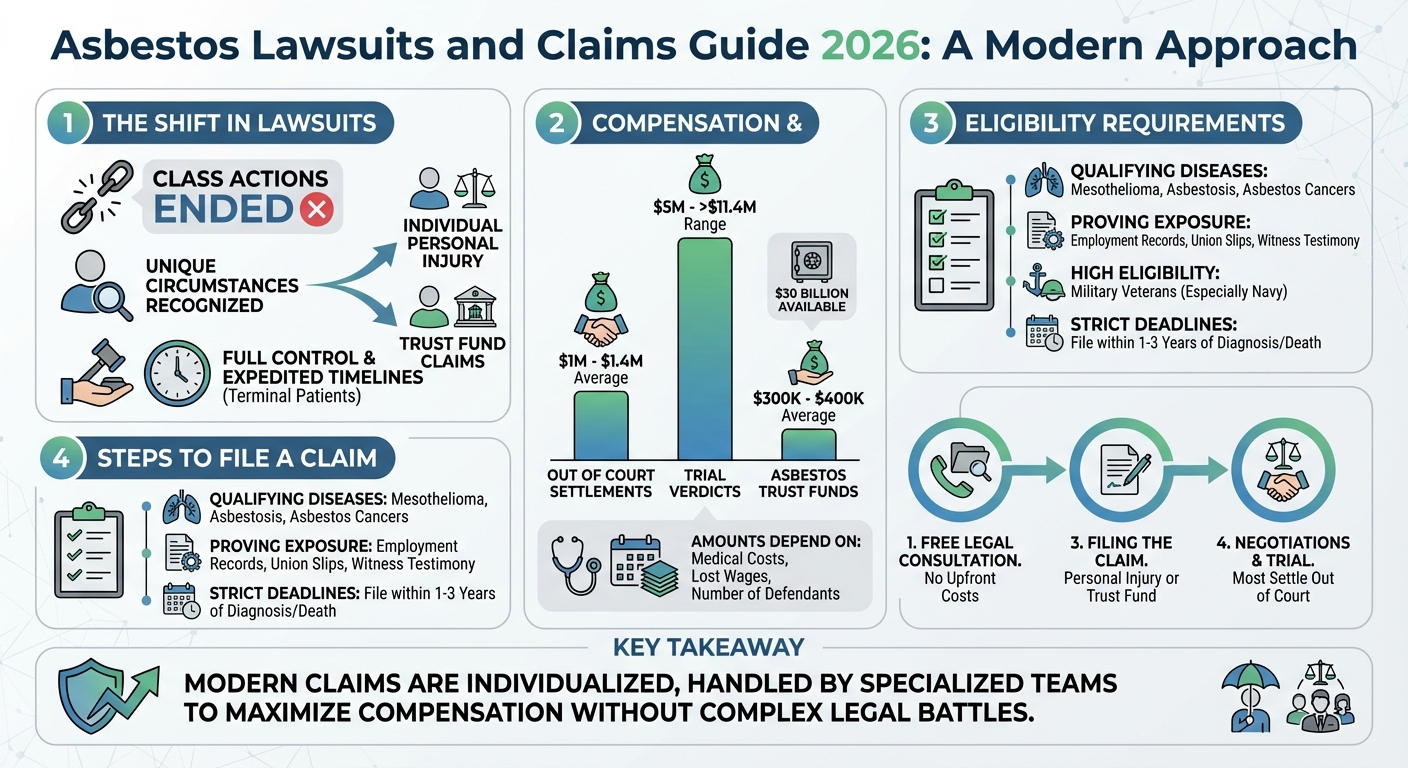
While asbestos class action lawsuits were common in the 1990s, they are rarely filed today. Because asbestos-related diseases like mesothelioma affect each person differently, courts now require victims to file individual personal injury lawsuits or asbestos trust fund claims to secure maximum compensation.
Asbestos Class Action Lawsuits: What You Need to Know in 2026
If you or a loved one has been diagnosed with mesothelioma or another asbestos-related disease, you are likely searching for ways to cover mounting medical bills and secure your family’s financial future. Historically, many victims joined an asbestos class action lawsuit to hold negligent manufacturers accountable. However, the legal landscape for asbestos litigation has drastically changed.
Today, pursuing compensation looks very different than it did thirty years ago. Understanding how modern asbestos claims work is the first step toward maximizing your financial recovery.
Is there a class action lawsuit for asbestos exposure?
Currently, there is no active class action lawsuit for asbestos exposure. While class actions were common in the 1990s, courts ruled that asbestos cases are too individualized for a single class. Today, victims must file individual personal injury lawsuits or trust fund claims to receive financial compensation.
Why Individual Asbestos Lawsuits Replaced Class Actions
In a traditional class action, a few lead plaintiffs represent a large group of people who suffered similar harm. While this works well for defective consumer products, it proved highly ineffective for asbestos exposure.
The Problem with Asbestos Class Actions
In the late 1990s, the U.S. Supreme Court effectively ended asbestos class actions. The courts recognized that asbestos victims do not share identical circumstances. Key differences include:
- Varying Diseases: One worker might develop fatal mesothelioma, while another develops mild asbestosis.
- Different Exposure Histories: Victims were exposed to different asbestos products across various industries and decades.
- Unique Financial Needs: Medical expenses and lost wages vary wildly from patient to patient.
Lumping these diverse cases into a single class action resulted in unfair compensation distributions, often leaving severely ill patients with pennies on the dollar.
Benefits of Filing an Individual Personal Injury Claim
Filing an individual lawsuit (often called a mass tort or personal injury claim) is now the standard. This approach offers significant advantages:
| Feature | Class Action Lawsuit | Individual Asbestos Lawsuit |
|---|---|---|
| Compensation | Divided equally among thousands | Based entirely on your specific damages |
| Control | Lead plaintiffs make decisions | You control settlement approvals |
| Timeline | Can take a decade or more | Often expedited for terminal patients |
Asbestos Trust Funds: The $30 Billion Alternative
Many companies that manufactured asbestos products filed for bankruptcy to avoid being sued out of existence. However, federal bankruptcy courts forced these companies to establish asbestos trust funds to compensate future victims. Today, there is an estimated $30 billion available across various active trusts. Filing a trust fund claim is an administrative process that does not require going to court.
How much is the asbestos lawsuit going to payout?
The payout for an asbestos lawsuit varies, but the average mesothelioma settlement ranges between $1 million and $1.4 million. Cases that go to trial can yield verdicts of $5 million to $11.4 million or more. Your specific payout depends on medical costs, lost wages, and the severity of your diagnosis.
Average Mesothelioma Settlement Amounts
Most asbestos lawsuits never see the inside of a courtroom. Defendants typically prefer to settle out of court to avoid the unpredictable nature of jury verdicts and negative public relations. A skilled mesothelioma lawyer will negotiate these settlements on your behalf, often securing funds within a few months of filing.
Factors That Impact Your Asbestos Compensation
No two asbestos cases are exactly alike. The value of your claim will be influenced by:
- Medical Expenses: Costs of surgery, chemotherapy, radiation, and palliative care.
- Lost Income: Past and future wages lost due to your inability to work.
- Pain and Suffering: Compensation for the physical pain and emotional distress caused by the disease.
- Number of Defendants: You may be able to file claims against multiple manufacturers, increasing your total payout.
How much is the payout for asbestos?
The payout for an asbestos claim depends on the route taken. While individual lawsuit settlements average over $1 million, asbestos bankruptcy trust fund payouts typically range from $300,000 to $400,000. Compensation is determined by your specific illness, the companies responsible, and the extent of your asbestos exposure.
Who Qualifies for Asbestos Compensation?
To file a successful asbestos claim, you must meet specific medical and legal criteria. You do not need to know exactly where or how you were exposed to begin the process—an experienced attorney will investigate that for you.
Eligible Asbestos-Related Diseases
Financial compensation is generally reserved for individuals diagnosed with illnesses directly linked to asbestos inhalation or ingestion. These include:
- Mesothelioma (pleural, peritoneal, or pericardial)
- Asbestos-related lung cancer
- Asbestosis
- Other cancers (such as laryngeal or ovarian cancer linked to asbestos)
Proving Asbestos Exposure in the Workplace
Your legal team will build your case by identifying the asbestos-containing products you handled. They will gather employment records, union dispatch slips, and witness testimonies. Veterans who served in the military—particularly the U.S. Navy—are also highly eligible, as asbestos was heavily used in ships and military bases.
Understanding the Statute of Limitations
Every state has a strict deadline, known as the statute of limitations, for filing an asbestos lawsuit. This window typically ranges from 1 to 3 years from the date of your diagnosis (or the date of a loved one’s death). Failing to file within this timeframe will permanently bar you from recovering compensation.
What famous person died from mesothelioma?
Several famous people have died from mesothelioma due to asbestos exposure. The most notable is actor Steve McQueen, who passed away in 1980 after being exposed to asbestos in the Marines and on movie sets. Musician Warren Zevon and actor Paul Gleason also died from this aggressive asbestos-related cancer.
Steps to File an Asbestos Claim Today
Taking legal action can feel overwhelming, especially when managing a severe illness. Fortunately, specialized asbestos law firms handle the heavy lifting. Here is what the process looks like.
Step 1: Free Legal Consultation and Case Evaluation
The process begins with a free, no-obligation consultation. An attorney will review your diagnosis, discuss your work history, and determine the best legal pathways for compensation. Top firms work on a contingency fee basis, meaning you pay nothing out of pocket unless you win.
Step 2: Gathering Medical and Employment Records
Once you hire a lawyer, their investigative team takes over. They will collect your pathology reports, medical records, and employment history. They use massive proprietary databases to link your past job sites to specific asbestos products and manufacturers.
Step 3: Filing the Lawsuit or Trust Fund Claim
Your attorney will file the necessary paperwork in the appropriate jurisdiction. Depending on the status of the companies responsible for your exposure, they may file a personal injury lawsuit, submit claims to multiple asbestos trust funds, or both.
Step 4: Settlement Negotiations or Trial
After filing, the discovery phase begins, and your lawyer will negotiate with the defendants. If a fair settlement cannot be reached, your attorney will be prepared to take your case to trial to fight for a jury verdict. However, the vast majority of cases are resolved through out-of-court settlements, providing you with faster access to the funds you need.
 Call (713) 747-7777