
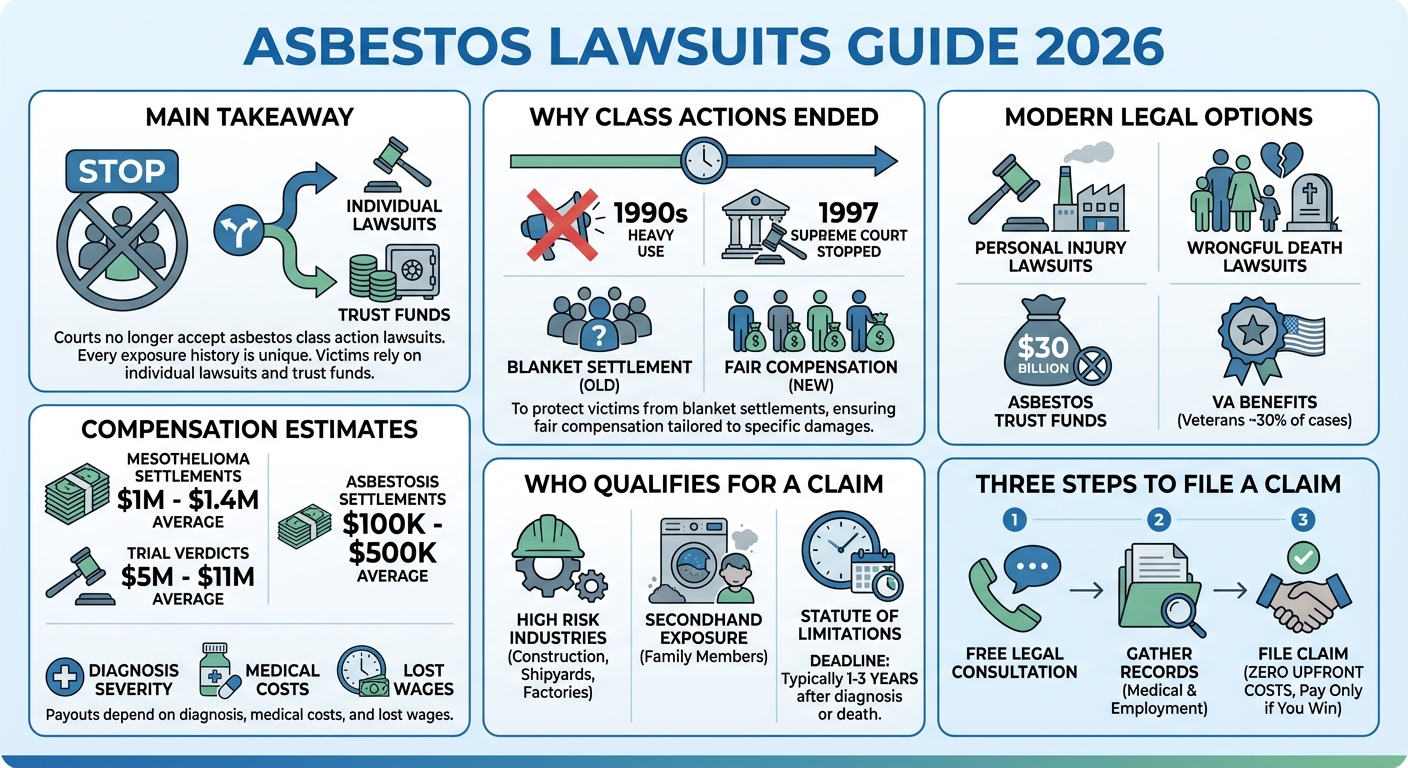
An asbestos class action lawsuit combines claims from multiple victims against the same asbestos companies. However, courts no longer accept asbestos class actions because each patient’s illness and exposure history is unique. Today, victims pursue compensation through individual personal injury lawsuits and asbestos trust fund claims.
Asbestos Class Action Lawsuits: 2026 Guide & Legal Options
If you or a loved one has been diagnosed with mesothelioma or another asbestos-related disease, you may be wondering how to join an asbestos class action lawsuit. While class actions were once the standard method for seeking justice against negligent asbestos manufacturers, the legal landscape has shifted dramatically.
Today, victims have more effective, personalized legal avenues to secure the financial compensation they deserve. This 2026 guide explains the history of asbestos litigation, why individual claims have replaced class actions, and how you can pursue maximum compensation through modern legal channels.
What is the class action lawsuit for asbestos?
An asbestos class action lawsuit is a legal claim where a large group of people exposed to asbestos join together to sue the responsible companies in a single case. While these were common in the 1990s, courts no longer allow asbestos class actions because each victim’s medical history, exposure level, and resulting illness are considered too unique for a single blanket ruling.
The history of asbestos class actions
In the late 20th century, as the devastating health impacts of asbestos became public knowledge, thousands of workers began filing lawsuits. To handle the sheer volume of claims, courts consolidated them into class action lawsuits. This allowed the legal system to process claims efficiently and hold massive corporations accountable for hiding the dangers of asbestos.
Why courts stopped certifying asbestos class actions
In 1997, the U.S. Supreme Court ruled in Amchem Products, Inc. v. Windsor that asbestos victims’ circumstances were too diverse to be grouped into a single class. A shipyard worker with mesothelioma requires different compensation and medical care than a construction worker with mild asbestosis. Because a class action splits a single settlement among all plaintiffs regardless of their specific damages, courts determined this method was fundamentally unfair to victims with severe illnesses.
Why Individual Lawsuits Replaced Class Actions
Today, asbestos litigation is handled almost exclusively through individual lawsuits. This shift ensures that victims receive compensation tailored to their specific medical bills, lost wages, and pain and suffering.
Class Action vs. Individual Asbestos Lawsuit
| Feature | Class Action Lawsuit | Individual Lawsuit |
|---|---|---|
| Compensation | Settlement is divided equally among all class members. | Compensation is based entirely on your specific damages and diagnosis. |
| Control | Lead plaintiffs make decisions for the entire group. | You and your attorney have full control over settlement decisions. |
| Timeline | Can take many years to resolve due to the size of the class. | Often expedited, especially for plaintiffs with severe illnesses like mesothelioma. |
| Current Status | No longer accepted by courts for asbestos injury claims. | The standard legal method used today. |
The unique nature of mesothelioma and asbestos-related diseases
Asbestos-related diseases have a latency period of 10 to 50 years. Two people exposed to the exact same asbestos products at the same job site might develop entirely different conditions decades apart. Individual lawsuits allow attorneys to build a customized case that proves exactly how, when, and where your specific exposure occurred.
Modern Legal Options for Asbestos Exposure Victims
Since class actions are no longer an option, victims and their families can pursue compensation through several other highly effective legal channels.
Personal Injury Lawsuits
If you have been diagnosed with an asbestos-related disease, you can file a personal injury lawsuit against the companies that manufactured or sold the asbestos products. These lawsuits seek compensation for medical expenses, lost income, and physical suffering.
Wrongful Death Lawsuits
If a loved one has passed away from mesothelioma or another asbestos-related illness, surviving family members can file a wrongful death lawsuit. This helps cover funeral costs, outstanding medical bills, and loss of financial support.
Asbestos Trust Fund Claims
Many asbestos companies filed for bankruptcy to avoid lawsuits. However, courts forced these companies to establish asbestos trust funds to compensate future victims. Today, there is an estimated $30 billion available in these trusts. Filing a trust fund claim does not require going to court and often results in faster payouts.
VA Benefits for Veterans
Veterans make up nearly 30% of all mesothelioma cases due to the heavy use of asbestos in military ships, vehicles, and bases. Veterans can file for VA disability benefits, VA healthcare, and pursue legal claims against the asbestos manufacturers (not the military) simultaneously.
Asbestos Lawsuit Compensation and Settlements
Understanding the potential financial recovery is crucial for victims facing mounting medical bills.
What is the average asbestos settlement amount?
The average asbestos settlement amount is typically between $1 million and $1.4 million. However, individual payouts vary widely based on the severity of the diagnosis, the specific asbestos companies involved, and whether the case goes to trial, where jury verdicts can range from $5 million to over $11 million.
What is the average claim for asbestosis?
The average claim for asbestosis generally ranges from $100,000 to $500,000. Because asbestosis is a non-cancerous condition, settlements are typically lower than those for mesothelioma or lung cancer. Compensation depends on the extent of lung damage, ongoing medical expenses, and the impact on the victim’s quality of life.
Factors that influence your settlement value
- Diagnosis: Mesothelioma and lung cancer cases yield higher settlements than non-malignant diseases.
- Medical Expenses: The cost of surgeries, chemotherapy, and ongoing care.
- Age and Lost Wages: Younger victims who lose years of earning potential typically receive higher compensation.
- Proof of Exposure: Clear documentation linking your illness to specific asbestos products strengthens your case.
Who Qualifies to File an Asbestos Claim?
You do not need to have worked directly with raw asbestos to qualify for a claim. Anyone diagnosed with an asbestos-related disease who can trace their exposure to a negligent company is eligible.
High-Risk Occupations (Construction, Shipyards, Manufacturing)
Workers in certain industries faced massive exposure risks before the 1980s. High-risk occupations include shipyard workers, electricians, plumbers, construction workers, auto mechanics, and factory workers.
Secondhand Exposure Cases
Many spouses and children developed mesothelioma simply by washing the asbestos-covered work clothes of their family members. Secondhand exposure victims have the same legal rights to compensation as those who worked directly with the materials.
Statute of Limitations: How long do you have to file?
Every state has a statute of limitations that restricts how long you have to file a lawsuit. For asbestos cases, this clock usually starts on the date of your diagnosis (for personal injury) or the date of death (for wrongful death). In most states, you have between 1 and 3 years to file your claim.
Public Awareness and Notable Cases
High-profile cases have helped shine a light on the devastating impact of corporate negligence regarding asbestos.
What famous person died from mesothelioma?
Several famous people died from mesothelioma, including actor Steve McQueen, who was exposed to asbestos while serving in the Marines and working on movie sets. Other notable figures include musician Warren Zevon, NFL Hall of Famer Merlin Olsen, and actor Paul Gleason, bringing significant public awareness to the dangers of asbestos exposure.
How to Start Your Asbestos Claim Today
Taking legal action can feel overwhelming, but experienced asbestos attorneys handle the heavy lifting for you.
Step 1: Get a Free Case Evaluation
The first step is contacting an experienced asbestos law firm. They will review your medical diagnosis and work history during a free, confidential consultation to determine if you have a valid claim.
Step 2: Gathering Medical and Employment Records
Your legal team will collect your medical records, employment history, and witness testimonies. They utilize massive databases of asbestos products to pinpoint exactly which companies are responsible for your exposure.
Step 3: Filing the Claim with No Upfront Costs
Asbestos lawyers work on a contingency fee basis. This means you pay absolutely nothing upfront. Your attorney only gets paid a percentage of your settlement or verdict if they successfully recover compensation for you. If you do not win, you owe nothing.
 Call (713) 747-7777