

Table of contents
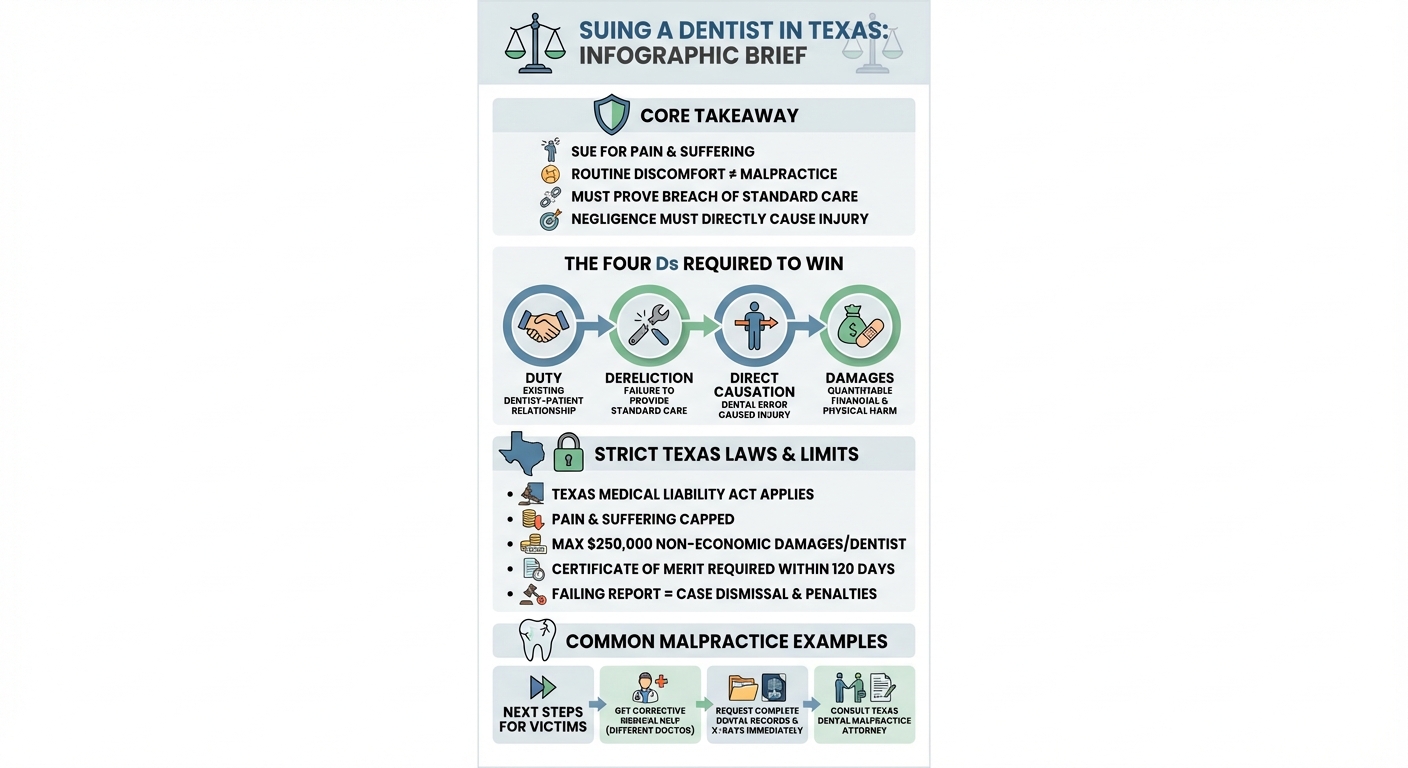
Yes, you can sue a dentist for pain and suffering in Texas by filing a dental malpractice lawsuit. To win, you must prove the dentist breached the standard of care and directly caused your injuries. Texas law caps non-economic damages, including pain and suffering, at $250,000 against a single dentist.
Can You Sue a Dentist for Pain and Suffering in Texas?
Yes, you can sue a dentist for pain and suffering in Texas, but these claims are governed by strict medical malpractice laws. Experiencing pain during or after a dental procedure is not enough on its own to justify a lawsuit. To successfully recover compensation for pain and suffering, you must prove that the dentist breached the standard of care and that this negligence directly caused your injuries.
Understanding Dental Malpractice vs. A Bad Dental Experience
Dentistry inherently involves some level of discomfort. A bad dental experience—such as a rude staff member, a painful but standard recovery, or a filling that needs a minor adjustment—does not constitute malpractice. Dental malpractice occurs only when a dental professional fails to provide the accepted standard of care, resulting in serious, preventable harm.
When Does Dental Pain Become Legal Negligence?
Dental pain crosses the line into legal negligence when it is the direct result of a dentist’s error, incompetence, or failure to act. For example, if a dentist severs a nerve during a routine extraction because they used the wrong technique, the resulting chronic pain and numbness are grounds for a malpractice claim. The key distinction is whether another reasonable dentist in Texas would have made the same mistake under similar circumstances.
What are the four D’s that must be present for a lawsuit against a dentist to be successful?
To successfully sue a dentist, four D’s must be present: Duty, Dereliction, Direct Causation, and Damages. You must prove the dentist owed you a duty of care, breached that duty (dereliction), and that this specific breach directly caused your measurable damages, including pain and suffering.
Duty of Care
This is established the moment a dentist-patient relationship is formed. By agreeing to treat you, the dentist assumes a legal obligation to provide care that meets the accepted standards of the dental profession.
Dereliction (Breach of Duty)
Dereliction occurs when the dentist fails to meet that standard of care. This could involve making a surgical error, failing to diagnose a serious condition like oral cancer, or administering the wrong dosage of anesthesia.
Direct Causation
You must prove that the dentist’s dereliction directly caused your injury. If you had a pre-existing condition that caused the pain, or if the injury would have happened regardless of the dentist’s actions, causation cannot be established.
Damages (Including Pain and Suffering)
Finally, there must be actual, quantifiable harm. This includes economic damages like additional medical bills and lost wages, as well as non-economic damages like physical pain, mental anguish, and emotional suffering.
Texas Laws on Pain and Suffering in Dental Malpractice
Suing a dentist in Texas is fundamentally different from a standard personal injury claim like a car accident. Dental malpractice falls under specific state statutes designed to limit frivolous lawsuits.
The Texas Medical Liability Act (Chapter 74)
Under the Texas Medical Liability Act (Chapter 74 of the Texas Civil Practice and Remedies Code), dental malpractice is treated as medical malpractice. This law imposes strict procedural requirements and caps the amount of money a patient can recover for non-economic damages.
How much can I sue for emotional distress in Texas?
In Texas medical malpractice cases, you can sue for emotional distress, but compensation is strictly limited. Texas law caps all non-economic damages—which include pain, suffering, and emotional distress—at $250,000 against a single dentist or healthcare provider, regardless of the severity of your emotional trauma.
How hard is it to sue a dentist?
It is very hard to sue a dentist in Texas due to strict medical malpractice laws. You must obtain a costly expert report from another qualified dentist to prove negligence. Additionally, Texas damage caps often limit potential payouts, making these cases expensive and legally complex to pursue.
The Requirement of a Certificate of Merit (Expert Report)
One of the biggest hurdles in Texas is the requirement to serve an “expert report” within 120 days of the defendant answering the lawsuit. This report must be written by a qualified, practicing dental expert who outlines the standard of care, how your dentist breached it, and how that breach caused your injury. If you fail to provide this report, your case will be dismissed, and you may have to pay the dentist’s legal fees.
What is the average payout for dental negligence?
There is no exact average payout for dental negligence, as settlements vary based on injury severity. Minor injuries might settle for $10,000 to $30,000, while severe cases involving permanent nerve damage or wrongful death can reach the Texas non-economic damage cap of $250,000 plus economic damages.
Common Examples of Actionable Dental Malpractice in Texas
While every case is unique, certain types of dental errors frequently lead to successful malpractice lawsuits in Texas.
Permanent Nerve Damage (Lingual or Inferior Alveolar Nerve)
During wisdom tooth extractions or implant placements, a dentist may drill too deeply or use improper techniques, severing the lingual or inferior alveolar nerve. This can cause permanent numbness, loss of taste, or chronic burning pain in the tongue, lips, and jaw.
Severe Infections from Improper Sterilization
Using unsterilized equipment or failing to properly clean a surgical site can lead to severe bacterial infections. In extreme cases, these infections can spread to the bloodstream (sepsis) or the brain, requiring hospitalization and extensive medical intervention.
Wrong-Tooth Extractions and Anesthesia Errors
Pulling the wrong tooth is a clear breach of the standard of care. Similarly, administering too much anesthesia or failing to monitor a patient’s vital signs while under sedation can lead to brain damage, heart attacks, or even death.
Steps to Take If You Suffered Severe Pain from Dental Work
If you believe you are a victim of dental malpractice, taking immediate action is crucial to protect your health and your legal rights.
Seek Corrective Medical Treatment
Your health is the top priority. Go to a different, independent dentist or a medical doctor to address the pain, infection, or injury. Do not return to the dentist who caused the harm for corrective procedures, as this can complicate your legal claim.
Request Your Complete Dental Records
Under Texas law, you have the right to a copy of your complete dental records, including x-rays, treatment notes, and consent forms. Request these immediately before any documents can be altered or “lost.”
Consult a Texas Dental Malpractice Attorney
Because these cases require expert witnesses and must navigate complex Texas tort reform laws, you need an attorney who specifically handles medical and dental malpractice. They can evaluate your records, consult with dental experts, and determine if you have a viable claim for pain and suffering.