

Table of contents
A Houston Jones Act lawyer helps injured offshore workers recover compensation under federal maritime law. If you qualify as a seaman, the Jones Act allows you to sue your employer for negligence, securing damages for lost wages, medical bills, and pain and suffering that standard workers’ compensation does not cover.
Houston Jones Act Lawyer: Protecting Injured Offshore Maritime Workers
Working offshore in the Texas Gulf Coast is one of the most dangerous jobs in the country. When an accident happens on a rig, ship, or barge, the physical and financial consequences can be devastating. Standard state workers’ compensation does not cover most offshore workers. Instead, injured seamen must rely on federal maritime law to seek justice. A dedicated Houston Jones Act lawyer understands the complexities of maritime injury claims and fights to ensure injured offshore workers recover the full compensation they need to heal and support their families.
Understanding the Jones Act and Your Maritime Rights
What is the Jones Act?
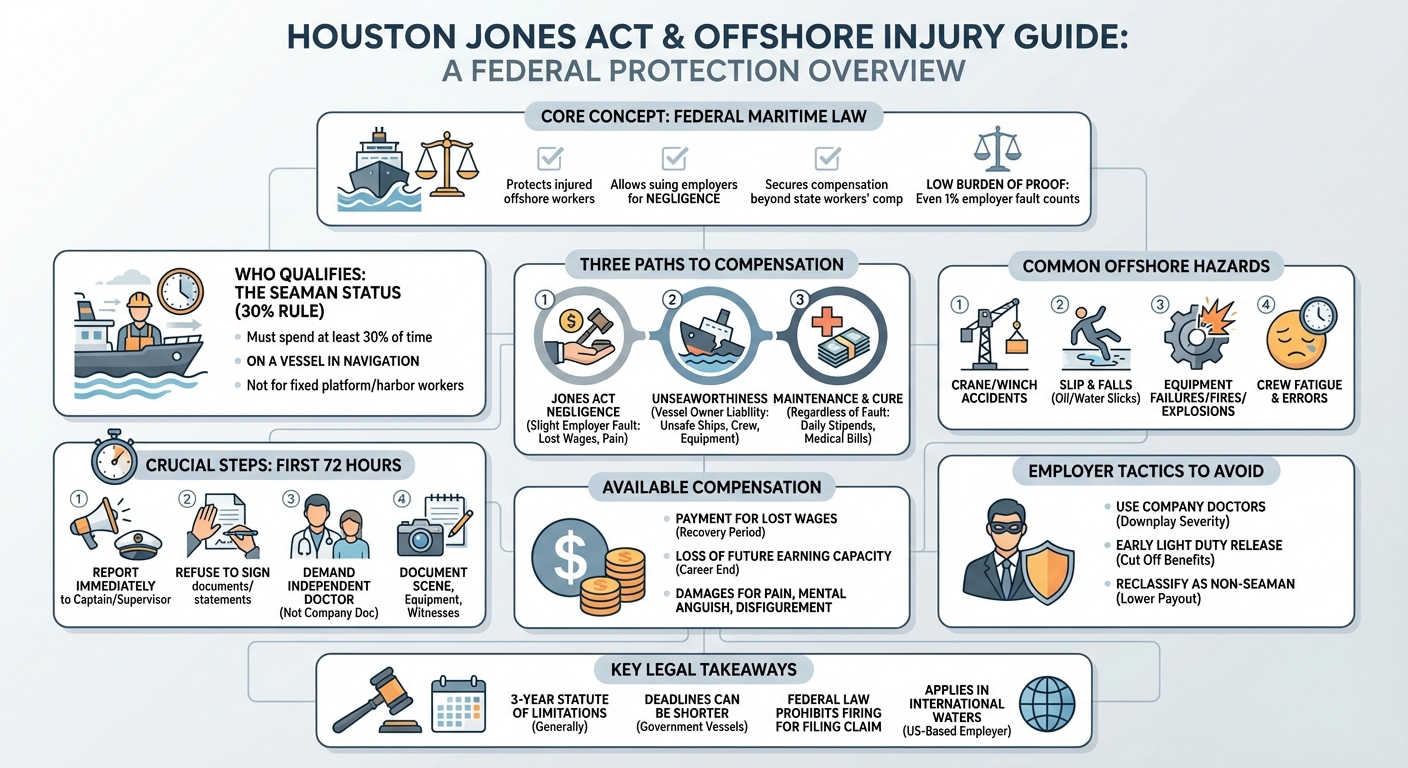
The Jones Act, formally known as the Merchant Marine Act of 1920, is a federal statute that provides vital protections to maritime workers. Unlike traditional workers’ compensation, which is a no-fault system with capped benefits, the Jones Act allows injured seamen to file a personal injury lawsuit directly against their employer. To win a Jones Act claim, the worker must prove that the employer’s negligence—even if it played only a minor role—contributed to their injury.
Who Qualifies as a Seaman? (The 30% Rule Explained)
Not every offshore worker is covered by the Jones Act. To qualify, you must be classified as a “seaman.” Courts generally use the “30% Rule” to determine this status. You must spend at least 30% of your working time in active service on a vessel (or a fleet of vessels under common ownership) that is in navigation. If you are a harbor worker, shipbuilder, or work on a fixed platform, you may instead be covered under the Longshore and Harbor Workers’ Compensation Act (LHWCA).
Jones Act Claims vs. General Maritime Law
Maritime injury cases often involve multiple avenues for compensation. Understanding the difference between these claims is critical to maximizing your recovery.
| Legal Claim | Who is Responsible? | What Must Be Proven? | Available Damages |
|---|---|---|---|
| Jones Act Negligence | The Employer | Slight negligence (“featherweight” burden) | Lost wages, medical costs, pain & suffering |
| Unseaworthiness | The Vessel Owner | Vessel or equipment was unsafe/unfit | Full compensatory damages |
| Maintenance & Cure | The Employer | No fault required (automatic right) | Daily living stipend and medical bills |
Proving Employer Negligence Under the Jones Act
Under the Jones Act, the burden of proof is incredibly low. This is known as a “featherweight” burden. If your employer’s negligence contributed to your injury in any way—even just 1%—they can be held liable. Examples of negligence include failing to provide proper safety gear, ordering work in hazardous weather, or ignoring safety protocols.
Unseaworthiness Claims Against Vessel Owners
Separate from a Jones Act claim, general maritime law allows you to file an “unseaworthiness” claim against the owner of the vessel. A vessel owner has an absolute, non-delegable duty to provide a ship, crew, and equipment that are reasonably fit for their intended purpose. If a frayed cable snaps or a deck lacks non-skid paint, the vessel is considered unseaworthy.
Your Absolute Right to Maintenance and Cure
Regardless of who is at fault for your offshore injury, general maritime law guarantees you the right to “Maintenance and Cure.” Maintenance is a daily stipend designed to cover your basic room and board while you recover. Cure covers all reasonable and necessary medical expenses related to your injury until you reach maximum medical improvement (MMI).
Common Offshore Accidents in the Texas Gulf Coast
Types of Vessels and Rigs Covered
The Houston and Galveston areas are hubs for maritime activity. The Jones Act covers workers on a wide variety of vessels, provided they are capable of moving on navigable waters. This includes:
- Jack-up rigs and semi-submersibles
- Drillships and floating production systems
- Tugboats and towboats
- Crew boats and supply vessels
- Barges and dredging vessels
Leading Causes of Severe Maritime Injuries
Offshore environments are inherently hazardous. Some of the most common causes of catastrophic maritime injuries include:
- Crane and Winch Accidents: Dropped loads or snapping cables causing crush injuries.
- Slip and Falls: Slick decks from oil, water, or lack of non-skid surfaces.
- Equipment Failures: Poorly maintained heavy machinery leading to amputations or severe fractures.
- Fires and Explosions: Combustible materials and blowout events resulting in severe burns.
- Fatigue and Understaffing: Overworked crews making critical errors.
What to Do in the First 72 Hours After an Offshore Injury
Report the Incident (But Do Not Sign a Recorded Statement)
Immediately report your injury to your captain or supervisor so an official incident report can be filed. However, do not sign any documents or give a recorded statement to company investigators or insurance adjusters without speaking to a lawyer first. They often use these statements to twist your words and minimize your claim.
Demand Independent Medical Attention
You have the absolute right to choose your own doctor. Do not let your employer force you to see the “company doctor” for your primary treatment. Company doctors are chosen and paid by the employer, meaning their priority is often getting you back to work quickly, not ensuring your full recovery.
Document the Scene, Equipment, and Witnesses
If you are physically able, take photos or videos of the accident scene, the defective equipment, and your injuries. Collect the names and contact information of any crew members who witnessed the event. Evidence disappears quickly on a working vessel.
Compensation Available in a Houston Maritime Injury Lawsuit
Recovering Lost Wages and Future Earning Capacity
A severe offshore injury can end your maritime career. Through a Jones Act claim, you can recover not only the wages you lost while recovering but also your loss of future earning capacity if you are unable to return to heavy offshore labor.
Compensation for Pain, Suffering, and Disfigurement
Unlike standard state workers’ compensation, the Jones Act allows injured seamen to recover non-economic damages. This includes financial compensation for physical pain, mental anguish, loss of enjoyment of life, and any permanent scarring or disfigurement caused by the accident.
How Maritime Employers and Insurance Companies Fight Your Claim
The Trap of the ‘Company Doctor’
Maritime employers frequently try to control your medical care. The company doctor may downplay the severity of your injuries, prescribe minimal treatment, and clear you for “light duty” before you are fully healed. This is a deliberate tactic to reduce the value of your Maintenance and Cure benefits.
Attempts to Reclassify Your Worker Status
Because Jones Act claims are expensive for employers, their legal teams will often argue that you do not meet the legal definition of a “seaman.” They may try to classify you as a maritime contractor or harbor worker to force your claim into the LHWCA or state workers’ comp systems, which offer significantly lower payouts.
Why You Need a Specialized Houston Offshore Injury Attorney
Navigating the Statute of Limitations for Maritime Claims
Maritime law is highly specialized and strictly governed by federal statutes. Generally, the statute of limitations for filing a Jones Act or general maritime law claim is three years from the date of the injury. However, if your injury occurred on a government-owned vessel, that window can be significantly shorter. Missing these deadlines means losing your right to compensation entirely.
Request a Free Confidential Case Evaluation
If you or a loved one has been injured working offshore, do not face the maritime insurance companies alone. A specialized Houston Jones Act lawyer can protect your rights, secure your medical care, and fight for the maximum compensation you deserve. Contact us today for a free, no-obligation case evaluation.
Frequently Asked Questions About Houston Jones Act Claims
Can I be fired for filing a Jones Act claim?
Federal maritime law strictly prohibits employers from firing or retaliating against a seaman for filing a Jones Act claim. If your employer terminates you for seeking rightful compensation, you may have grounds for a separate wrongful termination lawsuit.
What if my accident happened in international waters?
The Jones Act still applies if you meet the definition of a seaman and your employer is a U.S.-based company or the vessel has sufficient ties to the United States. A maritime lawyer can help establish jurisdiction regardless of where the injury occurred.
How long do I have to file an offshore injury lawsuit in Texas?
Under the Jones Act and general maritime law, the statute of limitations is generally three years from the date of the injury. However, specific circumstances can drastically reduce this timeline, making immediate legal action crucial.