

Table of contents
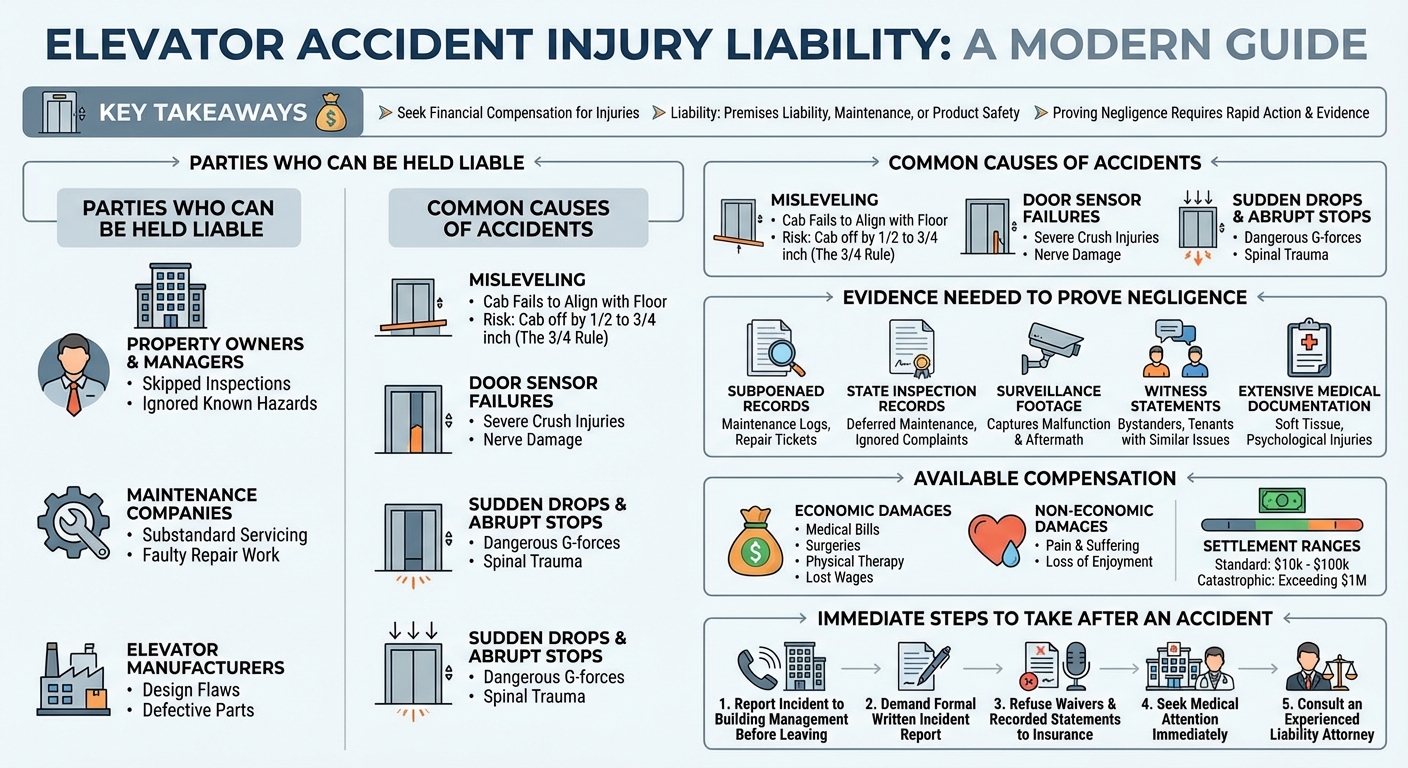
Liability for an elevator accident typically falls on the property owner, property manager, or the elevator maintenance company. If the accident was caused by poor maintenance, ignored safety violations, or defective parts, victims can pursue a premises liability or product liability claim to recover compensation for their injuries.
Elevator Accident Injury Liability: Understanding Your Legal Rights
Millions of people rely on elevators daily, trusting them to operate safely. However, when mechanical failures or poor maintenance lead to an accident, the physical and financial consequences can be devastating. Understanding elevator accident injury liability is the first step toward securing the compensation you deserve. Because these cases involve complex machinery and multiple corporate entities, determining who is legally responsible requires a thorough investigation into premises liability, maintenance contracts, and product safety laws.
Who Is Liable for an Elevator Accident?
Liability in an elevator accident is rarely straightforward. Depending on the root cause of the malfunction, one or more of the following parties may be held legally and financially responsible for your injuries.
Property Owners and Managers (Premises Liability)
Under premises liability law, property owners and building managers owe a duty of care to ensure their premises are reasonably safe for visitors and tenants. This includes conducting regular elevator inspections, addressing known hazards, and taking elevators out of service if they are malfunctioning. If a building owner ignores tenant complaints about a jerky elevator or fails to schedule legally required state inspections, they can be held fully liable for any resulting injuries.
Elevator Maintenance and Repair Companies
Most property owners do not repair their own elevators; they hire specialized third-party maintenance companies. These contractors are responsible for routine servicing, replacing worn cables, and testing safety sensors. If an elevator repair company performs substandard work, uses incorrect replacement parts, or signs off on a faulty system, they can be sued for negligence if that specific failure causes an accident.
Elevator Manufacturers (Product Liability)
Sometimes, an elevator accident occurs despite proper maintenance because of a fundamental design flaw or a defective manufacturing part. If a control board shorts out, a braking system fails, or a door sensor is inherently defective straight from the factory, the injured party can pursue a product liability claim against the elevator manufacturer or the company that fabricated the specific defective component.
Common Causes of Elevator Accidents and Injuries
Elevator accidents take many forms, each presenting unique dangers to passengers. Identifying the exact mechanism of the failure is crucial for proving liability.
Misleveling and Tripping Hazards
Misleveling occurs when an elevator cab fails to align perfectly with the building’s floor. This creates an unexpected step up or down when the doors open. Passengers who are unaware of the height difference frequently trip and fall, leading to severe broken bones, facial lacerations, and traumatic brain injuries.
Door Sensor Failures and Crush Injuries
Elevator doors are equipped with electronic sensors designed to detect obstructions and bounce back. When these sensors fail due to poor maintenance or electrical issues, the heavy doors can close forcefully on a passenger’s arm, leg, or torso. This can result in devastating crush injuries, nerve damage, and amputations.
Sudden Drops, Freefalls, and Abrupt Stops
While Hollywood often depicts elevators plummeting down shafts, modern elevators have multiple redundant braking systems. However, sudden drops of a few floors, or abrupt, violent stops caused by governor failures, are very real. The extreme G-forces generated by sudden stops can cause severe spinal cord injuries, knee trauma, and whiplash.
What is the 3 4 rule for elevators?
The 3/4 rule for elevators refers to the safety and ADA compliance standard regarding misleveling. If an elevator cab stops more than 1/2 to 3/4 of an inch above or below the building’s floor, it creates a dangerous tripping hazard. Property owners can be held liable for injuries caused by this discrepancy.
Proving Negligence in an Elevator Injury Claim
To win an elevator accident lawsuit, you must prove that the responsible party breached their duty of care and that this breach directly caused your injuries. This requires aggressive evidence gathering before the property owner or maintenance company can destroy or alter the records.
Gathering Maintenance Logs and Inspection Records
Every commercial elevator has a paper trail. Your attorney will subpoena maintenance logs, repair tickets, and state inspection records. These documents often reveal a history of ignored service calls, deferred maintenance to save money, or repeated complaints from other tenants about the exact issue that caused your injury.
Securing Surveillance Footage and Witness Statements
Video evidence is incredibly powerful in premises liability cases. Surveillance cameras inside the elevator cab or in the building lobby can capture the exact moment of the accident, proving how the malfunction occurred and the immediate aftermath. Additionally, statements from co-workers, tenants, or bystanders who witnessed the event or experienced previous issues with the same elevator can establish a pattern of negligence.
What is the hardest injury to prove?
The hardest injuries to prove in an elevator accident are soft tissue injuries, such as muscle sprains, and psychological trauma, like PTSD or claustrophobia. Because these conditions do not appear on standard X-rays or MRIs, insurance companies frequently dispute their severity, requiring extensive medical documentation and expert testimony to validate.
Compensation and Settlements for Elevator Accidents
Victims of elevator accidents are entitled to seek financial compensation to make them whole again. A successful personal injury claim should cover both your immediate economic losses and your long-term suffering.
Medical Bills, Lost Wages, and Out-of-Pocket Costs
Economic damages are the quantifiable financial losses you have suffered. This includes emergency room visits, surgeries, physical therapy, and any future medical care related to the injury. It also covers lost wages for the time you missed from work, as well as a loss of future earning capacity if your injuries leave you permanently disabled.
Is it worth suing for pain and suffering?
Yes, it is almost always worth suing for pain and suffering if you sustained significant injuries. These non-economic damages compensate you for physical agony, emotional distress, and loss of enjoyment of life. In many elevator accident claims, pain and suffering compensation significantly exceeds the total cost of your medical bills.
How much do most personal injury cases settle for?
While every case is unique, most standard personal injury cases settle for between $10,000 and $100,000. However, severe elevator accidents involving catastrophic injuries, permanent disability, or gross negligence often result in settlements or jury verdicts exceeding $1 million, depending on the liable party’s insurance policy limits and the victim’s damages.
Steps to Take Immediately After an Elevator Injury
The actions you take in the minutes and days following an elevator accident can make or break your personal injury claim. Protect your health and your legal rights by following these steps.
Report the Incident to Building Management
Before leaving the premises, notify the building manager, landlord, or security desk about the accident. Insist that they create a formal written incident report and request a copy for your records. Do not sign any waivers or give a recorded statement to their insurance company without speaking to a lawyer first.
Seek Immediate Medical Attention
Even if you feel fine due to adrenaline, see a doctor immediately. Some severe injuries, like internal bleeding or spinal trauma, may not show symptoms for hours or days. A prompt medical evaluation creates an official medical record linking your injuries directly to the elevator accident, which is vital for your claim.
Consult an Experienced Premises Liability Attorney
Elevator injury claims are highly technical and heavily defended by corporate insurance lawyers. Consult with an experienced personal injury attorney who specializes in premises liability. They will send spoliation letters to preserve evidence, hire elevator engineering experts to determine the cause of the crash, and fight to maximize your compensation.