

Table of contents
Under premises liability law, a pool owner is legally responsible for a drowning accident if their negligence caused the tragedy. To be held liable, the owner must have failed to maintain a safe environment, such as having broken fences, missing safety equipment, or failing to secure the pool from children.
Drowning Accident Liability: When is a Pool Owner Legally Responsible?
Losing a loved one in a swimming pool accident is an unimaginable tragedy. In the aftermath, families are often left wondering how the accident happened and who is to blame. Under premises liability law, pool owners have a legal duty to keep their property safe and secure. When they fail to meet this obligation, they can be held financially and legally responsible for a drowning accident.
Whether the incident occurred at a neighbor’s house, a community center, or a resort, determining drowning accident liability requires a careful investigation into the property owner’s negligence. This guide breaks down the legal framework surrounding swimming pool accidents, the duty of care owed to different types of visitors, and how families can seek justice.
Understanding Swimming Pool Liability Laws
What type of liability would a person who owns a pool have?
A person who owns a pool typically faces premises liability. This means they are legally responsible for maintaining a safe environment and warning visitors of hidden dangers. If their negligence—such as a broken gate or missing safety equipment—causes a drowning, they can be held financially liable for the victim’s damages.
Premises Liability: Invitees, Licensees, and Trespassers
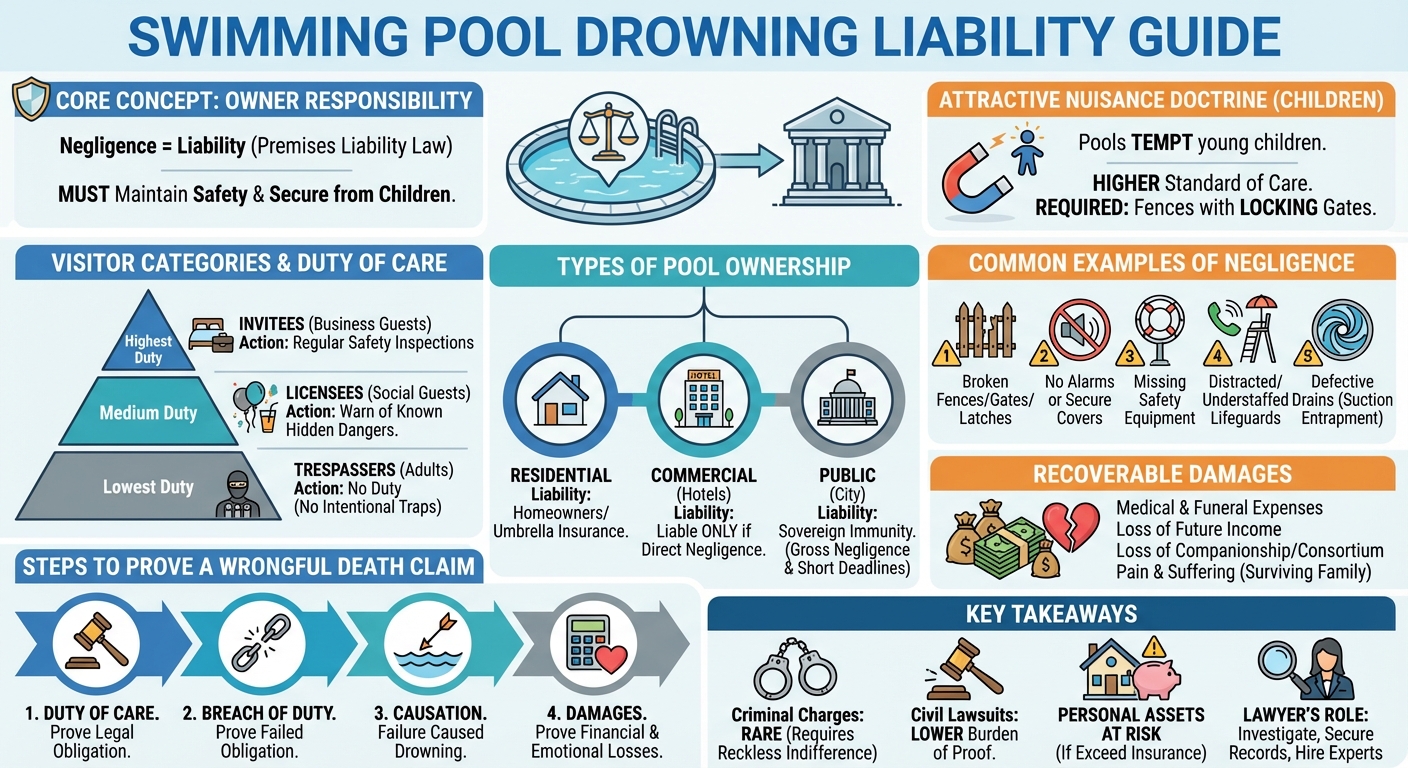
The level of legal responsibility a pool owner has depends heavily on the victim’s legal status on the property at the time of the accident. The law categorizes visitors into three distinct groups:
- Invitees: These are individuals invited onto the property for a business purpose (e.g., a hotel guest using the resort pool). Pool owners owe invitees the highest duty of care, requiring regular inspections to identify and fix hidden hazards.
- Licensees: These are social guests invited for non-commercial reasons, such as friends attending a backyard pool party. Owners must warn licensees of known dangers that are not obvious, such as a broken pool drain or a slippery deck.
- Trespassers: Generally, property owners owe no duty of care to adults who enter the property without permission. However, they cannot intentionally set traps. A major exception exists for trespassing children, governed by the attractive nuisance doctrine.
The Attractive Nuisance Doctrine: Protecting Children
Is a swimming pool an absolute liability?
No, a swimming pool is not an absolute liability. A pool owner is generally only liable if they were negligent in maintaining the pool or securing access. However, under the attractive nuisance doctrine, owners face a much higher standard of care to prevent young children from accessing the pool unsupervised.
Requirements for an Attractive Nuisance Claim
The law recognizes that young children do not fully understand the dangers of a swimming pool. Because pools are inherently tempting to children, owners must take reasonable steps to keep them out. To win a claim under the attractive nuisance doctrine, a plaintiff must typically prove:
- The pool owner knew or should have known that children were likely to trespass in the area.
- The pool presented an unreasonable risk of death or serious injury to children.
- The child, because of their youth, did not realize the risk involved in entering the pool.
- The burden of eliminating the danger (e.g., installing a fence with a locking gate) was slight compared to the risk to children.
- The owner failed to exercise reasonable care to eliminate the danger.
Private vs. Commercial Pools: How Liability Changes
Will a hotel be liable every time someone drowns in its pool?
No, a hotel will not be liable every time someone drowns in its pool. The hotel is only legally responsible if the drowning resulted from their direct negligence. This includes lacking required safety equipment, having broken gate latches, or failing to provide lifeguards when mandated by local safety laws.
Residential Pool Owners and Homeowner’s Insurance
When a drowning occurs in a private backyard pool, the homeowner’s insurance policy is usually the primary source of compensation. Most standard homeowner policies include liability coverage, but the limits may not fully cover the catastrophic damages of a wrongful death. Many pool owners carry additional umbrella insurance policies to protect their personal assets in the event of a severe accident.
Public and Municipal Pools: Sovereign Immunity Challenges
Drownings at city-owned or municipal pools introduce complex legal hurdles. Government entities are often protected by “sovereign immunity,” which shields them from certain types of lawsuits. To sue a municipality for a public pool drowning, you must typically file a specialized notice of claim within a very short timeframe (often 30 to 90 days) and prove gross negligence rather than ordinary negligence.
What happens if someone drowns in your pool?
If someone drowns in your pool, law enforcement will investigate the incident to determine if criminal negligence occurred. Simultaneously, the victim’s family may file a civil wrongful death lawsuit against you. Your homeowner’s insurance will typically handle the civil claim up to your policy’s maximum liability limits.
Immediate Legal and Financial Consequences
Following a drowning, the pool owner’s property will become an active investigation scene. Insurance adjusters will also conduct their own investigations, looking for ways to minimize the payout. If the damages exceed the homeowner’s insurance policy limits, the pool owner’s personal assets—such as savings and property—could be at risk in a civil lawsuit.
Criminal Charges vs. Civil Wrongful Death Lawsuits
It is important to distinguish between criminal and civil consequences. Criminal charges (like involuntary manslaughter) are rare and only brought by the state if the pool owner’s actions were recklessly indifferent to human life. Civil wrongful death lawsuits, on the other hand, are brought by the victim’s family. Civil cases have a lower burden of proof, requiring only a “preponderance of the evidence” to show that the owner’s negligence caused the death.
Common Examples of Pool Owner Negligence
Proving liability requires showing exactly how the pool owner failed to maintain a safe environment. Common examples of negligence include:
Lack of Proper Fencing, Alarms, and Broken Gates
Most local ordinances require residential and commercial pools to be enclosed by a fence of a specific height (usually at least 4 feet) with self-closing, self-latching gates. If a gate latch is broken, or if the owner props the gate open, they can be held liable if a child wanders in and drowns. Pool alarms and secure pool covers are also critical safety measures.
Missing Safety Equipment or Inattentive Lifeguards
Commercial pools, such as those at hotels or community centers, are often required to have accessible safety equipment like life rings and reaching poles. If lifeguards are on duty, they must be properly trained and attentive. A distracted lifeguard or an understaffed pool deck is a clear breach of the duty of care.
Defective Drains and Entrapment Hazards
Pool drains create powerful suction that can trap a swimmer underwater, leading to drowning. Under the federal Virginia Graeme Baker Pool and Spa Safety Act, all public pools must install anti-entrapment drain covers. If a private or public pool owner fails to maintain these covers, they can be held strictly liable for resulting injuries or deaths.
Filing a Wrongful Death Claim After a Pool Drowning
Proving Duty of Care, Breach, and Causation
To successfully recover compensation in a drowning lawsuit, your legal team must establish four key elements:
- Duty of Care: The owner had a legal obligation to keep the premises safe.
- Breach of Duty: The owner failed to meet that obligation (e.g., ignoring a broken fence).
- Causation: The breach directly caused the drowning accident.
- Damages: The family suffered quantifiable losses as a result of the death.
Damages Recoverable in a Drowning Lawsuit
While no amount of money can replace a loved one, a wrongful death claim can provide financial stability for the surviving family. Recoverable damages typically include:
- Medical expenses incurred prior to death (such as emergency room care or life support).
- Funeral and burial expenses.
- Loss of the deceased’s expected future income and financial support.
- Loss of consortium, companionship, and guidance.
- Pain and suffering experienced by the family.
How a Premises Liability Lawyer Can Help Your Family
Navigating drowning accident liability is incredibly complex, especially when dealing with grieving families, aggressive insurance companies, and strict legal deadlines. A skilled premises liability lawyer will conduct an independent investigation, secure maintenance records, interview witnesses, and hire aquatic safety experts to prove the pool owner’s negligence. If you have lost a loved one due to an unsafe swimming pool, securing experienced legal representation is the most critical step toward holding the responsible parties accountable and securing the justice your family deserves.