

Table of contents
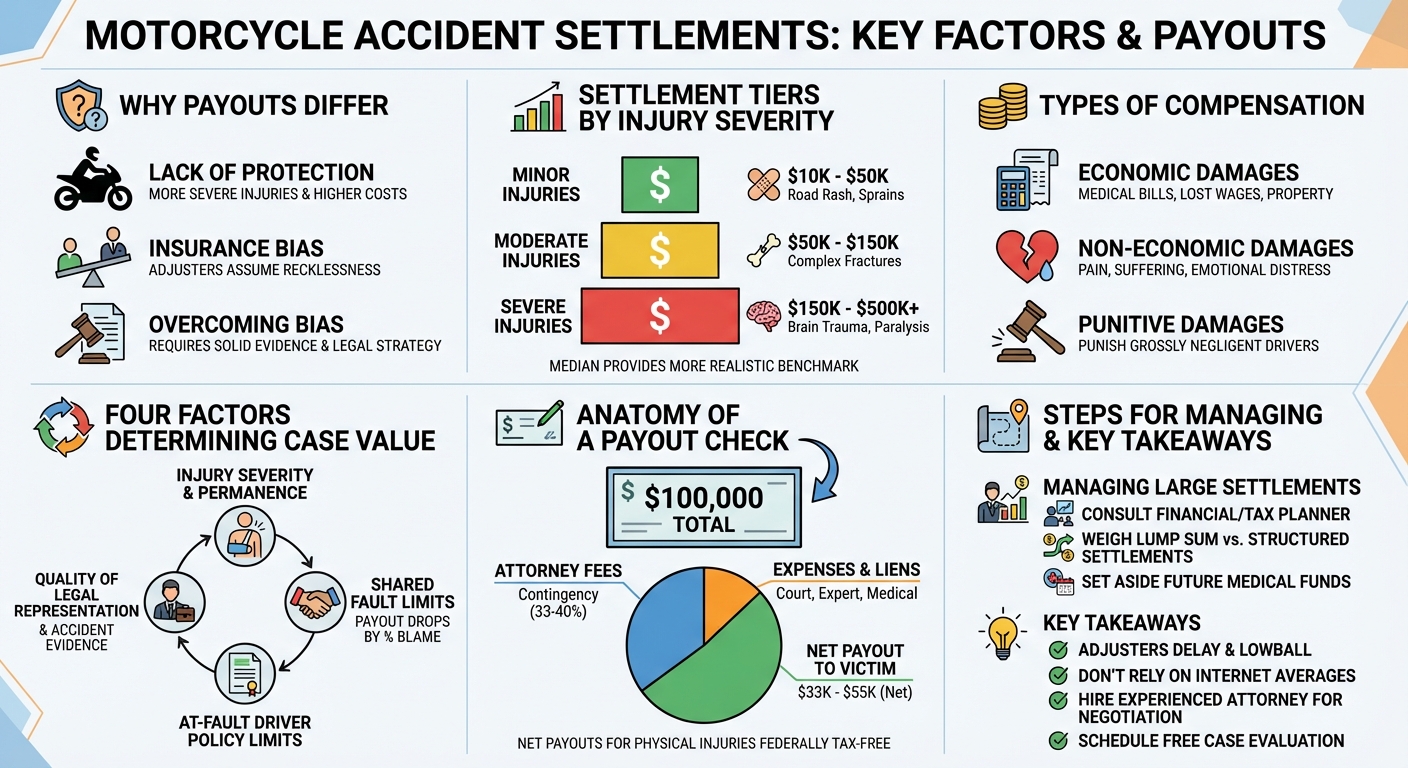
Motorcycle accident settlement amounts generally range from $10,000 to $50,000 for minor injuries. Moderate injuries average $50,000 to $150,000, while severe or catastrophic injuries frequently settle between $150,000 and $500,000.
Motorcycle Accident Settlement Amounts: Average Payouts and Value Guide
Filing a motorcycle accident claim can be a complex and overwhelming process. Because riders lack the physical protection of an enclosed vehicle, the resulting injuries and financial damages are often substantially higher than those seen in standard auto collisions.
Why Motorcycle Settlements Differ from Standard Car Accidents
Motorcycle accident settlements typically command higher payouts because the injuries are inherently more severe. Furthermore, insurance adjusters often harbor an unfair bias against motorcyclists, assuming they are reckless. Overcoming this bias requires rock-solid evidence, expert testimony, and a strategic approach to ensure the victim is not unfairly assigned fault.
How much are most motorcycle accident settlements?
Most motorcycle accident settlements range between $50,000 and $150,000 for moderate injuries, while minor injury claims typically settle for $10,000 to $50,000. Severe or catastrophic injuries frequently result in payouts exceeding $150,000 to $500,000. However, the exact amount depends entirely on your medical bills, liability, and available insurance coverage.
The National Average vs. Median Settlement Amounts
While some data suggests the national average for a motorcycle accident settlement hovers around $66,000 to $99,000, averages can be heavily skewed by a few multi-million-dollar verdicts. The median settlement—the middle point of all claims—is often a more realistic benchmark for a standard injury claim.
Tiered Settlement Breakdown
To better understand potential value, claims are generally categorized into three tiers based on injury severity:
| Injury Severity | Estimated Settlement Range | Typical Injuries |
|---|---|---|
| Minor | $10,000 – $50,000 | Minor road rash, sprains, simple fractures |
| Moderate | $50,000 – $150,000 | Complex fractures, concussions, deep lacerations |
| Severe | $150,000 – $500,000+ | Traumatic brain injuries (TBI), spinal cord damage, amputations |
Why Relying Solely on an ‘Average’ Can Be Misleading
No two accidents are identical. Relying on an internet average ignores the unique variables of your case, such as your specific wage loss, the exact limits of the at-fault driver’s insurance policy, and your long-term prognosis.
How much compensation do you get for a motorcycle accident?
The compensation you get for a motorcycle accident depends on your total damages. You can typically recover economic damages for medical bills, lost wages, and bike repairs, plus non-economic damages for pain, suffering, and emotional distress. In cases of extreme recklessness, punitive damages may also be awarded.
Calculating Economic Damages
Economic damages are the tangible, out-of-pocket expenses resulting from the crash. These include:
- Medical Bills: Emergency room visits, surgeries, physical therapy, and future medical care.
- Lost Wages: Income lost while recovering, as well as diminished future earning capacity.
- Property Damage: The cost to repair or replace your motorcycle and damaged gear.
Calculating Non-Economic Damages
Non-economic damages compensate you for the subjective, invisible toll of the accident:
- Pain and Suffering: Physical agony endured during and after the crash.
- Emotional Distress: PTSD, anxiety, and depression stemming from the trauma.
- Loss of Enjoyment of Life: Inability to participate in hobbies or daily activities you once loved.
The Role of Punitive Damages
If the at-fault driver’s actions were grossly negligent—such as driving under the influence or engaging in street racing—a judge or jury may award punitive damages. These are designed to punish the wrongdoer rather than just compensate the victim.
Key Factors That Determine Your Settlement Value
Severity and Permanence of Injuries
The most significant driver of your settlement value is the severity of your injuries. Permanent conditions like traumatic brain injuries (TBI), spinal cord paralysis, or severe road rash requiring skin grafts demand lifetime care, drastically increasing the claim’s value.
Liability and Shared Fault
Your settlement can be reduced if you are found partially at fault. Under comparative negligence laws, if you are deemed 20% responsible for the crash (e.g., speeding slightly), your final payout will be reduced by 20%.
Insurance Policy Limits
You can generally only recover up to the at-fault driver’s insurance policy limits. If your damages total $200,000 but the driver only carries $50,000 in bodily injury coverage, recovering the remaining balance may require tapping into your own Underinsured Motorist (UIM) coverage.
Quality of Evidence and Legal Representation
Cases backed by police reports, accident reconstruction experts, and witness testimony settle for more. Having an experienced attorney signals to the insurance company that you are prepared to go to trial if they fail to offer a fair settlement.
How much of a $100K settlement will I get?
From a $100,000 settlement, you will typically receive between $33,000 and $55,000 in your pocket. This final net amount is calculated after deducting standard attorney contingency fees—usually 33% to 40%—along with case expenses, court costs, and any outstanding medical liens or subrogation claims.
Understanding the Anatomy of a Payout
A settlement check does not go straight into your bank account. It is first deposited into your attorney’s trust account, where various legal and medical obligations must be satisfied before the final disbursement.
Deducting Contingency Fees and Legal Expenses
Most personal injury lawyers work on a contingency fee basis, meaning they take a percentage (usually 33.3% if settled out of court, or 40% if litigation is required). Additionally, hard costs like filing fees, expert witness fees, and medical record retrieval costs are deducted.
Resolving Medical Liens and Subrogation Claims
If your health insurance, Medicare, or a hospital paid for your crash-related care, they have a legal right (a lien) to be reimbursed from your settlement. A skilled attorney will negotiate these liens down to maximize your take-home pay.
Calculating the Final Net Amount
Once fees, expenses, and liens are paid, the remaining balance is disbursed to you. This net amount is tax-free at the federal level when it compensates for physical injuries or illness.
What to do with a $500,000 settlement?
If you receive a $500,000 settlement, you should first consult a financial planner to manage the funds effectively. Consider setting up a structured settlement for tax-free, long-term income, paying off immediate debts, and ensuring sufficient funds are reserved for future medical care related to your catastrophic injuries.
Managing Large Payouts from Catastrophic Claims
A sudden influx of half a million dollars requires careful planning. It is crucial to resist the urge to make large, impulsive purchases, as this money is meant to sustain you through ongoing medical needs and lost earning potential.
Structured Settlements vs. Lump Sum Payments
You can choose to receive your payout as a single lump sum or a structured settlement. A structured settlement provides guaranteed, tax-free periodic payments over time, which protects the principal from poor investments and ensures a steady income stream.
Consulting with Financial Planners and Tax Professionals
While physical injury settlements are generally non-taxable, any portion allocated to punitive damages or interest is subject to taxes. A certified financial planner and a CPA can help you navigate these nuances and invest your money wisely.
Ensuring Long-Term Medical Care Costs Are Covered
Before spending any settlement funds, set aside a dedicated account for future surgeries, physical therapy, or medical equipment. This ensures you will not face financial ruin if your condition worsens years down the line.
Why You Need an Experienced Attorney to Maximize Your Claim
How Insurance Companies Try to Devalue Motorcycle Claims
Insurance adjusters are trained to protect corporate profits. They will attempt to use your words against you, delay the claims process, or offer a lowball settlement before you fully understand the extent of your injuries.
The Importance of Aggressive Negotiation and Trial Readiness
An experienced motorcycle accident lawyer knows how to counter adjuster tactics. By meticulously preparing your case for trial from day one, your attorney forces the insurance company to take your claim seriously and offer maximum compensation.
Next Steps: Scheduling a Free Case Evaluation
If you or a loved one has been injured in a motorcycle crash, do not navigate the legal system alone. Contact our legal team today to schedule a free, no-obligation case evaluation and learn exactly what your claim is worth.