
Table of contents
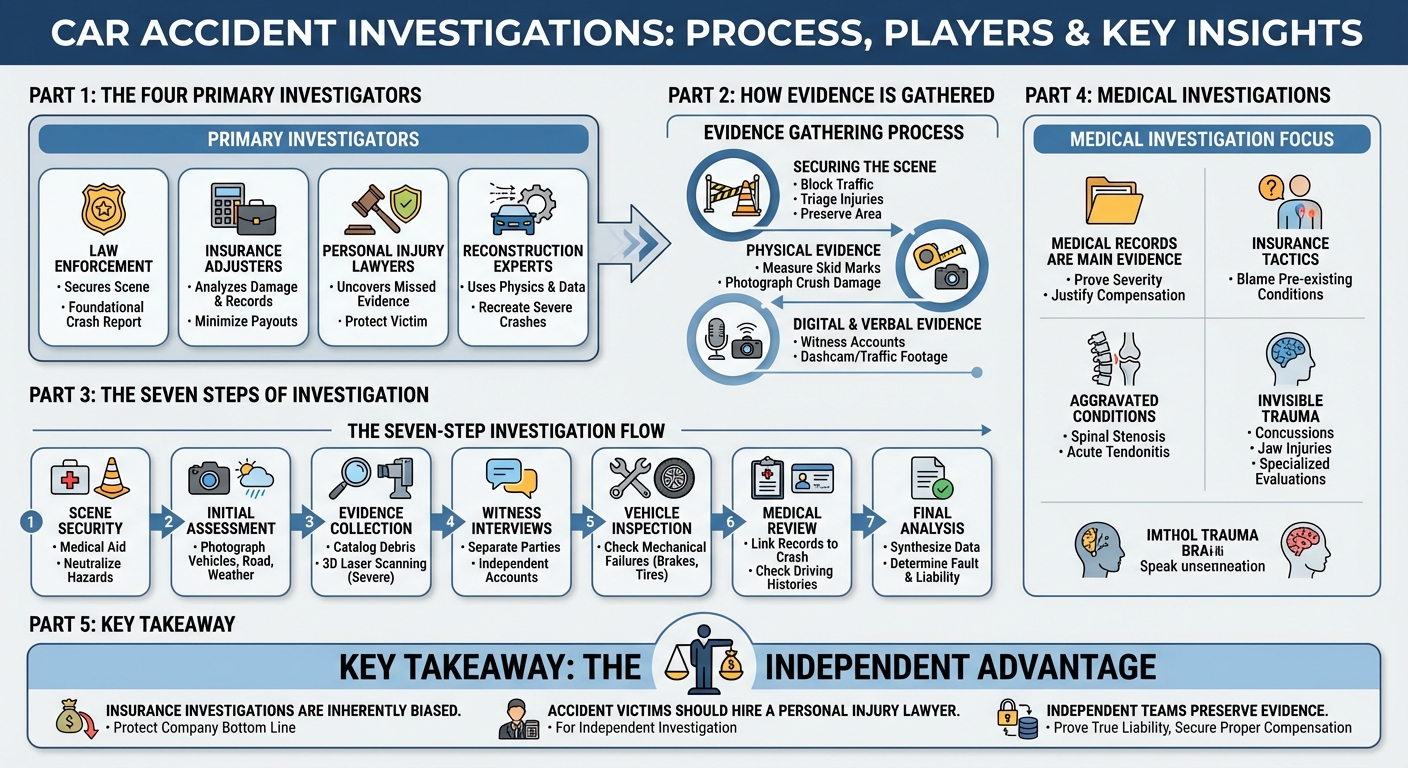
Car accidents are primarily investigated by responding law enforcement officers, such as local police or highway patrol. Subsequently, insurance company adjusters, personal injury attorneys, and specialized accident reconstruction experts conduct independent investigations to determine fault and assess damages.
Who Investigates Car Accidents? The 4 Primary Investigators
After a collision, determining exactly what happened—and who is at fault—requires a thorough examination of the facts. A car accident investigation is rarely handled by a single person. Instead, multiple parties with different objectives will scrutinize the crash.
Law Enforcement (Local Police & State Highway Patrol)
The first investigators on the scene are usually local police officers, sheriff’s deputies, or state highway patrol troopers. Their primary goal is public safety and documentation. They secure the scene, arrange for medical transport, and draft the official police crash report. This report serves as the foundational document for all subsequent investigations, detailing the date, time, weather conditions, and initial fault determinations.
Insurance Company Adjusters & Investigators
Once a claim is filed, insurance companies assign claims adjusters to investigate. It is important to remember that their objective is to minimize financial risk for the insurance company. They will review the police report, request recorded statements, assess property damage, and scrutinize medical records to determine how much compensation (if any) they are obligated to pay.
Personal Injury Lawyers & Private Investigators
Because insurance companies protect their own interests, victims often hire personal injury lawyers to conduct an independent investigation. Attorneys frequently employ private investigators to uncover evidence that law enforcement may have missed. This includes tracking down unlisted witnesses, obtaining surveillance footage from nearby businesses, and verifying the background of the at-fault driver.
Accident Reconstruction Experts & Forensic Specialists
In severe or highly contested crashes, attorneys and insurance companies bring in accident reconstruction experts. These forensic specialists use physics, engineering principles, and computer modeling to recreate the crash. They analyze vehicle data recorders (black boxes), crush damage, and skid marks to scientifically prove vehicle speeds, braking times, and the exact point of impact.
How are car crashes investigated?
Car crashes are investigated through a systematic process that begins at the scene and continues for weeks. Investigators secure the area, gather physical evidence like skid marks, collect witness statements, and analyze digital data such as dashcam footage to accurately reconstruct the event and determine liability.
Securing the Scene and Triage
The immediate priority is preventing further harm. First responders secure the perimeter with flares or cones, redirect traffic, and triage injured parties. This preserves the integrity of the scene so that evidence is not destroyed by passing vehicles or bystanders.
Gathering Physical Evidence (Skid marks, debris, vehicle damage)
Investigators meticulously document the physical aftermath of the crash. They measure skid marks to calculate vehicle speed and braking distance. They also map the distribution of debris, such as shattered glass and broken car parts, and photograph the specific crush damage on the vehicles to understand the angle and force of the impact.
Collecting Witness Statements and Digital Evidence (Dashcams, Traffic Cameras)
Eyewitness testimony provides crucial context that physical evidence alone cannot. Officers and private investigators interview drivers, passengers, and bystanders. Furthermore, modern investigations rely heavily on digital evidence. Investigators will subpoena traffic camera footage, request nearby commercial security video, and download dashcam or telematics data directly from the involved vehicles.
What are the 7 steps of accident investigation?
The 7 steps of accident investigation include securing the scene, conducting an initial assessment, collecting physical evidence, interviewing witnesses, inspecting vehicle mechanics, reviewing medical records, and performing a final analysis. This structured approach ensures all facts are documented to accurately determine fault and liability.
Step 1: Scene Security and Emergency Response
First responders arrive to provide medical aid, neutralize hazards (like leaking fuel), and block off the area to preserve the crash site for analysis.
Step 2: Initial Scene Assessment and Photography
Investigators take wide-angle and close-up photographs of the vehicles, road conditions, traffic signs, and weather elements before any vehicles are towed or debris is swept away.
Step 3: Evidence Collection and Preservation
Physical evidence, including paint transfers, tire marks, and broken components, is measured and cataloged. In fatal or catastrophic crashes, drone mapping or 3D laser scanning may be used.
Step 4: Witness Interviews and Driver Statements
Police and adjusters separate the involved parties and witnesses to get independent accounts of the crash, looking for inconsistencies or corroborating details regarding traffic signals and driver behavior.
Step 5: Vehicle and Mechanical Inspection
Mechanics or forensic engineers inspect the vehicles to rule out or confirm mechanical failures, such as blown tires, faulty brakes, or defective steering columns, which could shift liability to a manufacturer.
Step 6: Medical and Background Record Review
Investigators review the medical records of the injured parties to link the injuries directly to the crash. They also check the driving histories of the involved motorists for past infractions or suspended licenses.
Step 7: Final Analysis and Fault Determination
All collected data is synthesized. Law enforcement finalizes the crash report with citations, while insurance adjusters and attorneys use the compiled evidence to negotiate settlements or prepare for civil litigation.
The Role of Medical Investigations in Car Accidents
Why Medical Records Are Crucial Evidence
A car accident investigation isn’t limited to the roadway; it extends into the doctor’s office. Medical records are the primary evidence used to prove the severity of your injuries and justify compensation. Insurance companies will investigate your medical history to see if they can blame your pain on a pre-existing condition rather than the crash itself.
Can a car accident cause spinal stenosis?
While a car accident typically does not cause the underlying degenerative condition of spinal stenosis, the severe impact can aggravate or accelerate it. The trauma from a crash can suddenly worsen existing spinal narrowing, leading to immediate, severe pain, numbness, and mobility issues that require urgent medical treatment.
Can tendonitis be caused by a car accident?
Yes, a car accident can cause acute tendonitis. The sudden, violent force of a collision can overstretch or tear tendons in the shoulders, wrists, or knees. This sudden trauma leads to inflammation, swelling, and severe pain, requiring medical imaging and physical therapy to properly diagnose and heal.
Uncovering Invisible Trauma (TMJ and Closed Head Injuries)
Some of the most severe injuries do not show up on an initial X-ray. Medical investigations often uncover “invisible” trauma. For example, the whiplash motion of a crash can lead to debilitating TMJ (temporomandibular joint) injuries. Similarly, closed head injuries and concussions are frequently overlooked in the chaotic aftermath of a wreck, making specialized neurological and dental evaluations a critical part of a comprehensive accident investigation.
Why You Need an Independent Investigation
The Bias of Insurance Company Investigations
Relying solely on the at-fault driver’s insurance company to investigate your crash is a mistake. Insurance adjusters are trained to look for reasons to reduce your payout. They may interpret vague witness statements in their policyholder’s favor or argue that your injuries are unrelated to the collision. Their investigation is inherently biased toward protecting their bottom line.
How a Lawyer Protects Your Claim and Proves Liability
An experienced personal injury lawyer levels the playing field by launching an independent investigation. By sending preservation letters to prevent the destruction of digital evidence, hiring top-tier accident reconstructionists, and working with medical experts to document your injuries, an attorney ensures that the true cause of the accident is brought to light. This proactive approach is the most effective way to prove liability and secure the compensation you deserve.