

Table of contents
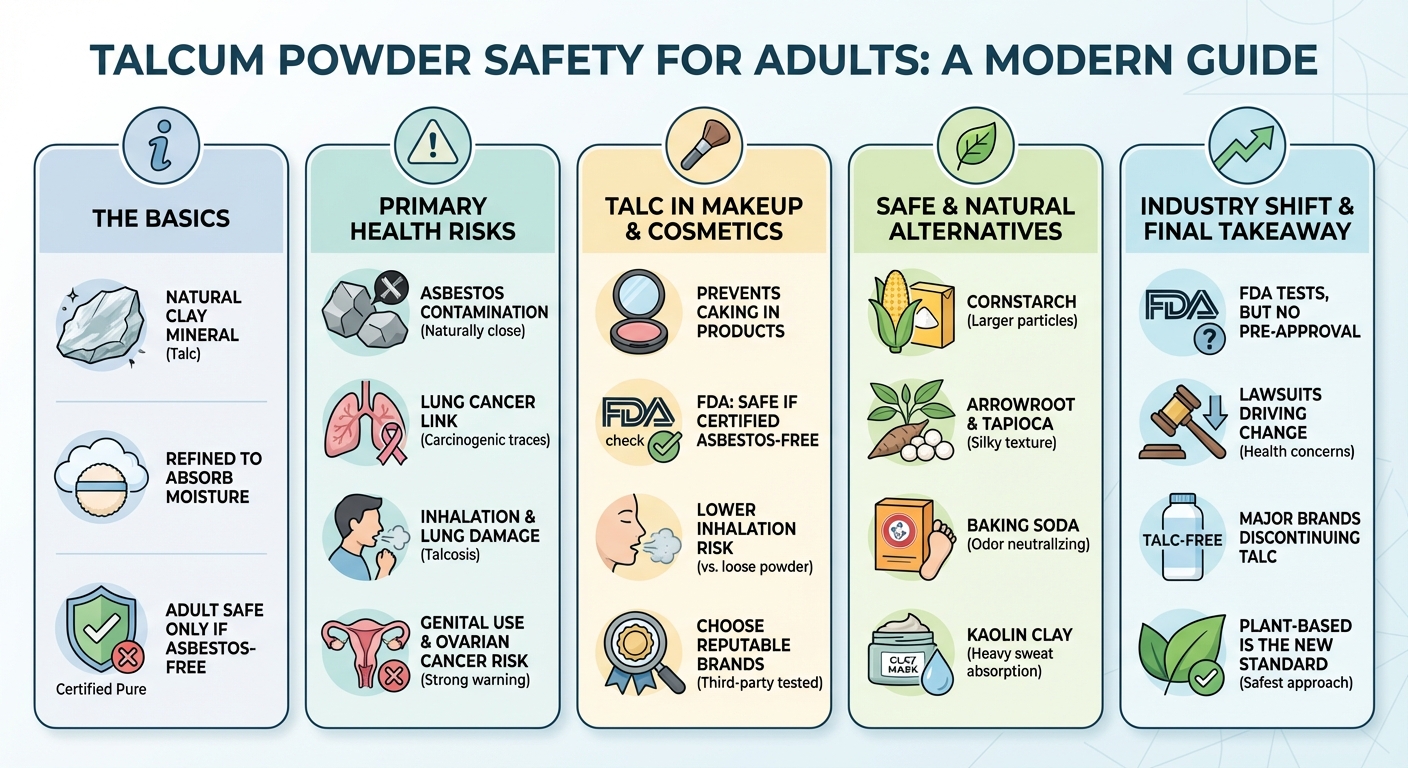
Talcum powder is generally safe for adults if it is strictly free of asbestos. However, health experts advise against using talcum powder on the genitals due to potential links to ovarian cancer. To eliminate risks associated with asbestos contamination or inhalation, many adults are switching to safer alternatives like cornstarch.
The Short Answer: Is Talcum Powder Safe for Adults?
For most adults, using cosmetic talcum powder on the body is generally considered safe only if it is completely free of asbestos. However, the medical community strongly advises against using talcum powder on the genital area due to studies suggesting a potential link to ovarian cancer.
Because talc is mined from the earth, it carries a risk of cross-contamination with asbestos, a known carcinogen. While modern cosmetic regulations require talc to be asbestos-free, the potential for contamination and the availability of safer alternatives have led many adults to stop using talc-based products entirely.
What’s the difference between talc and talcum powder?
Talc is a naturally occurring clay mineral composed of magnesium, silicon, and oxygen. It is mined directly from the earth and is the softest known mineral.
Talcum powder is the refined, manufactured consumer product made from crushed talc. During the manufacturing process, the talc is milled into a fine powder, and ingredients like fragrances or skin conditioners are often added to create the final product used for absorbing moisture and reducing friction.
The Main Health Risks Associated with Talcum Powder
When evaluating the safety of talcum powder, medical professionals and researchers focus on two primary health risks: carcinogenic contamination and respiratory irritation.
Asbestos Contamination: The Root Cause of Cancer Concerns
Talc and asbestos are both naturally occurring silicate minerals that frequently form close together in the earth. If mining sites are not carefully selected and tested, talc can become contaminated with asbestos fibers.
- The Danger: Asbestos is classified as a Group 1 carcinogen by the World Health Organization (WHO).
- The Exposure: Even trace amounts of asbestos in consumer powder can be inhaled or absorbed over years of daily use, potentially leading to mesothelioma or lung cancer.
Inhalation Risks and Respiratory Issues (Talcosis)
Because talcum powder is made of microscopic airborne particles, it is easily inhaled during routine application. Continuous inhalation of these fine particles can irritate the lungs. Over time, chronic exposure can lead to a condition known as talcosis, a form of pulmonary fibrosis that causes coughing, difficulty breathing, and permanent lung damage.
Is talcum powder safe for private parts?
No, medical experts and major health organizations advise against using talcum powder on private parts. The International Agency for Research on Cancer (IARC) classifies the perineal (genital) use of talc-based body powder as “possibly carcinogenic to humans.” Long-term use in this area has been linked in several epidemiological studies to an increased risk of ovarian cancer, as the powder particles may travel through the reproductive system.
Is Talc in Makeup and Cosmetics Safe?
Talc is widely used in cosmetics—such as blush, eyeshadow, and foundation—to absorb moisture, prevent caking, and create a smooth texture. The FDA considers talc in cosmetics safe, provided it is strictly asbestos-free.
Because cosmetics are applied in small amounts, the inhalation risk is significantly lower than with loose body powders. However, consumers should purchase cosmetics from reputable brands that conduct rigorous, third-party asbestos testing on their raw talc supplies.
What is the safest talcum powder to use?
The safest talcum powder to use is one that is explicitly certified and third-party tested to be 100% asbestos-free. However, because testing cannot guarantee every single bottle is perfectly pure, many dermatologists and oncologists suggest that the absolute safest approach is to avoid talc entirely and switch to a talc-free, plant-based alternative like cornstarch.
What is a good alternative to talcum powder?
If you want to keep your skin dry and chafe-free without the health risks associated with talc, several highly effective, natural alternatives are available.
Cornstarch-Based Powders
Cornstarch is the most popular talc alternative. It is highly absorbent, widely available, and completely safe. Because cornstarch particles are slightly larger than talc particles, they also pose a much lower inhalation risk.
Arrowroot Powder and Tapioca Starch
Derived from tropical plants, arrowroot and tapioca starches offer a silky, lightweight texture that closely mimics the feel of traditional baby powder. They are excellent for sensitive skin and provide natural moisture absorption without clogging pores.
Baking Soda and Kaolin Clay
- Baking Soda: Naturally neutralizes odor-causing bacteria, making it ideal for underarms or feet.
- Kaolin Clay: A gentle cosmetic clay that absorbs heavy moisture and sweat, perfect for high-friction areas.
FDA Regulations and the Future of Talc Products
In the United States, the FDA does not legally require cosmetic products to be approved before they go on the market. However, the FDA does actively monitor talc-containing cosmetics and conducts periodic testing to check for asbestos contamination.
Due to mounting consumer pressure, thousands of lawsuits, and shifting public perception, the personal care industry is rapidly moving away from talc. Major manufacturers, including Johnson & Johnson, have discontinued the global sale of talc-based baby powder, transitioning entirely to cornstarch-based formulas. Moving forward, talc-free powders are expected to become the universal standard for adult and infant care alike.