

Table of contents
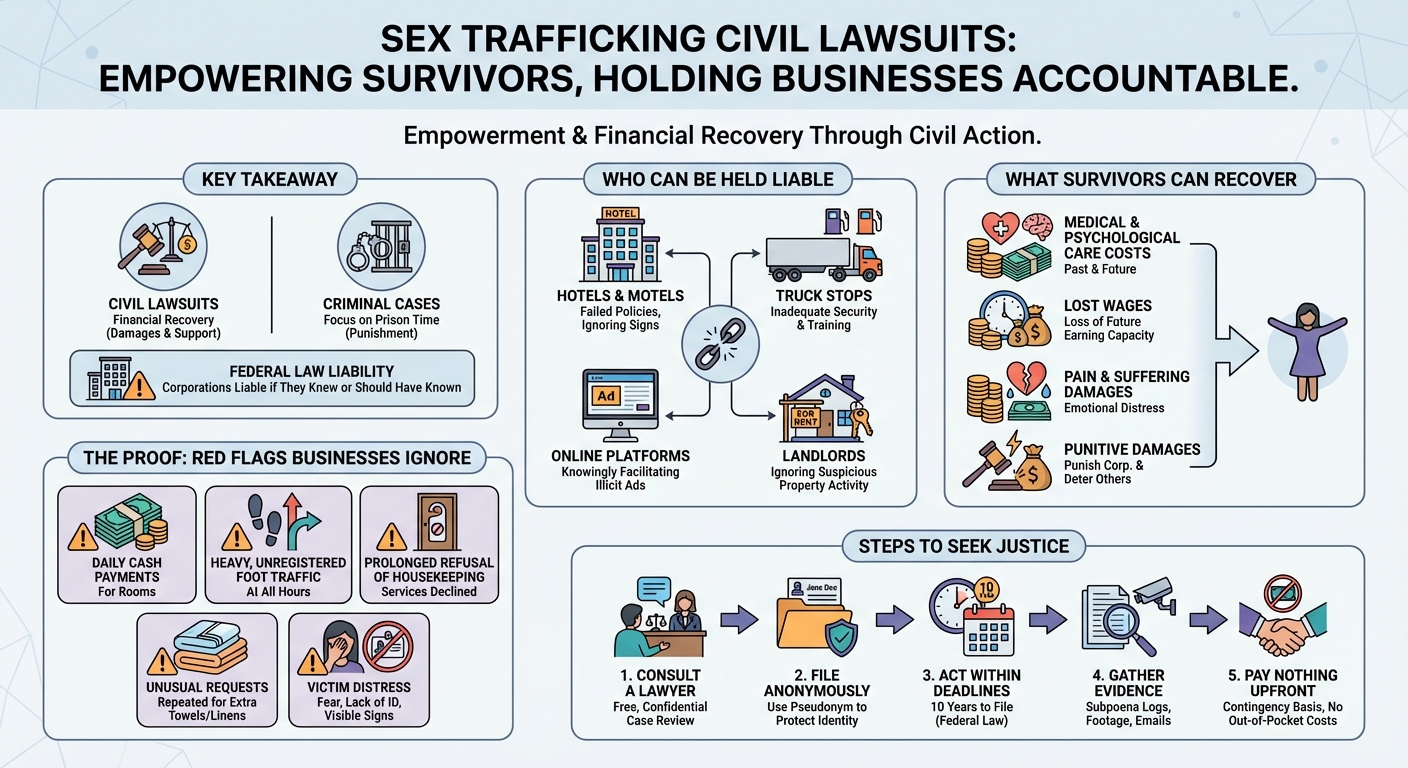
A sex trafficking lawsuit is a civil claim filed by survivors against third-party businesses—such as hotels, truck stops, or online platforms—that knew about or financially benefited from the exploitation. Under the Trafficking Victims Protection Reauthorization Act (TVPRA), victims can sue these complicit corporations for significant financial compensation.
Sex Trafficking Lawsuits: Holding Complicit Businesses Accountable
For decades, the justice system focused almost entirely on prosecuting individual traffickers. While criminal convictions are vital, they rarely provide survivors with the resources they need to rebuild their lives. Today, a powerful legal avenue exists: the sex trafficking civil lawsuit.
Survivors are now stepping forward to hold complicit third-party businesses accountable. When corporations—such as national hotel chains, truck stops, and online platforms—turn a blind eye to exploitation occurring on their premises to protect their profits, they can be held legally and financially responsible.
What is a Sex Trafficking Civil Lawsuit?
A sex trafficking civil lawsuit is a legal claim filed by a survivor against the individuals or businesses that facilitated, ignored, or profited from their abuse. Unlike criminal trials, which seek to put perpetrators in prison, civil lawsuits seek financial compensation for the victim.
Criminal vs. Civil Cases: Understanding the Difference
| Feature | Criminal Case | Civil Lawsuit |
|---|---|---|
| Objective | Punish the trafficker (prison time, fines). | Compensate the survivor (financial recovery). |
| Filed By | State or Federal Prosecutors (DOJ). | The survivor (with the help of a private attorney). |
| Burden of Proof | Beyond a reasonable doubt. | Preponderance of the evidence (more likely than not). |
| Target | The trafficker or criminal enterprise. | Complicit businesses (hotels, platforms, landlords). |
The Role of the Trafficking Victims Protection Reauthorization Act (TVPRA)
The cornerstone of these civil claims is the federal Trafficking Victims Protection Reauthorization Act (TVPRA). Specifically, 18 U.S.C. § 1595 allows survivors to sue anyone who “knowingly benefits, financially or by receiving anything of value” from a venture that they knew, or should have known, engaged in sex trafficking. This “should have known” standard is critical—it means a hotel cannot simply claim ignorance if obvious red flags were present.
Who Can Be Sued in a Sex Trafficking Lawsuit?
Under the TVPRA, liability extends far beyond the trafficker. Any entity that facilitated the abuse and profited from it can be named as a defendant.
Hotels, Motels, and the Hospitality Industry
Hotels and motels are the most common venues for sex trafficking. Lawsuits frequently target both the local franchise owners and the national corporate franchisors. Claims allege that these brands failed to implement anti-trafficking policies, ignored obvious signs of abuse, and prioritized room rental revenue over guest safety.
Truck Stops and Travel Plazas
Because of their transient nature, isolated parking lots, and 24-hour operations, truck stops are frequent sites for commercial sexual exploitation. Operators who fail to provide adequate security, lighting, or staff training can be held liable for trafficking that occurs on their property.
Online Platforms and Social Media Networks
Traffickers heavily rely on the internet to recruit victims and advertise illicit services. While platforms have historically hidden behind Section 230 of the Communications Decency Act, recent legal precedents and specific TVPRA provisions are increasingly allowing survivors to sue websites and apps that knowingly facilitate trafficking.
Landlords and Property Management Companies
Property owners who lease space to illicit massage parlors or residential brothels can also face civil liability. If a landlord receives complaints about excessive foot traffic or suspicious activity but continues to collect rent without investigating, they may be considered complicit.
Recent Sex Trafficking Lawsuit Updates and Settlements
The landscape of sex trafficking litigation is evolving rapidly, with courts increasingly ruling in favor of survivors.
Major Hotel Industry Lawsuits (Motel 6, Wyndham, Red Roof Inn)
Since 2019, a massive wave of litigation has hit the hospitality sector. Survivors have filed lawsuits in federal and state courts against major brands like Motel 6, Wyndham Hotels, and Red Roof Inn. These lawsuits allege systemic failures across the franchise networks, accusing corporate entities of knowing their properties were being used as safe havens for traffickers but failing to intervene.
Tech and Platform Settlements (The DOJ Backpage Remission)
In one of the largest compensation processes to date, the U.S. Department of Justice announced a remission process to compensate victims trafficked through Backpage.com. The platform was seized and shut down after it was proven to have facilitated the exploitation of thousands of women and children, setting a precedent for platform accountability.
EEOC Actions on Behalf of Trafficking Victims
The Equal Employment Opportunity Commission (EEOC) has also stepped in, filing lawsuits against companies for severe workplace discrimination and labor trafficking, which often overlaps with sexual exploitation. Cases like EEOC v. Global Horizons highlight the federal government’s commitment to penalizing corporate entities that exploit vulnerable populations.
Proving Liability: How Did the Business Know?
To win a TVPRA civil lawsuit against a business, your legal team must prove that the business knew or should have known about the trafficking. This is typically established by demonstrating that staff ignored obvious warning signs.
Common Red Flags Ignored by Hotel Staff
- Payment Methods: Paying for rooms in cash on a day-to-day basis.
- Excessive Foot Traffic: Multiple unregistered visitors entering and leaving a single room at all hours.
- Refusal of Services: Guests who consistently refuse housekeeping or room cleaning for extended periods.
- Unusual Requests: Constant requests for extra towels, linens, or room keys.
- Visible Distress: Individuals who appear malnourished, fearful, or lack control over their own identification and money.
Financial Benefiting from Trafficking Operations
Liability requires a financial benefit. For a hotel, this is easily proven: the trafficker paid for the room. The hotel may also have profited from vending machine sales, ATM fees, or Wi-Fi charges used by the trafficker to post online advertisements.
Failure to Train Employees on Trafficking Signs
Many lawsuits hinge on a corporation’s failure to train its workforce. If a national hotel chain lacks a mandatory, comprehensive anti-trafficking training program for its front desk staff and housekeeping, it can be argued that the corporation was negligent in its duty to prevent crime on its premises.
Compensation Available for Human Trafficking Survivors
A civil lawsuit aims to make the survivor “whole” again, providing the financial resources necessary for long-term recovery.
Medical and Psychological Treatment Costs
Survivors often require extensive medical care, including treatment for physical injuries, sexually transmitted infections, and long-term psychological therapy for PTSD, anxiety, and depression. Lawsuits seek to cover all past and future medical expenses.
Lost Wages and Future Earning Capacity
Victims are entitled to compensation for the income they were forced to generate for their trafficker, as well as the loss of legitimate earning capacity due to the trauma and disruption of their lives.
Pain, Suffering, and Emotional Distress
This covers the severe emotional and physical agony endured during the trafficking experience. In many cases, these non-economic damages make up the largest portion of a settlement.
Punitive Damages Against Complicit Corporations
When a corporation’s conduct is found to be particularly egregious or willfully blind, courts may award punitive damages. These are designed not just to compensate the victim, but to punish the business and deter other companies from prioritizing profits over human lives.
How to File a Sex Trafficking Lawsuit Safely
Taking legal action can feel intimidating, but the civil justice system has specific mechanisms designed to protect survivors.
Protecting Your Identity: Filing as a ‘Jane Doe’
You do not have to expose your identity to the public to seek justice. Courts routinely allow survivors of sex trafficking to file their lawsuits under a pseudonym, such as “Jane Doe” or “John Doe.” This keeps your real name out of public court records and media reports.
Statute of Limitations: How Long Do You Have to File?
Under the federal TVPRA, survivors generally have 10 years from the date the trafficking occurred (or 10 years from the date they turn 18, if they were a minor) to file a civil lawsuit. However, state laws vary, and some states have recently passed “lookback windows” that temporarily eliminate the statute of limitations for abuse claims. It is vital to consult an attorney quickly to protect your rights.
The Investigation and Discovery Process
Once a lawsuit is filed, your legal team will enter the discovery phase. This involves subpoenaing the business for evidence they would rather keep hidden, such as:
- Guest registries and payment logs.
- Internal emails between management regarding suspicious activity.
- Security camera footage.
- Employee training manuals (or the lack thereof).
Why Choose Our Firm for Your Sex Trafficking Claim
Holding powerful corporations accountable requires a legal team with specific experience in TVPRA litigation and a trauma-informed approach to client care.
Free, 100% Confidential Consultations
We provide a safe, secure environment to discuss your story. Your initial consultation is completely free and strictly confidential, even if you decide not to proceed with a lawsuit.
No Upfront Costs (Contingency Fee Basis)
We believe financial barriers should never prevent a survivor from seeking justice. We handle sex trafficking lawsuits on a contingency fee basis. This means you pay zero out-of-pocket costs, and we only collect a legal fee if we successfully secure a settlement or verdict on your behalf.