

Table of contents
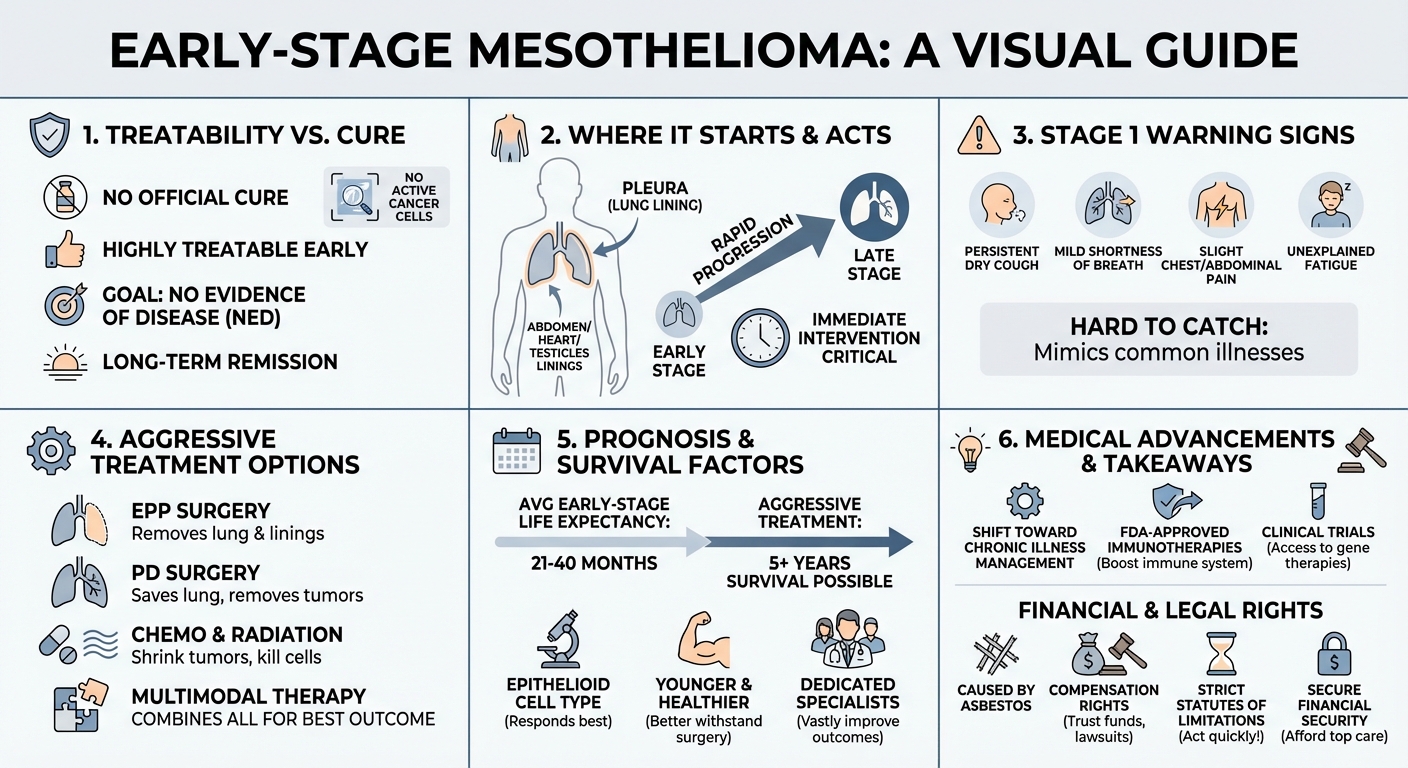
Currently, there is no official cure for mesothelioma, even if caught early. However, early-stage mesothelioma is highly treatable. When diagnosed in Stage 1, doctors can use aggressive treatments like surgery, chemotherapy, and radiation to remove visible tumors, often leading to long-term remission known as ‘No Evidence of Disease’ (NED).
Can Mesothelioma Be Cured If Caught Early?
A mesothelioma diagnosis is overwhelming, and the first question most patients ask is whether the disease can be cured. When caught in its earliest stages, the treatment options and overall prognosis improve dramatically, offering hope for long-term survival.
The Short Answer: No Official Cure, But High Treatability
Currently, there is no official, definitive cure for mesothelioma, even if it is caught early. However, early-stage mesothelioma (Stage 1 or Stage 2) is highly treatable. Because the cancer has not yet spread extensively to lymph nodes or distant organs, doctors can utilize aggressive, life-extending therapies. For many patients, these treatments successfully remove all visible signs of the cancer.
Understanding ‘No Evidence of Disease’ (NED) vs. Cured
In the oncology community, doctors rarely use the word “cured” for mesothelioma because microscopic cancer cells can remain and potentially cause a recurrence. Instead, the goal of early-stage treatment is to achieve No Evidence of Disease (NED) or long-term remission.
| Status | What It Means |
|---|---|
| Cured | The cancer is completely eradicated from the body and will never return. (Rare for mesothelioma). |
| NED / Remission | Scans and tests show no visible tumors or active cancer cells. The patient can live symptom-free for years. |
Understanding Early-Stage Mesothelioma
Early detection is the most critical factor in fighting this aggressive disease. Understanding how the cancer behaves in its infancy can help patients make informed treatment decisions.
Where does mesothelioma cancer usually start?
Mesothelioma cancer usually starts in the protective linings of the body’s internal organs. The most common starting point is the pleura, which is the lining of the lungs. It can also begin in the peritoneum (abdominal lining), the pericardium (heart lining), or the tunica vaginalis (testicular lining).
How quickly does mesothelioma progress?
Mesothelioma progresses very quickly once symptoms finally appear. It is an aggressive cancer that can advance from early stages to late stages in just a few months. Because of this rapid spread, immediate medical intervention and aggressive treatment are critical for extending a patient’s life expectancy.
Symptoms to Watch for in Stage 1
Stage 1 mesothelioma is notoriously difficult to diagnose because its symptoms mimic common, less severe illnesses. Early warning signs include:
- A persistent, dry cough
- Mild shortness of breath during physical activity
- Slight chest or abdominal pain
- Unexplained fatigue
Aggressive Treatment Options for Early Detection
If you are diagnosed early, you may be a candidate for “curative-intent” treatments. These are aggressive procedures designed to remove as much of the cancer as possible.
Curative-Intent Surgery: EPP and P/D Procedures
For pleural mesothelioma, surgeons typically rely on two major operations:
- Extrapleural Pneumonectomy (EPP): The removal of the affected lung, the pleural lining, the diaphragm, and parts of the heart lining.
- Pleurectomy with Decortication (P/D): A lung-sparing surgery that removes the pleural lining and any visible tumor masses while leaving the lung intact.
Targeted Radiation and Chemotherapy
Surgery alone is rarely enough. Doctors often use chemotherapy and radiation either before surgery (neoadjuvant) to shrink tumors, or after surgery (adjuvant) to kill off any remaining microscopic cancer cells.
Multimodal Therapy: Combining Treatments for the Best Outcome
The gold standard for early-stage mesothelioma is multimodal therapy. By combining surgery, chemotherapy, and radiation, specialists can attack the cancer from multiple angles. This approach yields the highest rates of long-term remission and survival.
Life Expectancy and Long-Term Remission
Catching mesothelioma early fundamentally changes a patient’s outlook.
What is the prognosis for early stage mesothelioma?
The prognosis for early-stage mesothelioma is the most favorable, with average life expectancies ranging from 21 to 40 months. Many patients who are healthy enough to undergo aggressive multimodal treatments—like surgery and chemotherapy—can achieve long-term remission, sometimes surviving five years or more.
Factors That Improve Your Survival Rate
Beyond early detection, several factors can positively impact your prognosis:
- Cell Type: Epithelioid mesothelioma cells respond better to treatment than sarcomatoid cells.
- Overall Health: Younger, healthier patients are better equipped to withstand aggressive surgeries.
- Specialist Care: Being treated by a dedicated mesothelioma specialist significantly improves outcomes.
The Future of Mesothelioma Research
The medical landscape for mesothelioma is evolving rapidly, offering new hope to newly diagnosed patients.
How close are we to a cure for mesothelioma?
While a definitive cure does not yet exist, researchers are closer than ever. Breakthroughs in FDA-approved immunotherapy, targeted gene therapies, and ongoing clinical trials are significantly extending survival rates. These advancements are slowly helping doctors manage mesothelioma more like a chronic illness rather than an immediate terminal diagnosis.
Promising Immunotherapy and Clinical Trials
Treatments like Opdivo (nivolumab) and Yervoy (ipilimumab) have been approved for mesothelioma, helping the patient’s own immune system identify and destroy cancer cells. Participating in clinical trials can also grant early-stage patients access to cutting-edge therapies before they are widely available.
Affording Early-Stage Mesothelioma Treatment
Accessing the best medical care is crucial, but it comes with significant financial challenges.
The High Cost of Curative-Intent Surgeries
Multimodal therapy, extended hospital stays, and specialized medications can cost hundreds of thousands of dollars. Even with excellent health insurance, out-of-pocket costs, travel expenses, and lost wages can quickly drain a family’s savings.
Securing Compensation to Access Top Specialists
Because mesothelioma is almost exclusively caused by asbestos exposure, patients have legal rights to compensation. Filing a claim through asbestos trust funds or pursuing a mesothelioma lawsuit can provide the financial resources needed to afford top-tier care at facilities like MD Anderson Cancer Center in Houston.
Why Acting Quickly Protects Both Your Health and Your Legal Rights
Just as early medical intervention is vital for your health, early legal action is vital for your financial security. Statutes of limitations restrict the amount of time you have to file a claim after a diagnosis. Consulting with a specialized mesothelioma lawyer ensures your family is financially protected while you focus entirely on your treatment and recovery.