

Table of contents
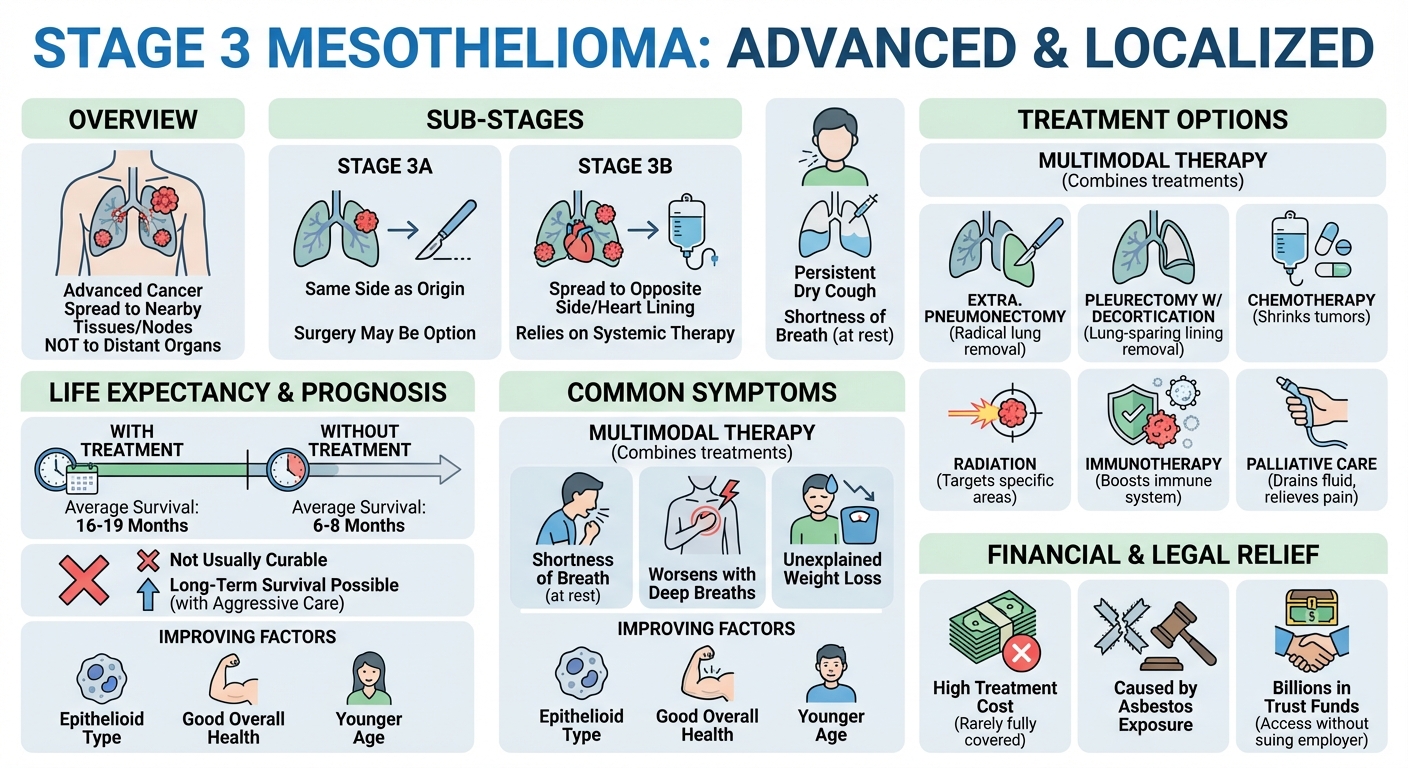
Stage 3 mesothelioma is an advanced cancer where tumors have spread from the original lining to nearby tissues, organs, and lymph nodes. The average life expectancy is 16 to 19 months. While not typically curable, aggressive treatments like surgery, chemotherapy, and immunotherapy can significantly extend survival and improve quality of life.
What is Stage 3 Mesothelioma?
Stage 3 mesothelioma is an advanced phase of asbestos-related cancer. At this point, the disease is no longer localized to the area where it first developed. While it has not yet spread to distant organs, it has advanced enough to make treatment more complex.
Defining Stage 3: Tumor Spread and Lymph Node Involvement
In stage 3, mesothelioma tumors have grown beyond the original mesothelial lining (such as the pleura around the lungs or the peritoneum around the abdomen). The cancer has typically invaded nearby tissues, chest walls, or the diaphragm. A defining characteristic of stage 3 is the involvement of nearby lymph nodes, which act as a gateway for the cancer to spread further into the lymphatic system.
Stage 3A vs. Stage 3B Pleural Mesothelioma
Doctors often use the TNM (Tumor, Node, Metastasis) staging system to further divide stage 3 pleural mesothelioma into two subcategories:
- Stage 3A: The cancer has spread to nearby tissues and lymph nodes on the same side of the body where the tumor originated. Surgery may still be a viable option for some patients.
- Stage 3B: The tumors have spread more extensively into the chest wall, heart lining, or lymph nodes on the opposite side of the chest. Surgery is less likely to be recommended, and treatment focuses heavily on systemic therapies like chemotherapy.
Stage 3 Mesothelioma Life Expectancy and Prognosis
A stage 3 diagnosis brings significant changes to a patient’s prognosis, but statistics are only averages. Individual outcomes vary widely based on health, age, and treatment response.
Average Survival Rates for Stage 3 Patients
Without treatment, the median life expectancy for stage 3 mesothelioma is roughly 6 to 8 months. However, with modern medical interventions, the average life expectancy increases to between 16 and 19 months. A small percentage of patients who respond exceptionally well to multimodal treatments can survive for several years.
How long do stage 3 cancer patients live?
Stage 3 mesothelioma patients live an average of 16 to 19 months after diagnosis. However, life expectancy varies based on cell type, patient age, and overall health. Patients who undergo aggressive multimodal treatments, such as surgery combined with chemotherapy or immunotherapy, often extend their survival significantly beyond this average.
Can you survive stage 3 mesothelioma?
While stage 3 mesothelioma is generally not considered curable, many patients survive for years with the right treatment plan. Long-term survival is possible for individuals who respond well to aggressive therapies like surgery and immunotherapy. Some patients have lived five years or more by participating in cutting-edge clinical trials.
Factors That Improve Your Prognosis
Several factors can positively influence a stage 3 prognosis:
- Cell Type: Epithelioid cells respond better to treatment than sarcomatoid or biphasic cells.
- Patient Age and Health: Younger, healthier patients can withstand more aggressive surgical treatments.
- Treatment Plan: Access to a specialized mesothelioma cancer center significantly improves survival odds.
Common Symptoms of Stage 3 Mesothelioma
Because the tumors have grown larger and spread to nearby tissues, stage 3 symptoms are much more pronounced than in earlier stages.
Respiratory Issues and Chest Pain
For pleural mesothelioma, the expansion of tumors against the lungs and chest wall causes severe discomfort. Patients frequently experience a persistent, dry cough, shortness of breath (dyspnea) even while resting, and sharp chest pain that worsens with deep breathing.
Fatigue, Weight Loss, and Fluid Buildup (Effusions)
Systemic symptoms become obvious in stage 3. Patients often suffer from extreme fatigue, night sweats, and unexplained weight loss. Additionally, fluid buildup in the chest (pleural effusion) or abdomen (peritoneal ascites) is common, causing painful swelling and further restricting breathing or digestion.
Treatment Options for Stage 3 Mesothelioma
Treating stage 3 mesothelioma requires a highly coordinated, aggressive approach. The goal is to extend life expectancy while maintaining the best possible quality of life.
Multimodal Therapy: Combining Treatments for Better Outcomes
The most effective strategy is multimodal therapy, which combines two or more treatments. A standard approach might involve shrinking the tumor with chemotherapy, removing as much of the cancer as possible with surgery, and following up with radiation to kill remaining microscopic cancer cells.
Surgical Options: Extrapleural Pneumonectomy (EPP) and Pleurectomy with Decortication (P/D)
If the patient is in good health and the cancer is deemed resectable (removable), surgeons may perform:
- Extrapleural Pneumonectomy (EPP): A radical surgery that removes the affected lung, the pleural lining, the diaphragm, and parts of the heart lining.
- Pleurectomy with Decortication (P/D): A lung-sparing surgery that removes the pleural lining and any visible tumors while leaving the lung intact. This is often preferred for stage 3 patients to preserve respiratory function.
Chemotherapy and Radiation
Chemotherapy is a cornerstone of stage 3 treatment, often utilizing a combination of Alimta (pemetrexed) and cisplatin. It can be administered before surgery to shrink tumors or after to prevent recurrence. Radiation therapy is frequently used to target specific areas of chest pain or to prevent tumors from growing into surgical incision sites.
Emerging Immunotherapy Treatments
Immunotherapy has revolutionized stage 3 treatment, especially for patients who cannot undergo surgery. Drugs like Opdivo (nivolumab) and Yervoy (ipilimumab) boost the patient’s immune system to recognize and attack mesothelioma cells, significantly extending survival for many advanced-stage patients.
Palliative Care to Manage Symptoms
Palliative care is integrated into the treatment plan to relieve pain and discomfort. Procedures like a thoracentesis (draining fluid from the chest) or a pleurodesis (sealing the lung lining to prevent fluid buildup) can dramatically improve a patient’s daily comfort and ability to breathe.
Understanding Mesothelioma Mortality and Severity
A stage 3 diagnosis naturally brings up difficult questions about mortality and the severity of the disease.
What stage of mesothelioma do people die in?
Patients can pass away at any stage due to complications, but most mesothelioma fatalities occur in stage 4. By the final stage, the cancer has metastasized to distant organs, severely compromising respiratory and bodily functions, making palliative care the primary focus to ensure comfort at the end of life.
Is mesothelioma the deadliest cancer?
Mesothelioma is one of the deadliest and most aggressive cancers, but it is not the single deadliest. Pancreatic cancer and glioblastoma typically have lower survival rates. However, mesothelioma’s long latency period and resistance to many standard treatments make it exceptionally challenging to cure, resulting in a generally poor prognosis.
Affording Stage 3 Treatment: Your Legal and Financial Options
The physical and emotional toll of stage 3 mesothelioma is compounded by the staggering cost of specialized medical care.
Why Stage 3 Treatment Costs Require Financial Assistance
Multimodal therapies, extended hospital stays, travel to specialist centers, and cutting-edge immunotherapy drugs can cost hundreds of thousands of dollars. Health insurance rarely covers the entirety of these expenses, leaving families facing significant out-of-pocket costs during an already difficult time.
Accessing Asbestos Trust Funds and Compensation
Because mesothelioma is almost exclusively caused by asbestos exposure, patients have unique avenues for financial relief. Manufacturers of asbestos products set up billions of dollars in trust funds to compensate victims. Accessing these trust funds, or pursuing a legal claim, can provide the necessary resources to afford life-extending treatments and secure your family’s financial future without suing your former employer directly.