

Table of contents
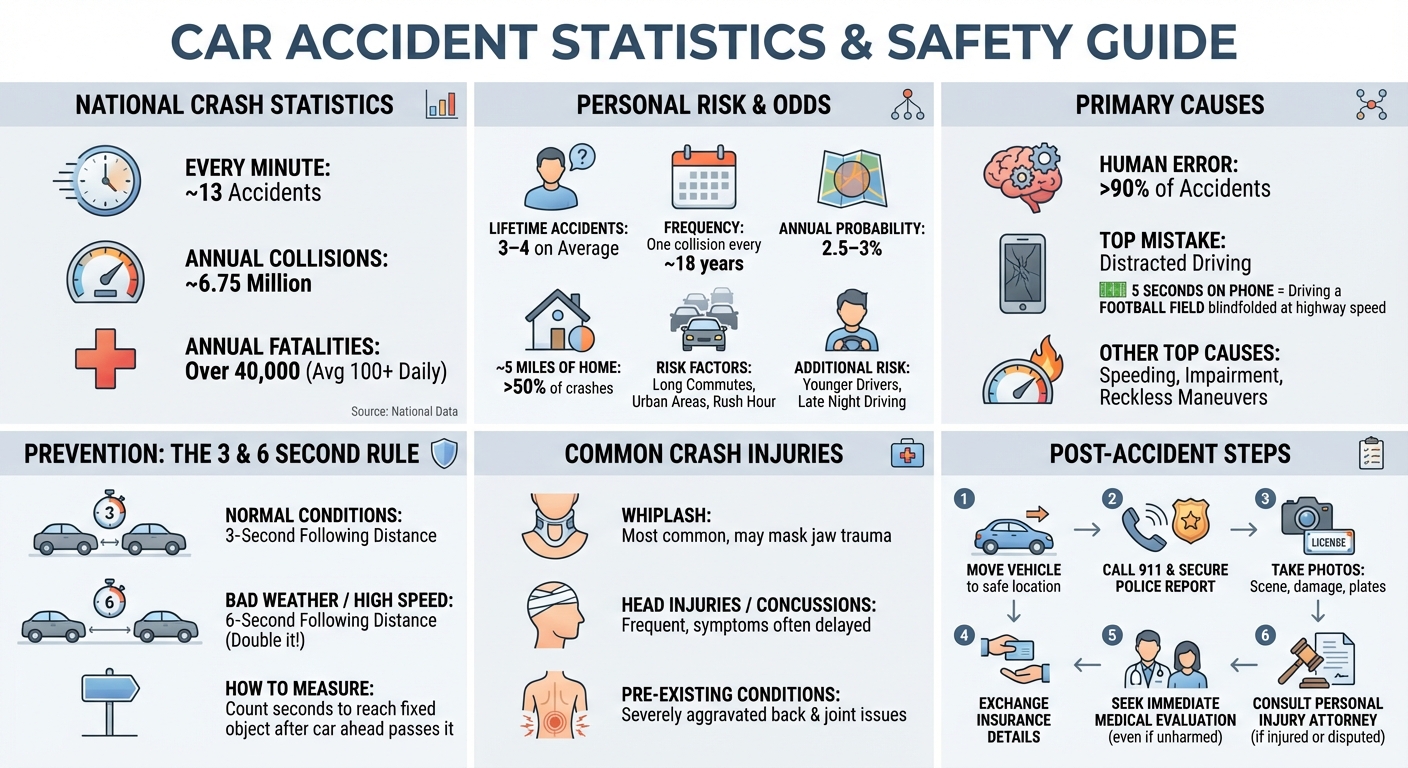
Car accidents are incredibly common in the United States, with approximately 13 crashes occurring every minute. This translates to roughly 6.75 million collisions annually, meaning the average driver will experience three to four accidents in their lifetime.
The Bottom Line: How Common Are Car Accidents in the U.S.?
Car accidents are a daily reality on American roads. According to data from the Bureau of Transportation Statistics and the National Highway Traffic Safety Administration (NHTSA), approximately 13 car accidents occur every minute in the United States. This staggering frequency translates to roughly 6.75 million collisions each year.
National Averages: Accidents Per Minute, Day, and Year
When you break down the national statistics, the sheer volume of traffic incidents becomes clear. With millions of vehicles navigating highways and city streets, minor fender benders and severe crashes happen constantly. While many of these are property-damage-only incidents, they still cause significant disruptions, financial strain, and insurance claims.
Fatal vs. Non-Fatal Crash Statistics
Fortunately, the majority of car accidents do not result in death. However, the fatality rate remains a serious concern. Recent NHTSA data shows over 40,000 motor vehicle fatalities annually, averaging more than 100 deaths per day. Millions more suffer non-fatal injuries ranging from minor scrapes to life-altering trauma.
How often does the average person get in a car accident?
The average person will be involved in three to four car accidents during their lifetime. Because most drivers are on the road for roughly 60 years, this averages out to one collision every 18 years. However, your individual frequency depends heavily on your driving habits and location.
The 3 to 4 Accidents Per Lifetime Rule
Insurance industry data consistently points to this 3-to-4 accident lifetime average. While this might sound alarming, it is important to note that this figure includes everything from minor parking lot scrapes to major highway collisions. Being a defensive driver can help you stay below this average.
Factors That Increase Your Personal Risk
Your likelihood of crashing increases if you have a long daily commute, drive primarily in densely populated urban areas, or frequently travel during rush hour. Additionally, younger, less experienced drivers and those who frequently drive late at night face a statistically higher risk of being involved in a collision.
What are the odds of getting in a car accident?
The odds of getting in a car accident are roughly 1 in 366 for every 1,000 miles you drive. Annually, your statistical probability of experiencing a crash is about 2.5 to 3 percent. However, these odds fluctuate significantly based on your daily mileage, local traffic density, and driving habits.
Daily Commute Probabilities
Because over 50% of car accidents happen within five miles of home, your daily commute is where you are most vulnerable. Familiarity breeds complacency; drivers often go on autopilot on familiar routes, decreasing their reaction times to sudden stops or erratic drivers.
How Location and Mileage Impact Your Odds
The more miles you drive, the higher your exposure to risk. Commercial drivers and super-commuters naturally face higher odds. Furthermore, driving in states with high traffic density, frequent severe weather, or poorly maintained infrastructure can significantly elevate your chances of a crash.
What are 90% of car accidents caused by?
Over 90% of car accidents are caused by human error rather than weather or mechanical failure. The leading driver mistakes include distracted driving, speeding, driving under the influence, and reckless maneuvers. Because these crashes stem from poor decision-making behind the wheel, the vast majority are entirely preventable.
The Role of Distracted Driving and Smartphones
Distracted driving is a leading culprit in the human error category. Texting, browsing social media, or adjusting navigation systems takes a driver’s eyes off the road for crucial seconds. At highway speeds, looking at a phone for just five seconds is the equivalent of driving the length of a football field blindfolded.
Speeding, Impairment, and Reckless Driving
Beyond distractions, speeding reduces reaction time and increases the severity of an impact. Impairment from alcohol or drugs severely diminishes cognitive function and motor skills. Aggressive driving behaviors, such as tailgating and weaving through traffic, also contribute heavily to the remaining percentage of human-error crashes.
What is the 3/6 second rule?
The 3/6 second rule is a safe driving guideline stating you should leave at least three seconds of following distance between your vehicle and the car ahead under normal conditions. In adverse weather or at high speeds, you should double this gap to a full six seconds.
How to Calculate Your Following Distance
To calculate your following distance, pick a fixed object on the side of the road, like a speed limit sign or a tree. When the rear bumper of the car in front of you passes that object, begin counting. If you pass the same object before you reach three seconds, you are following too closely.
Adjusting the Rule for Weather and Highway Speeds
Rain, snow, and ice drastically reduce your tire traction and increase stopping distance. In these conditions, the standard three seconds is not enough. Extending your following distance to six seconds gives you the necessary time to react and brake safely without rear-ending the vehicle ahead.
Common Injuries When the Inevitable Happens
Even with defensive driving, accidents happen. When they do, the physical toll can be complex. Understanding common injuries can help you seek the right medical attention.
Whiplash and Hidden TMJ Injuries
Whiplash is the most common car accident injury, but it often masks secondary issues. For instance, the violent jerking motion of a crash can cause TMJ (temporomandibular joint) injuries. This jaw pain is a frequently overlooked consequence of whiplash that requires specialized medical and dental evaluation.
Closed Head Injuries: The Invisible Trauma
Not all injuries leave a visible scar. Closed head injuries, including concussions and traumatic brain injuries (TBIs), are incredibly common in moderate to severe crashes. Because symptoms like dizziness, memory loss, or mood changes may not appear immediately, insurance companies often try to deny these invisible injuries.
How Pre-Existing Conditions Complicate Accident Claims
If you already suffer from back pain or joint issues, a car accident can severely aggravate those pre-existing conditions. Insurance adjusters frequently use prior medical records to argue that the crash did not cause your current pain. Navigating an injury claim with a pre-existing condition requires careful medical documentation.
What to Do If You Become Part of the Statistics
Knowing the statistics is one thing; knowing how to protect yourself after a crash is another. Taking the right steps immediately can safeguard your health and your legal rights.
Immediate Steps at the Crash Scene
First, move to a safe location if possible and call 911. Never skip a police report, even for a minor fender bender. Take photos of all vehicle damage, license plates, and the surrounding scene. Finally, exchange insurance information with the other driver and seek a medical evaluation immediately, even if you feel fine.
When to Consult a Personal Injury Attorney
If you suffer injuries, miss work, or face pushback from an insurance company, it is time to consult a personal injury attorney. An experienced lawyer can help you navigate complex claims involving hidden injuries or pre-existing conditions, ensuring you receive fair compensation for your medical bills and suffering.