

Table of contents
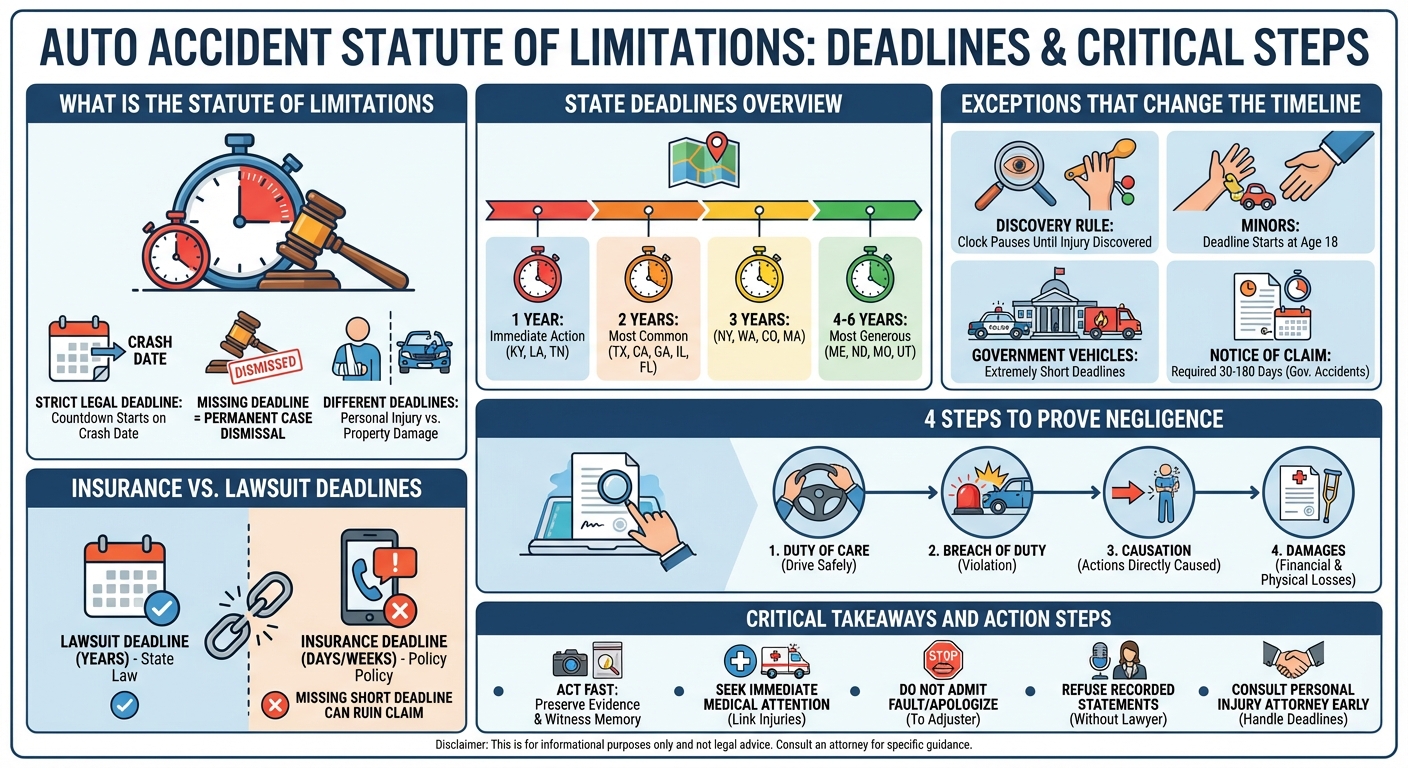
The statute of limitations for an auto accident is a legal deadline that dictates how long you have to file a lawsuit. In most U.S. states, you have between two and three years from the date of the crash to file a personal injury or property damage claim. However, deadlines range from one to six years depending on your state’s specific laws.
What is the Statute of Limitations on an Auto Accident?
Understanding Your Legal Time Limit
The statute of limitations is a strict legal deadline that dictates how much time you have to file a lawsuit after suffering harm. In the context of an auto accident, the clock typically starts ticking on the exact date the crash occurs. If you attempt to file a lawsuit after this window closes, the court will almost certainly dismiss your case, permanently barring you from recovering compensation for your medical bills, lost wages, or property damage.
How long after an accident can you still make a claim?
You can typically make a car accident claim for one to six years after the crash, depending on your state’s statute of limitations. Most states allow two to three years to file a lawsuit. However, insurance claims should be filed within days or weeks of the accident to avoid denial.
Car Accident Statute of Limitations by State
Personal Injury vs. Property Damage Deadlines
It is a common misconception that all accident-related damages fall under a single deadline. Many states separate the statute of limitations for personal injury (bodily harm) from property damage (vehicle repairs). For example, a state might give you two years to sue for your whiplash injury, but up to five years to sue for the total loss of your vehicle. Always verify both deadlines.
50-State Quick Reference Table
While laws are subject to legislative changes, auto accident lawsuit deadlines generally fall into the following categories across the United States:
| Time Limit | Common States (Examples) | Notes |
|---|---|---|
| 1 Year | Kentucky, Louisiana, Tennessee | These states require immediate legal action. Delays often result in lost rights. |
| 2 Years | Texas, California, Georgia, Illinois, Florida | The most common timeframe. Note: Florida recently reduced its limit from 4 years to 2 years. |
| 3 Years | New York, Washington, Colorado, Massachusetts | Colorado allows 3 years specifically for motor vehicle accidents, but 2 years for other injuries. |
| 4 to 6 Years | Maine (6), North Dakota (6), Missouri (5), Utah (4) | These states offer the most generous filing windows in the country. |
A Closer Look: Texas Auto Accident Time Limits
For drivers in Houston and throughout Texas, the statute of limitations for both personal injury and property damage is two years from the date of the crash. Whether you are dealing with a minor fender bender or a severe collision involving an 18-wheeler, the Texas civil court system strictly enforces this two-year cutoff.
Exceptions to the Rule: Can the Deadline Be Extended?
The Discovery Rule for Delayed Injuries
In rare cases, you might not realize you were injured until long after the crash. The “discovery rule” can sometimes pause (or “toll”) the statute of limitations until the date you discovered, or reasonably should have discovered, your injury. However, courts apply this rule very strictly in auto accident cases, as the trauma of a crash is usually immediately apparent.
Tolling the Statute for Minors
If a child is injured in a car accident, the legal clock usually does not start ticking until they reach the age of majority (typically 18). Once they turn 18, they will have the standard statutory period—such as two years—to file a lawsuit on their own behalf.
Claims Against Government Entities (Shorter Deadlines)
If your accident involved a city bus, a county utility truck, or a poorly maintained state highway, standard deadlines do not apply. Claims against government entities require a “Notice of Claim” to be filed incredibly fast—often within 30 to 180 days of the accident. Missing this administrative deadline destroys your right to sue.
Why You Should Never Wait Until the Deadline
Preserving Crucial Crash Scene Evidence
Waiting until the final months of your statute of limitations is a massive strategic error. Over time, skid marks wash away, traffic camera footage is deleted, and witnesses forget critical details. Building a strong case requires immediate investigation to document the scene and secure evidence before it vanishes.
What are the 4 things required to prove negligence?
To successfully prove negligence in an auto accident claim, you must establish four critical elements: duty of care, breach of duty, causation, and damages. This means showing the other driver owed you a safe driving duty, violated that duty, directly caused your crash, and resulted in your measurable financial losses.
Navigating Insurance Claims Before Time Runs Out
How Insurance Deadlines Differ from Lawsuit Deadlines
Your insurance policy includes its own deadlines, completely separate from state law. Most policies require you to report an accident “promptly” or “within a reasonable time”—usually a matter of days. Failing to notify your insurer quickly can result in a denied claim, regardless of how much time is left on the state’s statute of limitations.
What not to say to the insurance adjuster?
When speaking to an insurance adjuster, never admit fault, apologize, or say you are uninjured. Avoid giving a recorded statement without an attorney, and do not accept a first settlement offer immediately. Stick only to the basic facts of the crash, as adjusters will use your words to minimize payouts.
Delayed Symptoms and Long-Term Crash Injuries
Why Immediate Medical Evaluation is Critical
Insurance companies love to use gaps in medical treatment against you. If you wait weeks to see a doctor, the insurer will argue your injuries were caused by something else. Immediate medical evaluation links your injuries directly to the crash, protecting your health and your legal claim.
Can a car accident cause spinal stenosis?
Yes, a severe car accident can cause or accelerate spinal stenosis. The violent impact of a crash can rupture discs, fracture vertebrae, or trigger severe spinal inflammation. This trauma narrows the spinal canal, putting painful pressure on the spinal cord and nerves, often requiring extensive medical treatment or surgery.
Protect Your Right to Compensation
When Settlement Fails: Preparing for Litigation
Most car accident claims are resolved through out-of-court settlements. However, if the insurance company refuses to offer a fair payout, your only recourse is to file a lawsuit before the statute of limitations expires. Preparing for litigation early shows the insurer you are serious and often forces a better settlement offer.
Consulting with an Experienced Car Accident Lawyer
Navigating state laws, insurance policies, and strict legal deadlines is overwhelming when you are recovering from an injury. Consulting with a skilled personal injury attorney ensures your claim is filed correctly and on time. They will handle the adjusters, gather the evidence, and protect your right to maximum compensation while you focus on healing.