

Table of contents
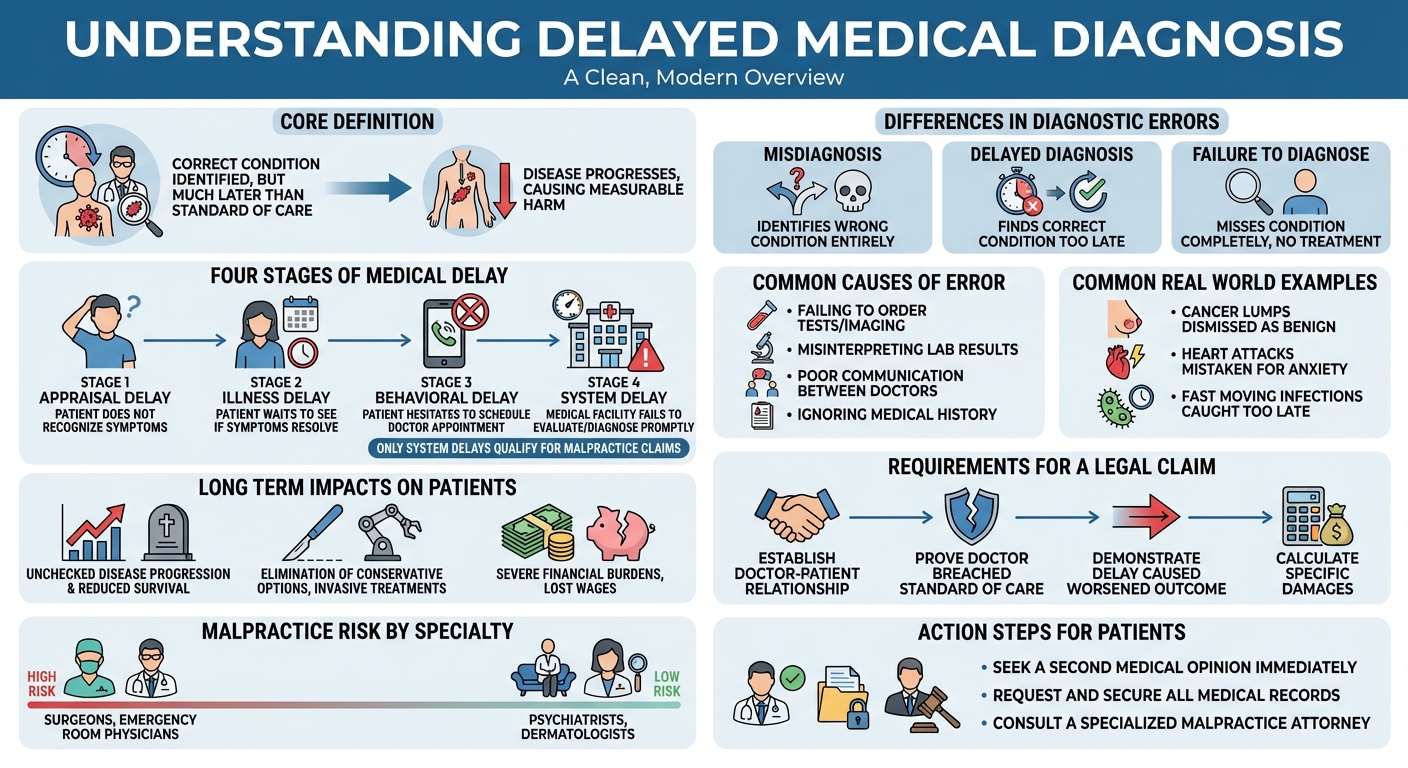
A delayed diagnosis occurs when a medical professional correctly identifies a patient’s condition, but does so significantly later than a competent doctor would have under similar circumstances. This delay often allows the disease to progress, resulting in worse health outcomes, severe complications, or the need for more aggressive treatments.
What is considered a delayed diagnosis?
A delayed diagnosis occurs when a medical professional eventually identifies a patient’s condition, but the diagnosis is made much later than it should have been under the accepted standard of care. This delay often allows the disease to progress, leading to worse outcomes or requiring more aggressive treatment.
The standard of care in the diagnostic process
In the medical field, the standard of care refers to the level of competence and caution that a reasonably skilled doctor with similar training would exercise under similar circumstances. If a competent doctor would have ordered a biopsy or an MRI based on your symptoms, but your doctor did not, they may have breached this standard.
How timeframes determine a ‘delay’
Not every medical condition can be diagnosed immediately. A legal ‘delay’ is established when the timeframe between the initial presentation of symptoms and the final correct diagnosis exceeds what is medically acceptable. The critical factor is whether the passage of time caused measurable harm to the patient.
Misdiagnosis vs. Delayed Diagnosis: What is the Legal Difference?
While often used interchangeably, these terms represent distinct types of medical errors. Understanding the difference is crucial for medical malpractice claims.
| Type of Error | Definition | Impact on Patient |
|---|---|---|
| Misdiagnosis | The doctor diagnoses the patient with the wrong condition entirely. | The patient receives unnecessary or harmful treatment for a disease they do not have, while their actual condition worsens. |
| Delayed Diagnosis | The doctor eventually makes the correct diagnosis, but too late. | The patient misses the critical window for early intervention, leading to disease progression. |
| Failure to Diagnose | The doctor completely misses the condition, and it remains undiscovered. | The patient receives no treatment at all, often resulting in severe injury or wrongful death. |
What are the 4 stages of delay?
The four stages of delay in healthcare include appraisal delay (the time it takes a patient to recognize symptoms), illness delay (deciding to seek medical help), behavioral delay (the time taken to schedule an appointment), and scheduling or healthcare system delay (when the medical system fails to diagnose promptly).
- Appraisal delay: The patient notices a physical change but does not immediately recognize it as a symptom of an illness.
- Illness delay: The patient recognizes they are sick but waits to see if the symptoms resolve on their own.
- Behavioral delay: The patient decides they need a doctor but delays making the actual appointment due to fear, cost, or time constraints.
- Scheduling and healthcare system delay: The patient enters the medical system, but the doctor or facility fails to evaluate, test, and diagnose the condition in a timely manner. Only this final stage typically qualifies for medical malpractice.
What is an example of a delayed diagnosis?
An example of a delayed diagnosis is when a doctor dismisses a patient’s breast lump as a benign cyst without ordering a biopsy, only to discover months later that it is stage 3 breast cancer. This preventable delay allows the cancer to spread unnecessarily.
Delayed cancer diagnosis
Cancer is one of the most common and devastating conditions subject to delayed diagnosis. When doctors fail to investigate persistent coughs (lung cancer), changes in bowel habits (colon cancer), or abnormal moles (melanoma), patients lose the opportunity for early, life-saving treatments.
Heart attack or stroke symptoms mistaken for anxiety or indigestion
Women and younger adults frequently experience delayed diagnoses for cardiovascular events. A doctor might attribute chest pain to acid reflux or shortness of breath to a panic attack, sending the patient home while a heart attack is actively occurring.
Infections caught too late for standard antibiotics
Conditions like sepsis, meningitis, or appendicitis require immediate intervention. A delayed diagnosis in these fast-moving infections can lead to organ failure, amputations, or fatal outcomes within a matter of hours or days.
Common Causes of Diagnostic Errors and Delays
Diagnostic delays are rarely intentional. They usually stem from systemic failures, cognitive biases, or rushed medical evaluations. Common causes include:
- Failure to order appropriate tests or imaging: Skipping an X-ray, CT scan, or blood panel to save time or insurance costs.
- Misinterpreting lab results: A radiologist or pathologist misreading a scan or tissue sample, leading the primary doctor to believe the patient is healthy.
- Poor communication: Vital information getting lost between primary care physicians, specialists, and hospital staff.
- Ignoring patient medical history: Dismissing a patient’s family history of a disease or ignoring their specific complaints and pain levels.
The Long-Term Effects of a Delayed Diagnosis
The consequences of waiting too long for a correct diagnosis extend far beyond the physical illness. Patients often face a cascading series of hardships.
Disease progression and reduced survival rates
The most severe impact is the unchecked progression of the disease. A condition that was highly treatable at stage 1 may become terminal by stage 4, drastically reducing the patient’s life expectancy.
Need for more aggressive, invasive treatments
A delayed diagnosis often means that conservative treatments are no longer viable. Patients may require radical surgeries, higher doses of chemotherapy, or prolonged hospital stays that could have been avoided.
Financial burden of extended medical care and lost wages
Aggressive treatments are expensive. Patients often face mounting medical bills while simultaneously being too sick to work, leading to severe financial instability for their families.
Can You Sue for a Delayed Diagnosis?
Yes, but a bad medical outcome alone does not guarantee a successful lawsuit. To win a medical malpractice claim for a delayed diagnosis, you must prove four specific legal elements.
Establishing a doctor-patient relationship
You must show that you hired the doctor and the doctor agreed to treat you, establishing a formal duty of care.
Proving a breach in the standard of care (negligence)
You must demonstrate that the doctor was negligent. This usually requires expert testimony from another doctor in the same specialty stating that a competent professional would have diagnosed the condition sooner.
Demonstrating direct causation between the delay and patient harm
This is often the hardest element to prove. You must show that the delay itself—not the underlying disease—caused your worsened condition. If the disease would have been terminal even with an early diagnosis, the claim may fail.
Calculating damages
You must prove specific damages resulting from the delay, such as additional medical bills, lost earning capacity, and physical pain and suffering.
Which doctor is least likely to be sued?
Psychiatrists, pediatricians, and dermatologists are generally the doctors least likely to be sued for medical malpractice. These specialties typically involve lower-risk procedures and non-life-threatening immediate emergencies, making catastrophic harm from a delayed diagnosis less common than in high-risk medical fields.
Why high-risk specialties face more claims
Conversely, surgeons, OB/GYNs, and emergency room physicians face the highest rates of malpractice claims. In these fast-paced, high-stakes environments, a delayed diagnosis of fetal distress, internal bleeding, or a stroke can result in immediate, irreversible damage.
Steps to Take If You Suspect a Delayed Diagnosis
If you believe your doctor missed critical signs of an illness, you must act quickly to protect your health and your legal rights.
- Seek a second medical opinion immediately: Your health is the priority. Do not wait for your current doctor to figure it out if your symptoms are worsening. Go to a different specialist or hospital.
- Request and secure all medical records: Obtain copies of your charts, lab results, imaging, and doctor’s notes before any documents can be lost or altered.
- Consult with a specialized medical malpractice attorney: Malpractice cases have strict statutes of limitations. An experienced attorney can review your records with medical experts to determine if you have a valid claim for compensation.