

Table of contents
A semi-truck accident lawsuit is a civil claim filed by an injured victim against a truck driver, trucking company, or other liable parties. The process involves evidence gathering, filing a formal complaint, discovery, negotiation, and potentially a trial to secure compensation for medical bills, lost wages, and pain.
Understanding the Semi-Truck Accident Lawsuit Process
Filing a semi-truck accident lawsuit is a complex legal undertaking designed to help victims recover financial compensation after a devastating crash. Unlike standard fender-benders, commercial trucking accidents involve severe injuries, massive insurance policies, and aggressive corporate defense teams.
Why Commercial Truck Crashes Differ from Car Accidents
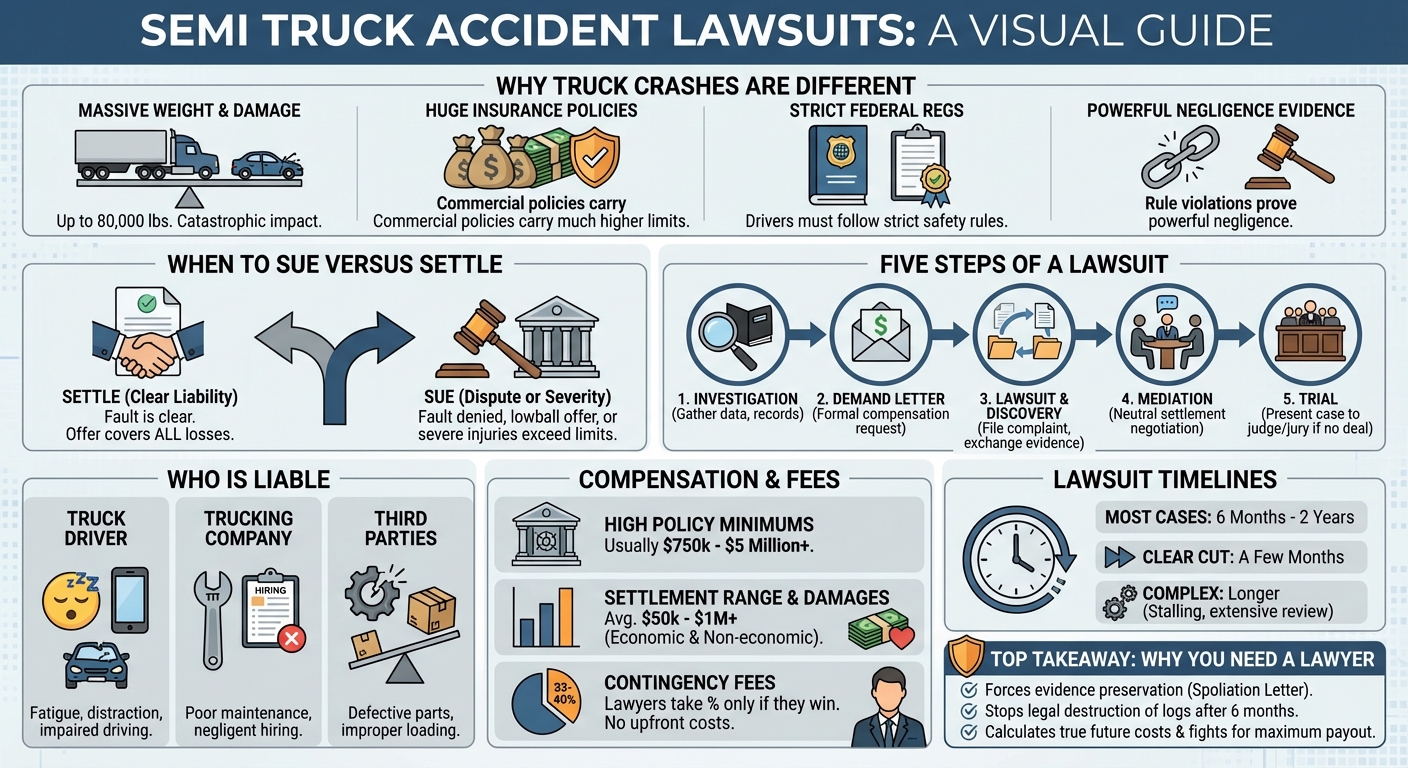
Semi-trucks can weigh up to 80,000 pounds, meaning collisions often result in catastrophic damage. Legally, these cases are distinct because commercial drivers and trucking companies are bound by strict Federal Motor Carrier Safety Administration (FMCSA) regulations. Violations of these rules—such as driving over the maximum allowed hours or skipping mandatory vehicle inspections—serve as powerful evidence of negligence.
When to File a Lawsuit vs. Accept an Insurance Claim
Not every truck accident requires a lawsuit. If liability is undisputed and the insurance company offers a settlement that fully covers your medical bills, lost wages, and pain and suffering, an out-of-court agreement may suffice. However, you should file a lawsuit if the insurer denies fault, offers a lowball settlement, or if your injuries are so severe that they exceed the initial policy limits offered.
Step-by-Step: How a Truck Accident Lawsuit Works
Navigating a commercial truck accident claim requires a strategic approach. Here is what you can expect during the legal process.
1. Investigation and Evidence Gathering (Black Box Data, Logbooks)
The foundation of a strong lawsuit is evidence. Your legal team will immediately work to preserve critical data before it is destroyed. This includes downloading the truck’s Event Data Recorder (the “black box”), securing the driver’s electronic logging device (ELD) to check for hours-of-service violations, and obtaining dashcam footage and maintenance records.
2. Sending the Demand Letter
Once you reach maximum medical improvement (MMI), your attorney will draft a demand letter to the trucking company’s insurance provider. This document outlines your injuries, the evidence proving their driver’s liability, your total financial losses, and a specific monetary demand to settle the case.
3. Filing the Complaint and Entering Discovery
If the insurer refuses to meet the demand, your lawyer will formally file a lawsuit (the Complaint) in civil court. This initiates the discovery phase, where both sides exchange evidence, request internal corporate documents, and conduct sworn depositions of the truck driver, safety managers, and medical experts.
4. Mediation and Settlement Negotiations
Before a trial begins, courts usually require both parties to attempt mediation. A neutral third-party mediator will facilitate negotiations between your legal team and the defense to see if a fair settlement can be reached without the risk and expense of a trial.
5. Going to Trial (If Necessary)
If mediation fails, your case proceeds to trial. Your attorney will present evidence, call expert witnesses, and argue your case before a judge or jury, who will then determine liability and the final compensation amount.
Determining Liability: Who Are You Suing?
One of the most complex aspects of a semi-truck accident lawsuit is identifying all liable parties. Multiple entities may share the blame for your crash.
The Truck Driver (Negligence, Fatigue, DUI)
The driver is often the primary defendant. Common causes of driver negligence include speeding, distracted driving, driving under the influence of drugs or alcohol, and severe fatigue from violating FMCSA rest regulations.
The Trucking Company (Vicarious Liability, Poor Maintenance)
Under the legal doctrine of “respondeat superior,” trucking companies are generally held liable for the actions of their employees. Furthermore, the company can be sued directly for negligent hiring, failing to conduct background checks, forcing drivers to meet unrealistic deadlines, or neglecting fleet maintenance.
Third-Party Manufacturers and Cargo Loaders
If a tire blowout or brake failure caused the crash, the manufacturer of the defective part could be held liable. Additionally, if the accident was caused by an unbalanced or overweight trailer, the third-party cargo loading company may be responsible.
Semi-Truck Accident Settlements: What to Expect
Victims naturally want to know the potential value of their claim. Because commercial trucks carry mandatory minimum insurance policies ranging from $750,000 to $5,000,000, the available compensation pool is much larger than in standard auto accidents.
How much are most truck accident settlements?
Most semi-truck accident settlements range from $50,000 to over $1,000,000, depending on injury severity and liability. Because commercial trucking policies carry higher limits, average payouts are significantly larger than standard car accidents, often exceeding six figures for victims with severe, life-altering injuries.
Key Factors That Increase Your Case Value (Severity of Injuries, Commercial Insurance Limits)
The value of your settlement is heavily influenced by the severity and permanence of your injuries. Traumatic brain injuries, spinal cord damage, and amputations yield the highest payouts. Additionally, cases involving gross negligence—such as a drunk truck driver—can trigger punitive damages, significantly increasing the case value.
Economic vs. Non-Economic Damages
Your settlement will be divided into two main categories. Economic damages cover quantifiable losses like past and future medical bills, rehabilitation costs, and lost earning capacity. Non-economic damages compensate you for subjective losses, including physical pain, emotional trauma, and loss of enjoyment of life.
Breaking Down Your Payout: Legal Fees and Net Compensation
Understanding how the money is divided after a successful settlement is crucial for managing your financial expectations.
How Contingency Fees Work in Personal Injury Cases
Most truck accident lawyers work on a contingency fee basis, meaning you pay nothing upfront. The attorney only gets paid if they win your case, typically taking a percentage (usually 33% to 40%) of the final settlement or court verdict.
How much will I get from a $50,000 settlement?
From a $50,000 settlement, you will typically receive between $25,000 and $33,000. After deducting a standard 33% attorney contingency fee (approximately $16,500) and covering any outstanding medical liens or out-of-pocket case expenses, the remaining balance is the net compensation that goes directly to you.
Is $100,000 a good settlement?
A $100,000 settlement is good if you suffered minor to moderate injuries, have low medical bills, and fully recovered. However, if you sustained permanent disabilities, require ongoing medical care, or cannot return to work, $100,000 is likely insufficient, especially given the high insurance limits of commercial trucking companies.
Lawsuit Timeline Expectations
Patience is essential when pursuing a commercial trucking claim, as these cases rarely resolve overnight.
How long does a semi truck settlement take?
A semi-truck settlement typically takes anywhere from six months to two years to resolve. Straightforward cases with clear liability may settle in a few months, while complex lawsuits involving severe injuries, multiple corporate defendants, or disputed evidence often take over a year to reach a final conclusion.
Why Commercial Trucking Cases Take Longer to Settle
Corporate insurers will drag out the process to pressure you into accepting a lower offer. Furthermore, the discovery phase in commercial cases is extensive, requiring the analysis of thousands of pages of corporate logs, maintenance records, and expert witness testimonies.
Why You Need an Experienced Truck Accident Lawyer
Taking on a massive logistics company and their team of corporate lawyers is not something you should do alone.
Protecting Evidence Before It Is Destroyed
Trucking companies are only legally required to keep certain records, like logbooks, for six months. An experienced attorney will immediately send a “spoliation letter” to legally force the company to preserve the truck, the black box data, and all relevant documents.
Maximizing Your Settlement Against Corporate Insurers
Insurance adjusters are trained to minimize payouts. A skilled lawyer knows how to accurately calculate your future medical needs, negotiate aggressively, and leverage the threat of a jury trial to secure the maximum possible compensation.
Free Case Evaluation
If you or a loved one has been injured in a commercial truck crash, time is of the essence. Contact our legal team today for a free, no-obligation case evaluation to discuss your rights and begin building a winning strategy.