

Table of contents
A quadriplegia lawyer specializes in catastrophic spinal cord injury claims, helping paralyzed victims recover maximum compensation. They prove negligence, calculate lifetime medical costs using life care planners, and negotiate settlements that cover ongoing treatments, lost wages, and pain and suffering.
Why You Need a Specialized Quadriplegia Lawyer
Sustaining a spinal cord injury that results in quadriplegia (also known as tetraplegia) is a life-altering event. Because the physical, emotional, and financial tolls are immense, securing compensation requires more than a standard personal injury approach. You need a specialized quadriplegia lawyer who understands the profound complexities of catastrophic nerve damage and lifelong paralysis.
The Difference Between General Personal Injury and Catastrophic Injury Claims
Not all injury claims are handled equally. While a standard car accident claim might resolve in months, a quadriplegia case involves high-stakes litigation against well-funded insurance companies.
| General Personal Injury | Catastrophic Injury (Quadriplegia) |
|---|---|
| Short-term medical treatment | Lifelong, 24/7 medical care and rehabilitation |
| Temporary loss of income | Permanent loss of earning capacity |
| Standard medical records suffice | Requires life care planners and economic experts |
| Lower policy limits typically apply | Often involves umbrella policies and corporate liability |
How We Build Your Legal and Medical Team
A successful quadriplegia claim relies on a multidisciplinary approach. Your attorney will assemble a team of medical specialists, vocational rehabilitation experts, and forensic economists. This team works collaboratively to map out your exact future needs, ensuring no medical expense or home modification is left out of your final demand package.
Common Causes of Quadriplegia and Spinal Cord Injuries
Quadriplegia occurs when there is severe damage to the cervical spine (the neck region), cutting off communication between the brain and the body. These catastrophic injuries typically stem from high-impact trauma.
Severe Motor Vehicle and Truck Accidents
High-speed collisions, particularly those involving commercial trucks, are a leading cause of spinal cord injuries. The sheer force of an 80,000-pound semi-truck striking a passenger vehicle frequently causes the sudden, violent neck movements that sever or crush the cervical spinal cord.
Slip and Fall and Premises Liability Incidents
Property owners have a legal obligation to maintain safe environments. A catastrophic fall from a height, a slip on an unmarked wet floor, or an incident involving poorly maintained stairs can result in devastating spinal trauma. In these premises liability cases, proving the owner knew of the hazard is critical.
Workplace and Construction Site Accidents
Construction workers face daily risks of scaffolding collapses, heavy machinery malfunctions, and falls. When a workplace accident leads to paralysis, a quadriplegia lawyer can help you navigate both workers’ compensation claims and third-party lawsuits against negligent contractors or equipment manufacturers.
Proving Liability: What are the 4 proofs of negligence?
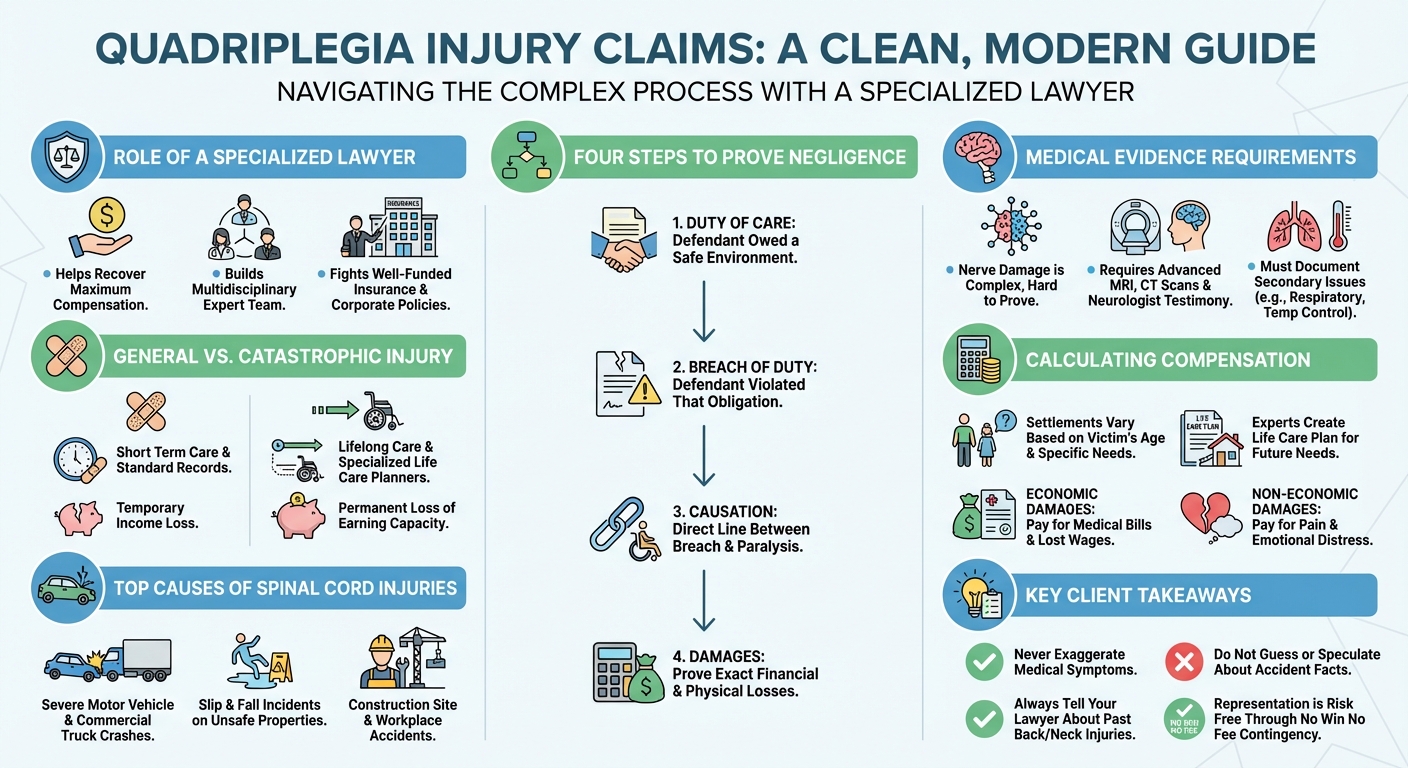
To win a quadriplegia lawsuit, your lawyer must establish the 4 proofs of negligence: duty of care (the defendant owed you a safe environment), breach of duty (they failed to provide it), causation (their failure directly caused your spinal cord injury), and damages (you suffered quantifiable financial and physical losses).
Duty of Care
The first step is proving the defendant had a legal obligation to act reasonably. For example, a truck driver has a duty to obey traffic laws, and a property owner has a duty to fix known safety hazards.
Breach of Duty
Next, we must demonstrate how the defendant violated that duty. This could be a driver texting behind the wheel, a store ignoring a massive spill, or a manufacturer releasing a defective product.
Causation
We must draw a direct line between the defendant’s breach of duty and your paralysis. The defense will often try to blame preexisting conditions, making expert medical testimony vital to prove the accident was the primary cause of your quadriplegia.
Damages
Finally, we must prove the extent of your losses. In a quadriplegia case, damages are extensive, covering everything from emergency surgeries and customized wheelchairs to immense physical pain and emotional suffering.
Medical Evidence: What is the hardest injury to prove?
While quadriplegia is highly visible, nerve damage and the subjective severity of chronic pain are often considered the hardest injuries to prove. Unlike a simple bone fracture, proving the exact extent of neurological impairment requires specialized medical imaging, expert testimony, and comprehensive functional capacity evaluations.
Nerve Damage vs. Bone Fractures
A broken bone shows up clearly on a standard X-ray. Spinal cord damage, however, requires advanced MRI and CT scans, alongside detailed neurological assessments. Insurance companies often dispute the severity of nerve damage, which is why your lawyer must rely on top-tier neurologists to testify on your behalf.
Documenting the Full Extent of Tetraplegia
Tetraplegia affects more than just limb movement. It impacts respiratory function, bowel and bladder control, and temperature regulation. Documenting these secondary complications is essential to illustrate the full scope of your daily struggles and secure appropriate compensation.
Compensation: What is the average settlement for a spinal cord injury?
There is no true average settlement for a spinal cord injury, as case values range from hundreds of thousands to multi-million dollar verdicts. Quadriplegia cases typically yield the highest settlements due to the need for 24/7 care, home modifications, lifetime medical expenses, and total loss of earning capacity.
Why ‘Average’ Settlements Don’t Apply to Quadriplegia
Every paralysis case is unique. A 25-year-old who suffers quadriplegia will require decades more medical care than a 75-year-old with the same injury. Because the financial impact varies drastically based on age, career trajectory, and the specific level of cervical spine injury, relying on an “average” number is misleading.
Calculating Lifetime Medical Costs with a Life Care Plan
A Life Care Plan is a comprehensive document created by medical and economic experts. It outlines every future expense you will face, including:
- Ongoing physical and occupational therapy
- Home and vehicle accessibility modifications
- Replacement costs for customized wheelchairs
- In-home nursing care and specialized medical equipment
Economic vs. Non-Economic Damages
Your settlement will be divided into two main categories. Economic damages cover tangible costs like hospital bills and lost wages. Non-economic damages compensate you for the intangible losses, such as loss of enjoyment of life, emotional distress, and physical pain and suffering.
Protecting Your Claim: What not to say to an injury lawyer?
When consulting your attorney, do not exaggerate your symptoms, guess about facts you aren’t sure of, or hide previous accidents. Knowing what not to say to an injury lawyer ensures your legal team isn’t blindsided by the defense. Always provide honest, factual, and complete information regarding your medical history.
Avoiding Exaggerations and Speculation
Stick to the facts. If you do not know the answer to a question, simply say “I don’t know.” Speculating about how fast a car was going or guessing about your medical prognosis can create inconsistencies that the opposing counsel will use to undermine your credibility.
The Importance of Complete Honesty About Prior Injuries
Never hide a preexisting back or neck injury from your lawyer. Insurance adjusters will find out about your medical history. If your lawyer knows about prior injuries upfront, they can proactively hire experts to prove that the recent accident aggravated or caused your current paralysis, rather than the old injury.
Schedule a Free Consultation with a Quadriplegia Injury Attorney
If you or a loved one has suffered a catastrophic spinal cord injury, you do not have to fight the insurance companies alone. Securing the right legal representation is the most important step in protecting your family’s future.
No Win, No Fee Representation
We operate on a contingency fee basis. This means you pay nothing out of pocket. We cover all the upfront costs of investigating your case, hiring experts, and taking your claim to trial. We only get paid if we successfully recover compensation for you.
What to Expect During Your Free Case Evaluation
During your initial consultation, we will listen to your story, review any available accident reports or medical records, and provide a clear, honest assessment of your legal options. Contact us today to schedule your free, no-obligation case evaluation with an experienced quadriplegia lawyer.