

Table of contents
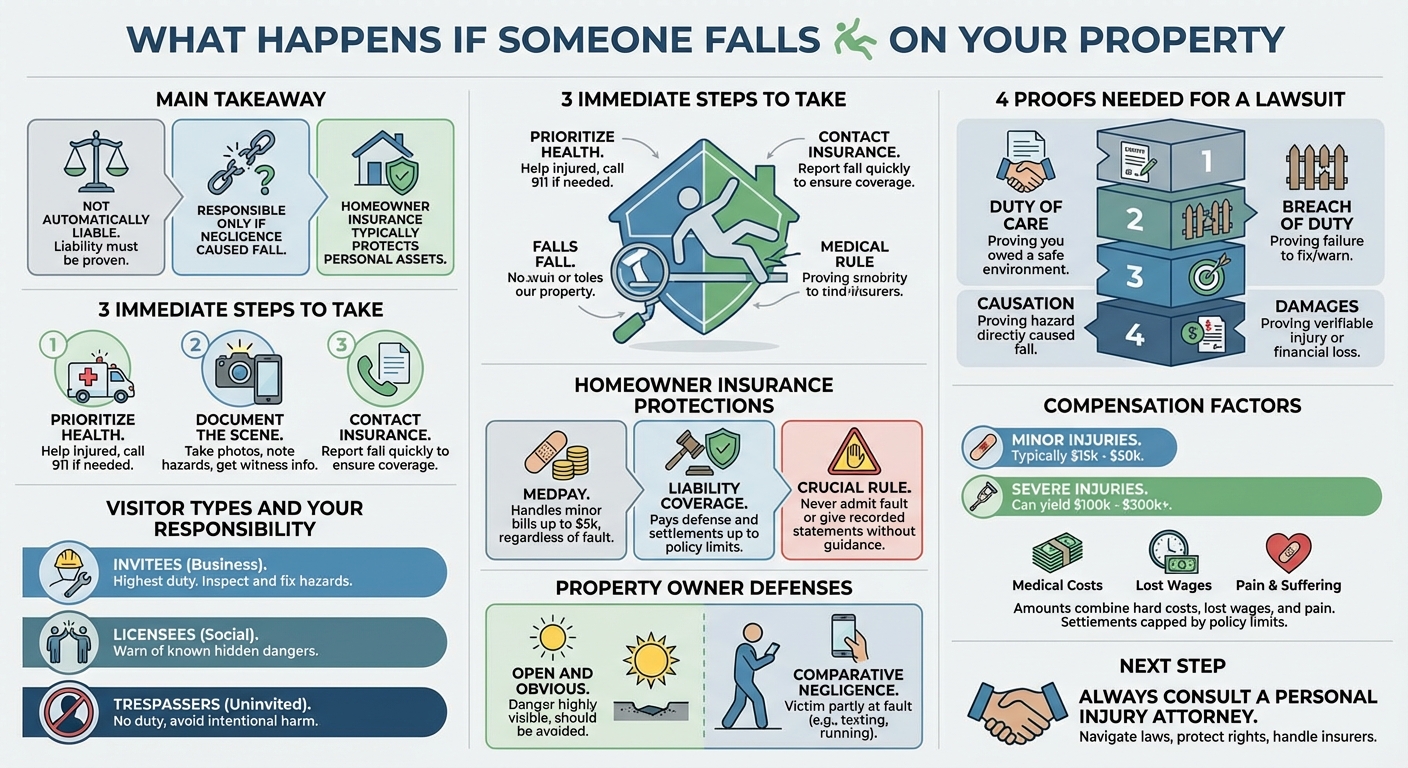
If someone falls on your property, you are not automatically liable. You are only legally responsible if the fall was caused by your negligence, meaning you knew or should have known about a hazard and failed to fix it. Your homeowner’s insurance typically covers medical expenses and liability claims.
What Happens If Someone Falls on Your Property?
When a guest, contractor, or even a stranger takes a tumble in your yard or inside your home, the reality of premises liability quickly sets in. Slip and fall accidents are incredibly common, but a fall alone does not automatically mean you will be drained financially.
Panic is not the answer. Understanding your legal and financial protections is crucial. In most cases, your homeowner’s insurance policy is designed to step in and shield your personal assets, provided you handle the immediate aftermath correctly and understand the legal threshold for negligence.
Immediate Steps to Take When a Fall Occurs
How you react in the first few minutes following an accident can significantly impact both the injured person’s well-being and any subsequent legal claims.
- Prioritize health and safety: Your immediate focus should be the injured person. Offer assistance and call 911 for medical help if they request it or if the injury appears severe.
- Document the scene: Take clear photos of the exact location where the fall occurred, including any potential hazards like wet floors, uneven pavement, or poor lighting. Collect contact information from any witnesses.
- Report the incident to your homeowner’s insurance provider: Notify your insurer promptly. Failing to report an incident within a reasonable timeframe can sometimes give the insurance company grounds to deny coverage later.
Are you responsible if someone falls on your property?
You are not automatically responsible just because someone falls on your property. You are only legally liable if the fall occurred due to your negligence. If the incident was a pure accident or caused by the visitor’s own clumsiness, the property owner is generally not held responsible.
Premises liability law distinguishes between a simple accident and actual negligence. To determine your level of responsibility, the law looks at the visitor’s classification:
- Invitees: People invited for business purposes (like a plumber). You owe them the highest duty of care to inspect for and fix hazards.
- Licensees: Social guests and friends. You must warn them of known dangers that aren’t obvious, but you aren’t strictly required to inspect the property for hidden issues.
- Trespassers: Uninvited individuals. Generally, you owe them no duty of care, other than refraining from intentionally harming them (though exceptions exist for trespassing children).
What are the 4 proofs of negligence?
To win a slip and fall claim, the injured party must establish the four proofs of negligence: Duty of Care, Breach of Duty, Causation, and Damages. If even one of these elements is missing, the property owner cannot be held legally liable for the accident.
- Duty of Care: Did you owe the person a safe environment? (This depends on their visitor classification).
- Breach of Duty: Did you fail to fix or adequately warn the visitor about a known, dangerous hazard?
- Causation: Did that specific hazard directly cause the slip, trip, or fall?
- Damages: Did the victim suffer actual, verifiable injuries or financial loss (like medical bills or lost wages) as a result?
How Homeowner’s Insurance Handles Slip and Fall Claims
If you are found liable, or if the injured party simply needs minor medical attention, your homeowner’s insurance is your primary line of defense.
- Medical Payments Coverage (MedPay): This is a “no-fault” coverage built into most policies. It pays for minor medical bills (usually between $1,000 and $5,000) regardless of who was at fault, helping to resolve small issues before they become lawsuits.
- Liability Coverage: If the injured person sues you for negligence, this coverage pays for your legal defense and any settlement or court judgment up to your policy limits (often $100,000 to $300,000).
Even with insurance, you must protect yourself. Never admit fault at the scene or give a recorded statement to an insurance adjuster without legal guidance. Adjusters often use these statements to twist your words and deny coverage. Learn more about The Recorded Statement Trap to protect your claim.
How hard is it to win a slip and fall lawsuit?
It is notoriously hard to win a slip and fall lawsuit because the burden of proof rests entirely on the injured party. They must definitively prove that the property owner knew, or reasonably should have known, about the dangerous condition and negligently failed to correct it.
Property owners and their insurance companies have several strong defenses:
- Open and Obvious Hazards: If a danger was so obvious that a reasonable person would have noticed and avoided it, the property owner may not be liable.
- Comparative Negligence: If the injured person was texting, running, or wearing inappropriate footwear, the court may determine they are partially or entirely at fault for their own fall.
How much compensation can you get for a fall?
Compensation for a fall typically ranges from $15,000 to $50,000 for minor injuries, while severe injuries requiring surgery can yield settlements between $100,000 and $300,000 or more. The exact amount depends heavily on medical bills, lost wages, and the severity of pain and suffering.
Several factors influence the final settlement amount:
- Economic vs. Non-Economic Damages: Hard costs like hospital bills and lost income are combined with subjective damages like pain, suffering, and reduced quality of life.
- The Impact of ‘Minor’ Injuries: Even if an injury seems small at first, it can lead to chronic pain. Discover Why Your “Minor” Soft Tissue Injury Deserves to Be Taken Seriously when calculating compensation.
- Insurance Policy Limits: Most payouts are capped by the homeowner’s liability policy limits. If a claim exceeds these limits, the injured party would have to pursue the homeowner’s personal assets, which is legally complex and often unsuccessful.
When to Consult a Personal Injury Lawyer
Whether you are the property owner facing a lawsuit or the victim of a negligent hazard, consulting a personal injury lawyer is a critical step. An attorney protects your rights, ensures evidence is preserved, and handles all communication with aggressive insurance companies.
Insurance companies are notorious for delaying, denying, or underpaying valid claims. An experienced lawyer knows how to navigate Bad Faith Insurance Practices to ensure a fair outcome. If you or someone you know has been involved in a slip and fall incident, the best next step is to schedule a free case evaluation to understand your legal standing.