
Table of contents
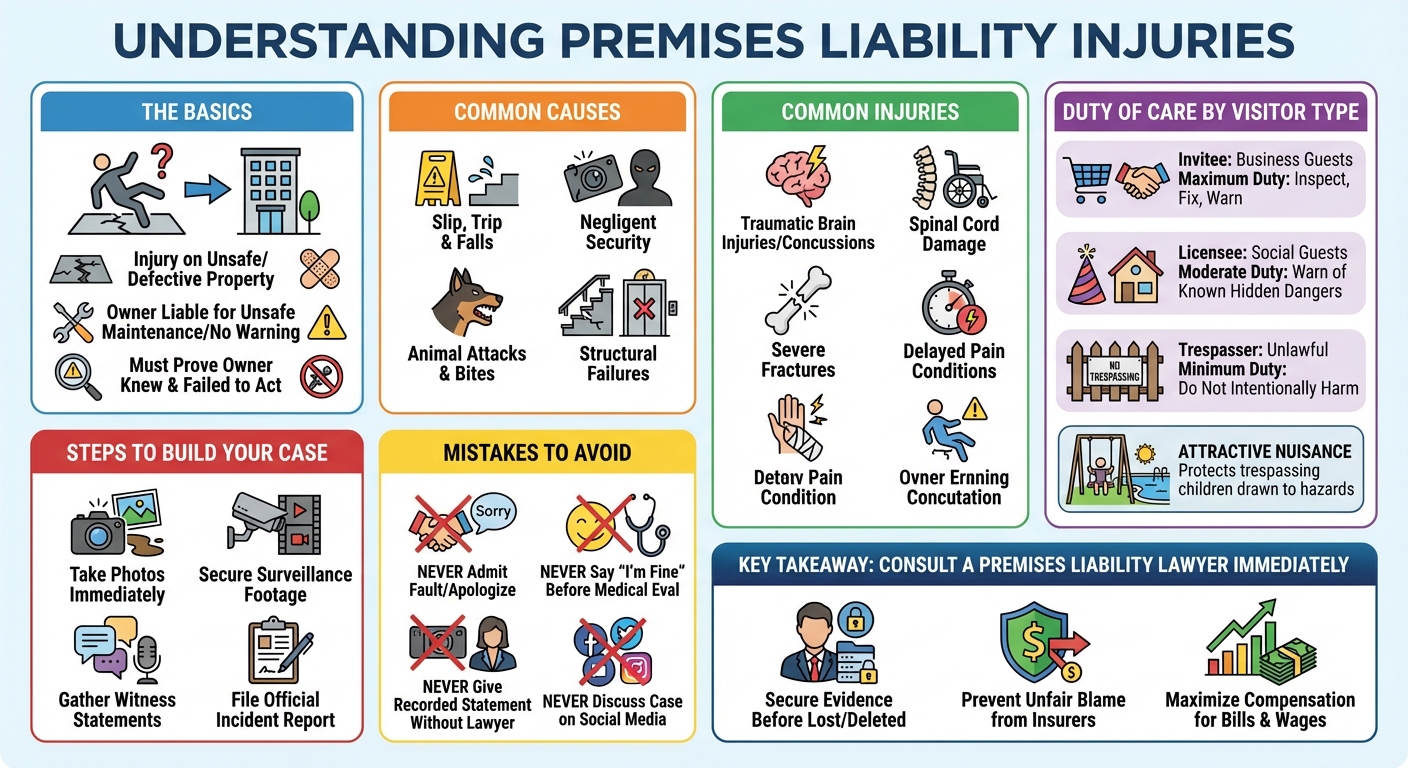
Premises liability injuries occur when a person is harmed on someone else’s property due to unsafe or defective conditions. Common examples include slip and falls, dog bites, and negligent security incidents. To recover compensation, victims must prove the property owner knew about the hazard but failed to fix it.
What is a premises injury?
A premises injury occurs when a person is hurt on someone else’s property due to an unsafe or defective condition. These injuries fall under premises liability law, which holds property owners or occupiers legally responsible for failing to maintain a safe environment or warn visitors of hidden hazards.
The legal definition of premises liability
Premises liability is a legal doctrine dictating that property owners have a duty of care to ensure their environment is reasonably safe for visitors. If an owner is negligent in maintaining the property and someone gets hurt as a direct result, the owner can be held financially accountable for the victim’s medical bills, lost wages, and pain and suffering.
How premises injuries differ from standard personal injuries
While a standard personal injury claim (like a car accident) usually revolves around a specific negligent action, a premises liability claim revolves around the condition of a physical space. The focus is on whether the property owner knew—or reasonably should have known—about a hazard and failed to correct it.
Common Types of Premises Liability Accidents
Unsafe properties can lead to a wide variety of accidents. The most frequent incidents leading to premises liability claims include:
- Slip, trip, and fall incidents: Often caused by wet floors, torn carpeting, uneven sidewalks, or poor lighting.
- Negligent security and assaults: When a commercial property owner fails to provide adequate security (like cameras, guards, or locks), leading to a preventable assault or robbery.
- Dog bites and animal attacks: Homeowners are frequently held liable when their pets attack guests or delivery workers on their property.
- Elevator, escalator, and structural failures: Poorly maintained stairs, collapsing balconies, and malfunctioning elevators can cause catastrophic harm.
Frequent Injuries Sustained on Dangerous Properties
The severity of a premises injury can range from minor scrapes to life-altering conditions. Victims frequently suffer from:
- Traumatic Brain Injuries (TBIs) and closed head injuries: Falling on hard surfaces can cause concussions or severe closed head injuries. These are notoriously difficult to diagnose immediately and are often heavily scrutinized by insurance companies.
- Spinal cord damage and paralysis: High-impact falls from balconies or defective stairs can permanently damage the spinal cord.
- Broken bones and severe fractures: Hip, wrist, and ankle fractures are especially common in slip and fall accidents involving older adults.
- Delayed pain: When minor injuries become major: Adrenaline can mask pain immediately after an accident. What seems like a minor muscle tweak can evolve into a major issue, such as a herniated disc or chronic joint problem, days or weeks later.
Are you liable if someone is injured on your property?
You may be liable if someone is injured on your property if the injury resulted from your negligence. Property owners must maintain safe conditions and warn visitors of known hazards. However, liability depends heavily on the visitor’s legal status—whether they are an invitee, licensee, or trespasser.
Understanding the property owner’s duty of care
The law categorizes visitors into three distinct groups, each owed a different level of protection:
| Visitor Status | Definition | Duty of Care Owed |
|---|---|---|
| Invitee | Someone invited for business purposes (e.g., a grocery store shopper). | Maximum: Owners must actively inspect for hazards, fix them promptly, and warn visitors. |
| Licensee | A social guest or someone allowed on the property for non-business reasons. | Moderate: Owners must warn guests of known hidden dangers but are not required to actively inspect the property. |
| Trespasser | Someone on the property unlawfully without permission. | Minimum: Owners generally owe no duty of care, except to refrain from intentionally harming them. Exception: The “attractive nuisance” doctrine protects trespassing children drawn to hazards like unfenced pools. |
Are premises liability cases hard to win?
Yes, premises liability cases can be hard to win because the victim must prove the property owner had “actual or constructive notice” of the hazard. You must demonstrate that the owner knew or should have known about the danger but failed to fix it before the injury occurred.
The challenge of proving notice
Insurance companies will often argue that a spill happened just seconds before you slipped, meaning the owner had no reasonable time to clean it up. Overcoming this requires strong evidence showing the hazard existed for a significant amount of time.
Gathering evidence
To win, you need immediate proof. This includes securing surveillance footage, gathering witness statements, taking photos of the hazard before it is cleaned up, and filing an official incident report with the property manager.
Comparative fault
Property owners often try to shift the blame to the victim, arguing they were distracted by a phone or wearing improper footwear. Under comparative fault rules, if you are found partially responsible for your injury, your compensation may be reduced.
What should I not say during settlement?
During a settlement, you should never admit fault, apologize, or say “I’m fine.” Do not give a recorded statement to the property owner’s insurance company without a lawyer, and avoid downplaying your injuries or discussing your case on social media, as these statements can destroy your claim.
- Never admit fault or apologize at the scene: Saying “I’m so clumsy” can be used as an admission of guilt.
- Avoid giving recorded statements: Insurance adjusters are trained to ask leading questions that trick you into minimizing the property owner’s liability.
- Do not downplay your injuries: Never tell an adjuster you feel “okay” before a doctor has fully evaluated you, as some injuries take days to manifest.
When to Consult a Premises Liability Lawyer
If you suffer a serious injury on someone else’s property, consulting an attorney is critical. A dedicated premises liability lawyer will immediately send spoliation letters to preserve security footage and maintenance logs before they are deleted or “lost.” By thoroughly investigating the unsafe conditions and handling all aggressive insurance adjusters, an attorney ensures you are positioned to maximize your compensation for medical bills, lost wages, and long-term rehabilitation.