

Table of contents
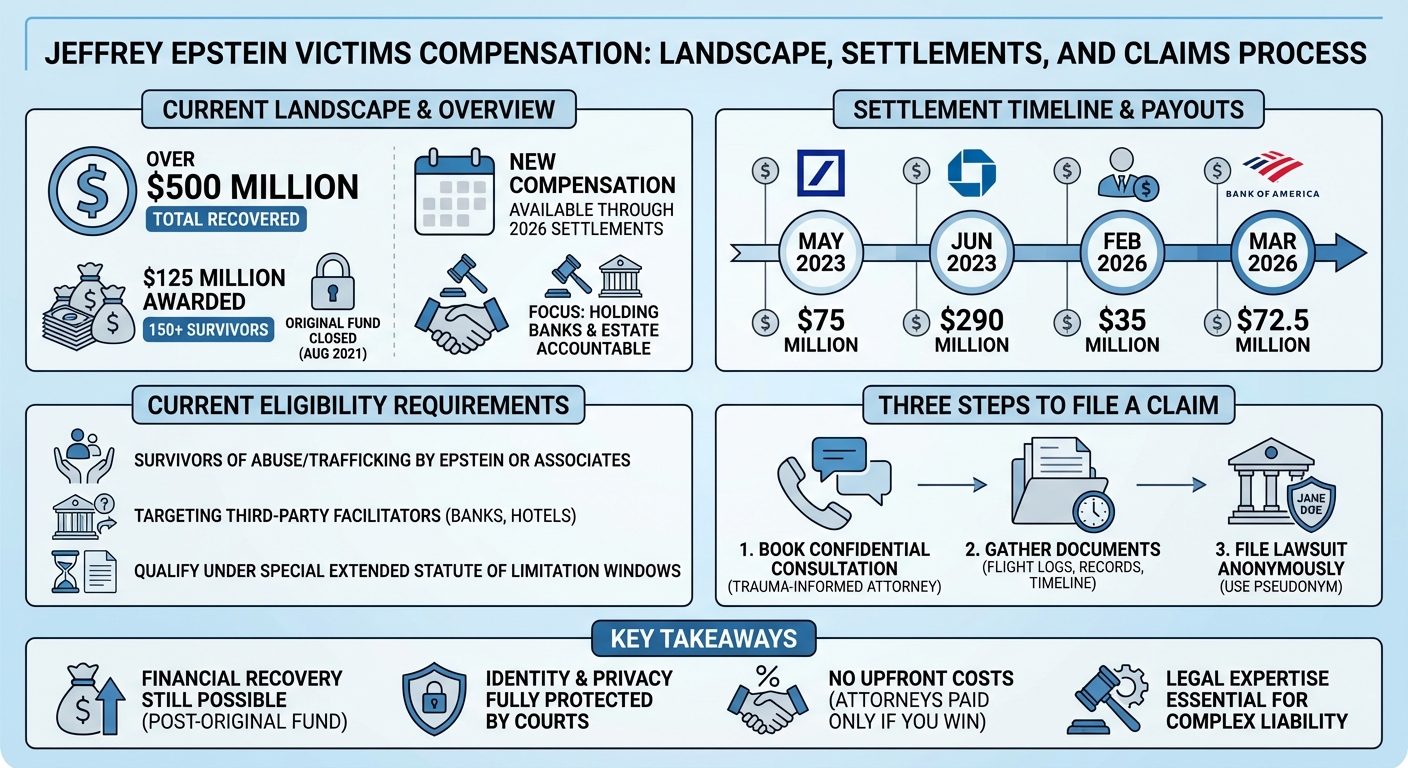
The original Jeffrey Epstein Victims’ Compensation Program awarded $125 million to over 150 survivors before closing in August 2021. However, victims can still seek compensation today through recent 2026 class-action settlements, including a $35 million estate settlement and a $72.5 million settlement with Bank of America.
Jeffrey Epstein Victims’ Compensation: 2026 Updates and Legal Options
The pursuit of justice for survivors of Jeffrey Epstein has evolved significantly over the last few years. While the criminal case ended with his death, the civil fight to hold his estate and the institutions that enabled him accountable continues. Today, ongoing legal battles are securing substantial financial recoveries for survivors.
To date, victims have recovered over $500 million through a combination of estate payouts and massive settlements with global financial institutions. If you were affected, understanding the current landscape of the Jeffrey Epstein Victims’ Compensation Fund and subsequent class-action settlements is critical to protecting your legal rights.
The Original Epstein Victims’ Compensation Program (EVCP)
For many survivors, the first avenue for justice was the Epstein Victims’ Compensation Program (EVCP).
When and Why the EVCP Was Established
Established in June 2020, the EVCP was created as an independent, voluntary claims process funded by the Epstein estate. Its goal was to provide a confidential, non-adversarial alternative to traditional litigation, allowing survivors of Epstein’s sexual abuse and trafficking to seek restitution without enduring a public trial.
Total Payouts and Program Closure
The EVCP was highly active during its operational window. By the time the original claims process officially closed in August 2021, the program had awarded approximately $125 million to over 150 eligible claimants. While this fund is now closed to new applicants, the fight for compensation did not end there.
Recent Major Settlements: The Estate and Financial Institutions
Because Epstein did not operate in a vacuum, legal focus shifted toward the third parties—specifically major banks—that facilitated his sex trafficking ring by ignoring glaring red flags. Recent years, particularly 2026, have seen landmark settlements.
The 2026 Epstein Estate Settlement ($35 Million)
In February 2026, the executors of the Epstein estate reached a $35 million settlement in a class-action lawsuit brought by victims. This unopposed settlement permanently shields the estate’s executors from further civil liability but provides a new pool of compensation for survivors who missed the original EVCP window.
Bank of America Settlement (March 2026 – $72.5 Million)
In March 2026, Bank of America agreed to pay $72.5 million to settle a lawsuit alleging the bank overlooked obvious signs that Epstein’s accounts were being used to finance his abuse of young women. This marks another major victory in holding financial facilitators accountable.
JPMorgan Chase Settlement (June 2023 – $290 Million)
One of the largest recoveries to date occurred in June 2023, when JPMorgan Chase agreed to a staggering $290 million settlement with Epstein survivors. The lawsuit, spearheaded by a survivor known as Jane Doe 1, accused the bank of financially enabling Epstein’s crimes for over a decade.
Deutsche Bank Settlement (May 2023 – $75 Million)
Shortly before the JPMorgan agreement, Deutsche Bank settled a similar class-action lawsuit for $75 million, compensating victims for the bank’s role in maintaining Epstein’s accounts despite his prior conviction for sex offenses.
Timeline and Breakdown of Epstein-Related Settlements
| Date | Defendant / Entity | Settlement Amount | Status |
|---|---|---|---|
| August 2021 | Original EVCP (Epstein Estate) | $125 Million | Closed |
| May 2023 | Deutsche Bank | $75 Million | Settled |
| June 2023 | JPMorgan Chase | $290 Million | Settled |
| February 2026 | Epstein Estate (Executors) | $35 Million | Settled |
| March 2026 | Bank of America | $72.5 Million | Settled |
Who is Eligible for Epstein-Related Compensation Today?
Even with the original fund closed, compensation is still accessible through ongoing class actions and new settlements.
- Survivors of Sexual Abuse and Trafficking: Any individual who was sexually abused, assaulted, or trafficked by Jeffrey Epstein or his associates may be eligible to join current settlement classes.
- Third-Party Liability Claims: Eligibility now heavily involves claims against banks, hotels, and recruitment facilitators who turned a blind eye to the abuse.
- Statute of Limitations: While standard personal injury timelines vary by state, special lookback windows (like the New York Adult Survivors Act) and the nature of class-action settlements have temporarily extended the deadlines for many victims to file claims.
How to File a Claim or Join a Lawsuit
Taking legal action against powerful estates and financial institutions requires a strategic approach.
Step 1: Schedule a Confidential Consultation
The first step is to speak with a trauma-informed sexual abuse attorney. These consultations are strictly confidential and designed to evaluate your eligibility for current settlement pools without pressuring you.
Step 2: Gathering Evidence and Establishing a Timeline
Your legal team will help you compile necessary documentation. This may include flight logs, financial records, witness testimonies, or personal accounts that establish a timeline of the abuse and connect it to the liable third parties.
Step 3: Filing Under a Pseudonym (Jane Doe)
Privacy is a top concern for survivors. The legal system allows victims of sexual assault to file their claims anonymously using pseudonyms like “Jane Doe.” This ensures your identity remains protected from the public and the media throughout the entire process.
Why You Need an Experienced Sexual Abuse Attorney
Securing compensation in the aftermath of the Epstein scandal is highly complex. An experienced attorney provides crucial advantages:
- Navigating Corporate Liability: Proving that a global bank or estate executor is liable requires deep resources and an understanding of complex financial and corporate laws.
- Maximizing Compensation: Well-funded institutions will deploy aggressive defense teams. A skilled lawyer ensures your claim is valued correctly based on the trauma endured.
- Contingency Fee Basis: Reputable sexual abuse attorneys work on a contingency fee basis. This means you pay zero upfront costs, and your legal team only gets paid if they successfully recover compensation for you.
Frequently Asked Questions (FAQs)
Is the original Epstein Victims’ Compensation Fund still open?
No, the original EVCP officially closed to new claims in August 2021. However, survivors can still seek financial recovery through recent 2026 class-action settlements involving the Epstein estate and major banks.
Can I still sue the banks that facilitated Epstein’s crimes?
Yes. Survivors continue to successfully hold financial institutions accountable. Recent settlements with Bank of America, JPMorgan Chase, and Deutsche Bank prove that third-party facilitators can be made to pay for their negligence.
How much compensation are victims receiving on average?
Compensation amounts vary based on the specific settlement and the severity of the abuse. The original EVCP paid out $125 million to roughly 150 victims (averaging over $800,000 per claim), while recent bank settlements use tiered allocation models to distribute funds.
Will my identity be made public if I file a lawsuit?
No. Courts routinely grant sexual abuse survivors the right to file under pseudonyms, such as “Jane Doe,” ensuring complete anonymity and privacy during the legal proceedings.