

Table of contents
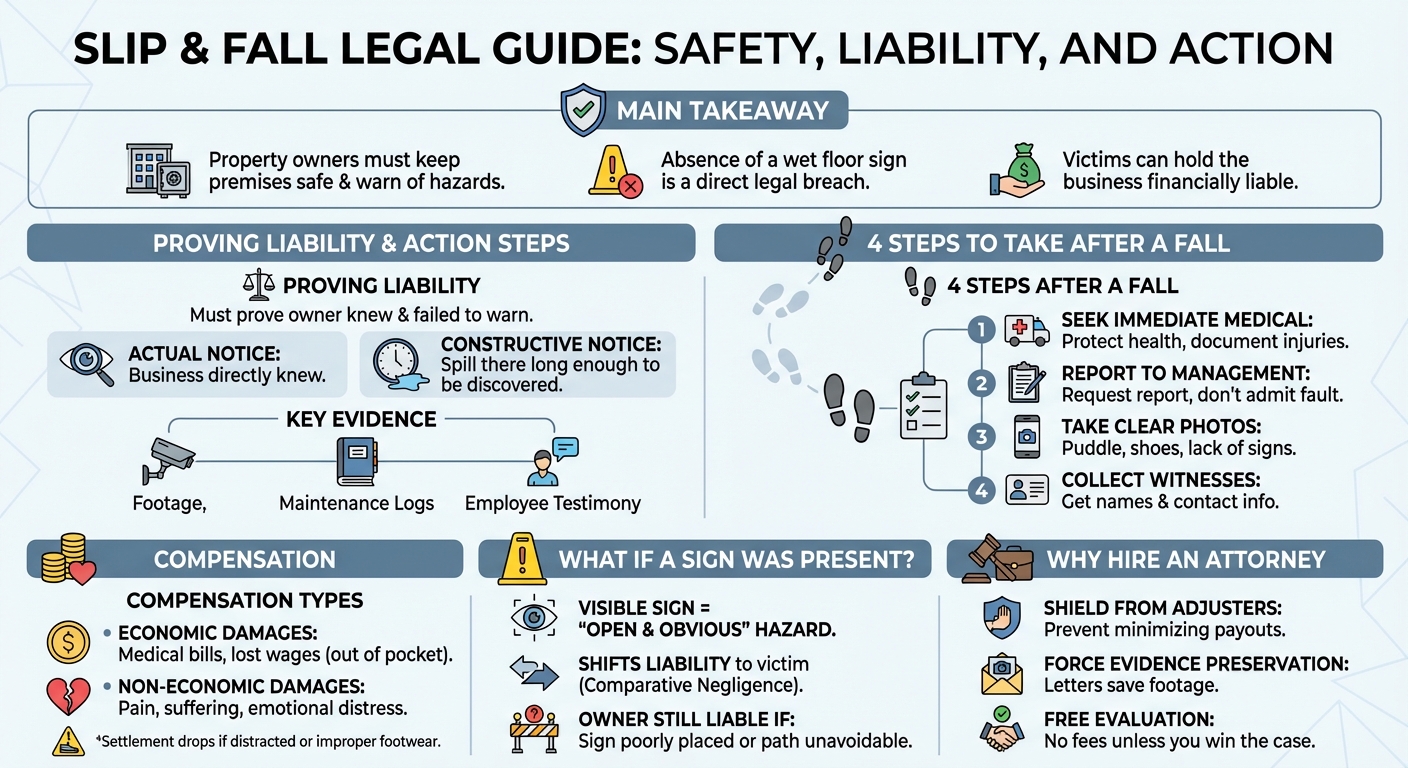
If you slip on a wet floor with no warning sign, you can typically hold the property owner liable for your injuries. Property owners have a legal duty to warn visitors of hazards. The absence of a wet floor sign serves as strong evidence of negligence, allowing you to seek compensation.
Slipped on a Wet Floor with No Sign? Your Legal Rights Explained
Walking into a grocery store, restaurant, or office building shouldn’t end in a trip to the emergency room. Yet, slipping on a wet floor with no sign is one of the most common causes of severe premises liability injuries. When a business fails to warn you of a hazard, they can be held financially responsible for the aftermath.
Understanding Premises Liability Basics
Premises liability is the legal concept that holds property owners and managers responsible for maintaining a safe environment. When you enter a business as a customer or invited guest, you are owed the highest duty of care. This means the property owner must actively inspect the premises for hazards and either fix them promptly or provide a clear warning.
Why the Absence of a Warning Sign Matters
A bright yellow caution sign is more than just a piece of plastic; it is a legal shield for the business and a necessary warning for you. The absence of a warning sign when a floor is freshly mopped, leaking, or spilled upon is a direct breach of the owner’s duty of care. Without a sign, you have no reasonable way to anticipate the danger, placing the fault squarely on the property owner.
What happens if there is no wet floor sign?
If there is no wet floor sign, the property owner can be held liable for your injuries. The absence of a warning sign demonstrates a failure to warn visitors of a known hazard, which strongly supports your negligence claim and increases your chances of recovering compensation.
Establishing a Failure to Warn
To win a slip and fall case, you must establish that the business failed to warn you of a danger they knew existed. If an employee mopped the floor and walked away without placing a cone, they created an invisible hazard. This failure to warn is the cornerstone of your legal claim.
How It Strengthens Your Negligence Claim
Insurance companies often try to blame the victim, arguing that you should have watched where you were going. However, water or clear liquids on tile or linoleum are notoriously difficult to see. The lack of a wet floor sign neutralizes the defense’s argument that the hazard was ‘open and obvious,’ making your negligence claim significantly stronger.
Proving the Property Owner Knew About the Hazard
It is not enough to simply prove the floor was wet. You must also prove the property owner had knowledge of the hazard before your fall.
Actual Notice vs. Constructive Notice
Liability hinges on two types of notice. Actual notice means the business explicitly knew about the spill (e.g., an employee dropped a jug of milk). Constructive notice means the spill was there long enough that a reasonable property owner should have discovered it during routine inspections.
The ‘Reasonable Time’ Standard for Cleaning Spills
The law grants businesses a ‘reasonable time’ to discover and address hazards. If a customer spills water and you slip on it five seconds later, the store may not be liable. But if the puddle sat there for 45 minutes while employees walked past it, the business has failed the reasonable time standard.
Evidence Needed (CCTV, Maintenance Logs, Employee Testimony)
Proving notice requires hard evidence. Your attorney will seek to obtain CCTV surveillance footage showing how long the spill existed. They will also request sweep logs, maintenance records, and employee testimony to determine if the business was following its own safety protocols.
What to do if you slip on a wet floor?
If you slip on a wet floor, immediately seek medical attention for your injuries. Next, report the incident to management and request a written report. Document the scene by taking photos of the wet floor and the lack of warning signs, and collect contact information from any witnesses.
Seek Immediate Medical Attention
Your health is the priority. Adrenaline can mask the pain of torn ligaments, fractures, or concussions. Seeing a doctor immediately not only protects your health but also creates a time-stamped medical record linking your injuries directly to the fall.
Report the Incident to Management
Notify a manager or supervisor before you leave the premises. Ask them to file a formal incident report and request a copy for your records. Do not sign any waivers or admit fault during this conversation.
Document the Scene (Photos of the Floor and Lack of Signs)
Evidence disappears quickly. Use your smartphone to take wide-angle and close-up photos of the puddle, the surrounding area, and the explicit lack of wet floor signs. Capture the footwear you were wearing as well.
Collect Witness Contact Information
Independent witnesses are invaluable. If another customer saw you fall or noticed the spill earlier, get their name, phone number, and email address. Their objective testimony can prevent the store from changing the narrative.
How much compensation for slipping on a wet floor?
Compensation for slipping on a wet floor varies widely, ranging from a few thousand to hundreds of thousands of dollars. The exact amount depends on your economic damages, like medical bills and lost wages, plus non-economic damages, such as pain and suffering and the severity of your injuries.
Economic Damages (Medical Bills, Lost Wages)
Economic damages reimburse you for out-of-pocket losses. This includes emergency room visits, physical therapy, surgeries, mobility aids, and any wages you lost while recovering from your injuries.
Non-Economic Damages (Pain and Suffering)
Non-economic damages compensate you for the physical pain, emotional distress, and loss of enjoyment of life caused by the fall. Severe injuries, such as traumatic brain injuries or spinal cord damage, result in higher non-economic payouts.
Factors That Increase or Decrease Settlement Value
Your settlement value can increase if the property owner’s negligence was particularly egregious. Conversely, it can decrease if the insurance company successfully argues that you were distracted (e.g., texting while walking) or wearing inappropriate footwear.
Are you responsible if a person slips when there is a wet floor sign?
If a person slips when there is a wet floor sign, the property owner might not be fully responsible. A visible sign serves as a warning, making the hazard open and obvious. However, liability depends on comparative negligence, sign placement, and whether the hazard was completely unavoidable.
How Warning Signs Affect Liability
When a business properly places a wet floor sign, they fulfill their duty to warn. If a customer ignores the sign and walks through the puddle anyway, the business can argue that the customer assumed the risk, shifting the liability away from the property owner.
Comparative Negligence and Open/Obvious Hazards
Most states follow comparative negligence rules. If a sign was present but you still fell, a jury might find you partially at fault. If the hazard was deemed ‘open and obvious,’ your compensation could be reduced by your percentage of fault, or barred entirely depending on your state’s laws.
When a Sign Isn’t Enough (Poor Placement or Unavoidable Hazards)
Simply throwing a sign in the general vicinity isn’t a get-out-of-jail-free card for businesses. If the sign was hidden behind a display, placed too far from the actual spill, or if the wet floor spanned an unavoidable pathway (like the only exit), the property owner may still be held liable.
Why You Need a Slip and Fall Attorney
Slip and fall cases are notoriously difficult to win without legal representation. Property owners and their corporate insurers fight these claims aggressively to protect their bottom line.
Dealing with Aggressive Insurance Adjusters
Insurance adjusters are trained to minimize your payout. They may call you shortly after the accident, acting friendly, while trying to get you to provide a recorded statement that damages your case. An attorney handles all communication, protecting your rights.
Securing Time-Sensitive Evidence
Surveillance footage is often overwritten within 24 to 48 hours. A skilled attorney will immediately send a spoliation letter to the business, legally compelling them to preserve the video footage of your fall and the events leading up to it.
Free Case Evaluation
If you or a loved one suffered an injury after slipping on a wet floor with no sign, do not wait to seek legal help. Most personal injury attorneys offer a free case evaluation and work on a contingency fee basis, meaning you pay nothing unless they win your case.