

Table of contents
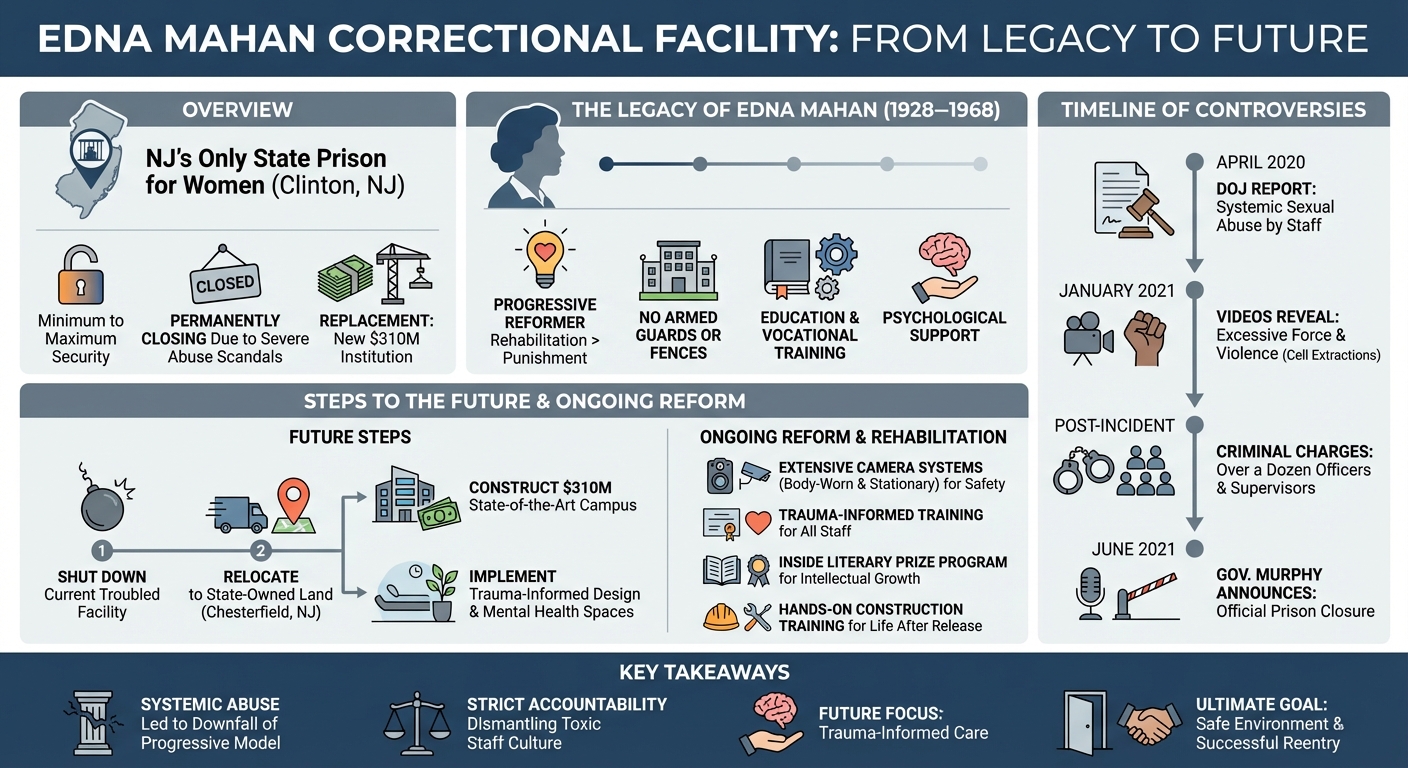
The Edna Mahan Correctional Facility for Women is New Jersey’s only state prison for female offenders. Named after progressive prison reformer Edna Mahan, the facility has recently faced severe abuse scandals. Consequently, the state is closing the prison and building a new $310 million women’s facility to replace it.
The Edna Mahan Correctional Facility: History, Controversies, and Future
The Edna Mahan Correctional Facility for Women (EMCF) is New Jersey’s only state-level prison for female offenders. Located in Clinton, New Jersey, the institution has a complex legacy. Originally celebrated as a pioneering model for female rehabilitation, the facility has spent recent years at the center of severe abuse scandals and federal investigations. Today, the state is in the process of permanently closing EMCF, marking the end of an era and the beginning of a massive cultural and infrastructural reform in New Jersey’s correctional system.
Who is Edna Mahan?
Edna Mahan was a pioneering American correctional administrator who served as the superintendent of the New Jersey Reformatory for Women (Clinton Farms) from 1928 to 1968. Known for her progressive approach to female rehabilitation, her 40-year career left a lasting legacy, leading New Jersey to rename its only women’s prison in her honor.
Early Career and Appointment in 1928
Edna Mahan began her career in corrections in 1923, gaining early experience in the California penal system. In 1928, at just 28 years old, she was appointed as the superintendent of the New Jersey Reformatory for Women. Her appointment was considered highly progressive for the era, bringing a fresh, reform-focused perspective to the East Coast.
Superintendent of Clinton Farms (1928-1968)
During her 40-year tenure at what was then known as Clinton Farms, Mahan transformed the facility. She operated the institution without perimeter fences or armed guards, relying instead on an honor system. She championed the idea that incarcerated women needed education, vocational training, and psychological support rather than strict punitive measures.
Legacy in Women’s Correctional Reform
Mahan’s philosophy heavily influenced modern correctional frameworks. She advocated for integrating incarcerated women into the community through supervised work release programs. Upon her retirement in 1968, she was widely regarded as one of the most influential figures in American penal reform, prompting the state to rename the facility the Edna Mahan Correctional Facility for Women.
History of New Jersey’s Only Women’s Prison
From Clinton Farms to EMCF
Opened in 1913 as Clinton Farms, the facility was originally designed as a working farm where women could learn agricultural and domestic skills. Over the decades, as the state’s penal philosophy shifted and the population grew, the open-campus model was gradually replaced with standard prison infrastructure, culminating in its renaming to EMCF.
Facility Layout and Custody Levels
EMCF is situated on a sprawling campus in Hunterdon County. Unlike standard male prisons, it houses offenders across all security classifications—minimum, medium, and maximum custody—within a single compound. The layout includes multiple distinct housing units, a medical wing, and vocational training centers.
Demographics of the Incarcerated Population
The facility houses female offenders aged 16 and older who have been sentenced to state prison terms. The population demographics reflect broader systemic trends, with a significant percentage of the women serving time for non-violent offenses, though maximum-security inmates convicted of severe felonies are also housed on the premises.
Controversies, Abuse Scandals, and the DOJ Investigation
Systemic Abuse and the Department of Justice Report
In April 2020, the U.S. Department of Justice released a scathing report detailing a long-standing pattern of sexual abuse at EMCF. The investigation revealed that staff members routinely abused incarcerated women, and the New Jersey Department of Corrections (NJDOC) failed to implement adequate safeguards, violating the inmates’ constitutional rights.
The January 2021 Cell Extraction Videos
Public outrage peaked in early 2021 when the state Attorney General’s office released disturbing videos of violent cell extractions that occurred on January 12, 2021. The footage showed officers using excessive force, pepper spray, and physical violence against several inmates, resulting in severe injuries and prompting immediate political intervention.
Criminal Charges and Accountability Measures
Following the January 2021 incident, more than a dozen correctional officers and supervisors were criminally charged with official misconduct, aggravated assault, and tampering with public records. The state appointed an independent monitor to oversee the facility, and sweeping accountability measures were introduced to dismantle the toxic culture among the staff.
Is Edna Mahan closing?
Yes, the Edna Mahan Correctional Facility is closing. Following a Department of Justice investigation and severe abuse scandals, New Jersey Governor Phil Murphy announced plans to shut down the troubled prison. It will be replaced by a new $310 million women’s correctional facility located in Chesterfield, New Jersey.
Governor Murphy’s Announcement to Close EMCF
In June 2021, Governor Phil Murphy publicly declared that EMCF had a long history of systemic abuse that could not be fixed through policy changes alone. He announced the state’s commitment to permanently closing the facility, stating that the incarcerated women deserved a safe, modern environment free from the shadow of past traumas.
Construction of the New $310M Women’s Prison
To replace EMCF, New Jersey has allocated $310 million for the construction of a state-of-the-art women’s correctional facility. The new prison is designed with a trauma-informed approach, featuring modernized housing, enhanced surveillance to protect inmates, and dedicated spaces for mental health treatment and family visitation.
Relocation to the Albert C. Wagner Youth Correctional Facility Site
The new women’s prison is being built on state-owned land adjacent to the Albert C. Wagner Youth Correctional Facility in Chesterfield, New Jersey. This location was chosen to provide a centralized, accessible campus that allows for easier staff recruitment and better access to community-based rehabilitation programs.
Rehabilitation Programs and Cultural Reform at EMCF
The Inside Literary Prize Initiative
Despite its troubled history, EMCF has continued to host valuable rehabilitation programs. Recently, incarcerated women at the facility participated in the Inside Literary Prize, an initiative led by Freedom Reads. This program empowers inmates by allowing them to read, discuss, and vote on contemporary literature, fostering intellectual growth and community.
New Construction Skills Partnerships
To prepare women for successful reentry into society, the NJDOC has introduced new vocational partnerships. Incarcerated women at EMCF can now enroll in hands-on construction skills training. These programs provide industry-recognized certifications, equipping participants with the tools needed to secure stable, well-paying jobs upon release.
Ongoing Cultural Reform Efforts by the NJDOC
The NJDOC has implemented strict cultural reform initiatives at EMCF while the new facility is being built. These efforts include the installation of extensive body-worn and stationary camera systems, enhanced trauma-informed training for all staff, and the establishment of anonymous reporting channels to ensure inmate safety and staff accountability.
Frequently Asked Questions About Women’s Prisons
What state has the most female inmates?
Texas currently holds the highest number of female inmates in the United States. With a massive state prison system, Texas consistently reports the largest population of incarcerated women, followed closely by states like California and Florida, reflecting broader national trends in state-level incarceration rates.
What are female prisons called?
Female prisons are typically called women’s correctional facilities, women’s prisons, or reformatories. In the past, they were often referred to as reformatories for women or prison farms, emphasizing rehabilitation and domestic labor. Today, modern terminology favors correctional facility or correctional institution to align with standard criminal justice naming conventions.