

Table of contents
Back pain after being rear-ended is typically caused by the sudden whipping motion that overstretches muscles and compresses the spine. Common injuries include whiplash, muscle strains, and herniated discs. You should seek immediate medical attention, document your symptoms, and consult a personal injury attorney to protect your rights.
Getting hit from behind is a jarring experience, and the physical toll often doesn’t become apparent until hours or even days later. If you are experiencing back pain after being rear-ended, you are not alone. The violent, unexpected forces involved in these crashes make the spine highly vulnerable to injury, ranging from minor muscle strains to severe spinal disc damage.
The Hidden Impact: Why Rear-End Collisions Cause Severe Back Pain
The physics of a rear-end crash and spinal compression
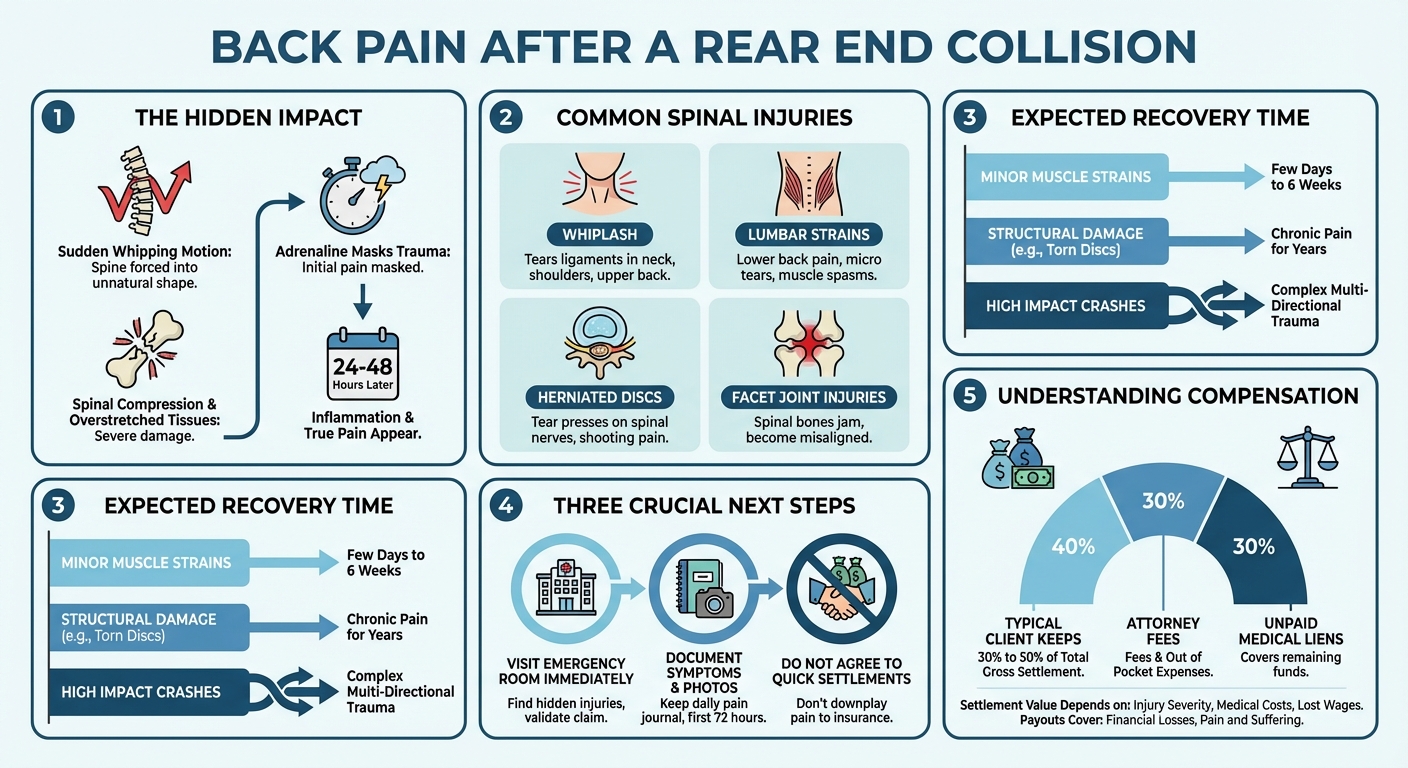
When a vehicle strikes yours from behind, your car is violently pushed forward. However, your body, adhering to the laws of inertia, wants to stay in place. Your seat pushes your torso forward, but your head and neck snap backward before violently whipping forward. This rapid acceleration-deceleration forces the spine into an unnatural “S” shape, causing severe spinal compression and overstretching the surrounding soft tissues.
Why delayed pain symptoms are incredibly common
It is entirely normal to walk away from a rear-end collision feeling perfectly fine, only to wake up the next morning in agonizing pain. During a crash, your body releases a massive surge of adrenaline and endorphins. These “fight or flight” hormones act as natural painkillers, masking the immediate signs of trauma. As these hormones wear off over the next 24 to 48 hours, the inflammation sets in, and the true extent of your back pain reveals itself.
Is back soreness normal after a car accident?
Yes, back soreness is incredibly normal after a car accident. The sudden force of a collision jolts your spine out of alignment and overstretches your muscles. Even minor fender benders can cause significant soreness that appears hours or days later due to adrenaline masking the initial trauma.
Common Back Injuries Sustained in Rear-End Crashes
Whiplash and its effect on the upper back and neck
While whiplash is primarily known as a neck injury, the trauma frequently radiates down into the upper back and shoulders. The violent whipping motion can tear ligaments and muscles in the cervical and thoracic spine, leading to stiffness, burning pain, and restricted range of motion.
Muscle strains and ligament sprains in the lower back
The lower back (lumbar spine) absorbs a massive amount of kinetic energy during a rear-end impact. This force can stretch the muscles and ligaments beyond their normal limits, causing micro-tears. Lumbar strains are characterized by localized pain, muscle spasms, and difficulty standing up straight.
Herniated and bulging discs
The spinal discs act as shock absorbers between your vertebrae. The immense pressure of a rear-end crash can cause the tough outer layer of a disc to bulge or tear, allowing the soft inner core to leak out and press against sensitive spinal nerves. This often results in sharp, shooting pain, numbness, or tingling down the legs (sciatica). For a deeper dive into this specific injury, read our complete guide on Herniated and Bulging Discs After a Texas Car Accident: What You Need to Know.
Facet joint injuries and spinal misalignment
Facet joints connect the bones of your spine and allow you to bend and twist. A sudden impact can cause these joints to jam together or become misaligned, leading to chronic pain, inflammation, and a condition known as facet joint syndrome.
How long does back pain last after getting rear-ended?
Back pain after getting rear-ended typically lasts anywhere from a few days to six weeks for minor muscle strains. However, if you suffered structural damage like a herniated disc or severe whiplash, chronic pain can persist for months or even years without proper medical intervention.
How long does it take for back muscles to heal after a fall?
Back muscles typically take two to four weeks to heal after a minor fall, provided you rest and use ice or heat therapy. Severe muscle tears or sprains can take up to six weeks or longer, often requiring physical therapy to fully restore mobility.
Comparing fall injuries to high-impact car accident trauma
While a fall usually involves localized, blunt-force trauma to a specific area of the back, a rear-end car accident involves multi-directional, high-velocity forces. Car accidents are much more likely to cause complex, multi-level spinal injuries, nerve compression, and whiplash compared to a standard slip and fall.
Crucial Next Steps: Protecting Your Health and Your Claim
Why you must visit the ER immediately
Never assume your back pain will just “go away.” Getting a prompt medical evaluation is critical for identifying hidden injuries like internal bleeding or spinal fractures. Furthermore, a delayed medical visit can give insurance companies an excuse to deny your claim. Learn more about Why You Should Never Skip the Emergency Room After a Texas Car Accident.
Documenting your pain in the first 72 hours
The days immediately following your crash are critical. Keep a daily pain journal, take photos of any bruising, and follow all doctor recommendations. Discover exactly What to Do in the First 72 Hours After Your Houston Car Accident to protect your physical and financial recovery.
Navigating the insurance company’s initial calls
Insurance adjusters often call quickly, hoping to catch you off guard and secure a recorded statement that minimizes your injuries. Do not downplay your back pain or agree to a quick settlement before knowing the full extent of your injuries. Read The Truth About Dealing with Insurance Companies After a Houston Car Accident before you pick up the phone.
Compensation for Back Injuries: What to Expect
Factors that influence your back injury settlement value
The value of a back injury claim varies wildly based on several factors:
- Severity of the injury: A permanent herniated disc will yield a higher settlement than a temporary muscle strain.
- Medical expenses: The total cost of your ER visits, physical therapy, imaging (MRIs), and potential surgeries.
- Lost wages: Compensation for the time you missed from work due to your back pain.
- Impact on daily life: How the injury affects your ability to sleep, exercise, or care for your family.
Economic vs. non-economic damages for chronic back pain
Your settlement should cover both economic damages (tangible financial losses like medical bills and lost income) and non-economic damages (intangible losses like pain and suffering, emotional distress, and loss of enjoyment of life).
How much of a $100K settlement will I get?
From a $100,000 settlement, you will typically receive between $30,000 and $50,000 in your pocket. This amount is calculated after deducting standard attorney contingency fees (usually 33% to 40%), outstanding medical liens, and out-of-pocket case expenses like court filing fees or expert witness costs.
Breaking down attorney fees, medical liens, and out-of-pocket costs
To understand where the money goes, here is a hypothetical breakdown of a $100,000 settlement:
| Expense Category | Estimated Amount |
|---|---|
| Total Gross Settlement | $100,000 |
| Attorney Contingency Fee (e.g., 33.3%) | -$33,333 |
| Case Expenses (Filing fees, records, experts) | -$2,500 |
| Medical Liens / Unpaid Bills | -$20,000 |
| Net to Client (Your Pocket) | $44,167 |
Note: This is just an example. Your actual net settlement will depend on your specific fee agreement and the exact amount of your medical bills.