

Table of contents
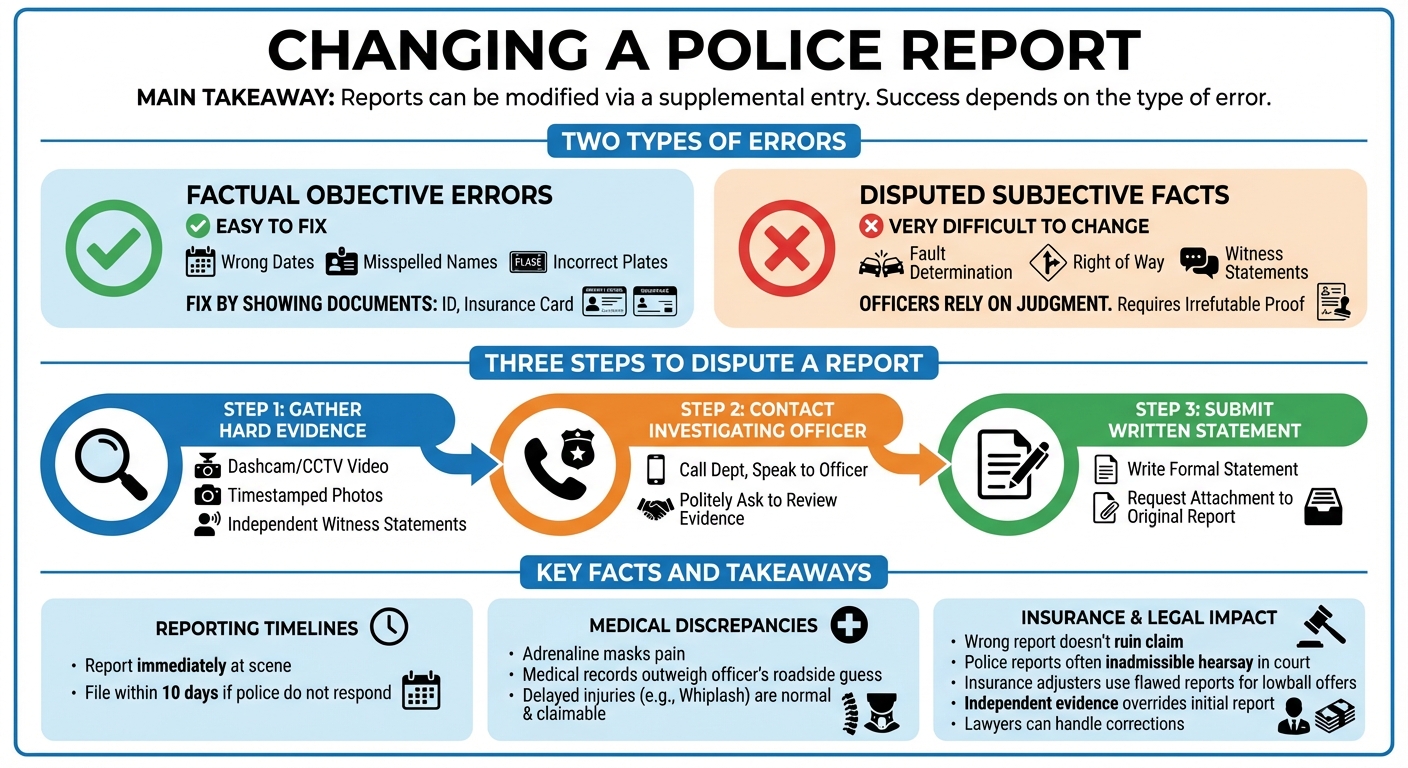
Yes, a police report can be changed after an accident, but the process depends on the type of error. Objective factual mistakes—such as an incorrect date, misspelled name, or wrong insurance policy number—are usually easy to amend by providing documentation to the investigating officer. However, subjective disputes, like witness statements or fault determinations, are much harder to modify. To change subjective findings, you typically must provide irrefutable evidence, such as dashcam footage. If the officer refuses to amend the report, you can request to attach a supplemental written statement detailing your version of events.
Can a Police Report Be Changed After an Accident?
Discovering an error on your car accident report can be stressful, especially when insurance companies use that document to determine fault and payout amounts. Fortunately, it is possible to change a police report after an accident, though the process depends heavily on the type of error you are trying to correct. While objective mistakes are relatively easy to fix, changing an officer’s subjective opinion requires substantial proof.
Can a police report be modified?
Yes, a police report can be modified after it is filed, but typically only by the investigating officer who originally wrote it. Instead of erasing the original document, the officer will usually issue a supplemental report that corrects the errors or adds new information to the official case file.
Factual Errors vs. Disputed Information
The success of your request to amend a crash report comes down to whether the mistake is an objective fact or a subjective conclusion.
How to Fix Objective Factual Errors
Objective errors are simple, verifiable mistakes. Law enforcement officers are usually willing to correct these quickly because they do not change the narrative of the crash. Examples include:
- Incorrect vehicle make, model, or license plate number
- Misspelled names or wrong addresses
- Incorrect date, time, or location of the crash
- Wrong insurance policy numbers
To fix these, you simply need to provide the investigating officer with the correct documentation, such as your driver’s license, vehicle registration, or insurance card.
Why Subjective Disputed Facts Are Harder to Change
Subjective disputes involve the officer’s interpretation of the crash. These are notoriously difficult to change because the officer relies on their professional judgment and the evidence available at the scene. Examples include:
- Who had the right of way or a green light
- Witness statements regarding speeding or erratic driving
- The officer’s final determination of fault
An officer will rarely change a subjective finding just because you disagree with it. To successfully amend disputed information, you must present irrefutable evidence that contradicts the original report.
What to do if you disagree with a police accident report?
If you disagree with a police accident report, you should first gather concrete evidence like dashcam footage or photographs. Next, politely contact the investigating officer to request an amendment. If the officer refuses to change the report, you can submit a written supplemental statement to be attached to the official record.
Step 1: Gather Hard Evidence (Photos, Dashcam Footage)
Before contacting the police department, compile evidence that proves the report is wrong. The most compelling evidence includes dashcam video, nearby security camera footage, timestamped photographs of skid marks or vehicle damage, and statements from independent third-party witnesses.
Step 2: Contact the Investigating Officer Directly
Call the police department and ask to speak with the specific officer who drafted the report. Be polite and professional. Explain that you have new evidence that clarifies the events of the crash and ask if they would be willing to review it and issue a supplemental report.
Step 3: Submit a Written Supplemental Statement
If the officer declines to amend the report, you still have options. You can write a formal, factual statement detailing your version of the accident. Submit this to the police department and request that it be permanently attached to the original crash report. While this doesn’t erase the officer’s findings, it ensures your perspective is on the record for insurance adjusters to see.
How long after an accident should it be reported?
In most states, including Texas, an accident involving injury, death, or significant property damage should be reported immediately at the scene by calling 911. If law enforcement does not respond to the scene, you typically have up to 10 days to file a crash report with the Department of Transportation.
Medical Discrepancies: When Injuries Aren’t on the Report
A common issue accident victims face is a police report stating there were “no injuries” at the scene. Because adrenaline masks pain, many severe injuries do not present symptoms until days later. Insurance companies often use this “no injury” notation to deny claims.
Can a car accident cause spinal stenosis?
Yes, a car accident can cause or severely aggravate spinal stenosis. The violent impact of a crash can herniate discs, fracture vertebrae, or cause tissue inflammation that narrows the spinal canal. This places immense pressure on the spinal cord and nerves, leading to pain, numbness, and weakness.
If your report says you were uninjured but you later develop conditions like spinal stenosis, whiplash, or a concussion, do not panic. Medical records from a physician carry far more weight regarding your health than a police officer’s roadside observation.
Does a Wrong Police Report Ruin Your Personal Injury Claim?
A flawed police report is a hurdle, but it does not automatically ruin your case. In fact, police reports are generally considered hearsay and are often inadmissible as evidence of fault in a trial.
Why Insurance Companies Rely on Reports (And How to Fight Back)
Insurance adjusters love to use inaccurate police reports as leverage to offer lowball settlements or deny claims entirely. They know the report isn’t the final word, but they hope you don’t. You can fight back by building an independent body of evidence—utilizing accident reconstruction experts, medical records, and witness depositions—that overrides the initial police report.
How a Houston Car Accident Lawyer Can Help Correct the Record
Dealing with stubborn police departments and aggressive insurance adjusters is overwhelming when you are trying to recover from a crash. An experienced attorney can step in to handle this process for you. They can track down the investigating officer, present compelling evidence to demand an amendment, or draft a legally sound supplemental statement. More importantly, a lawyer will ensure that an inaccurate police report doesn’t stop you from securing the compensation you deserve.