

Table of contents
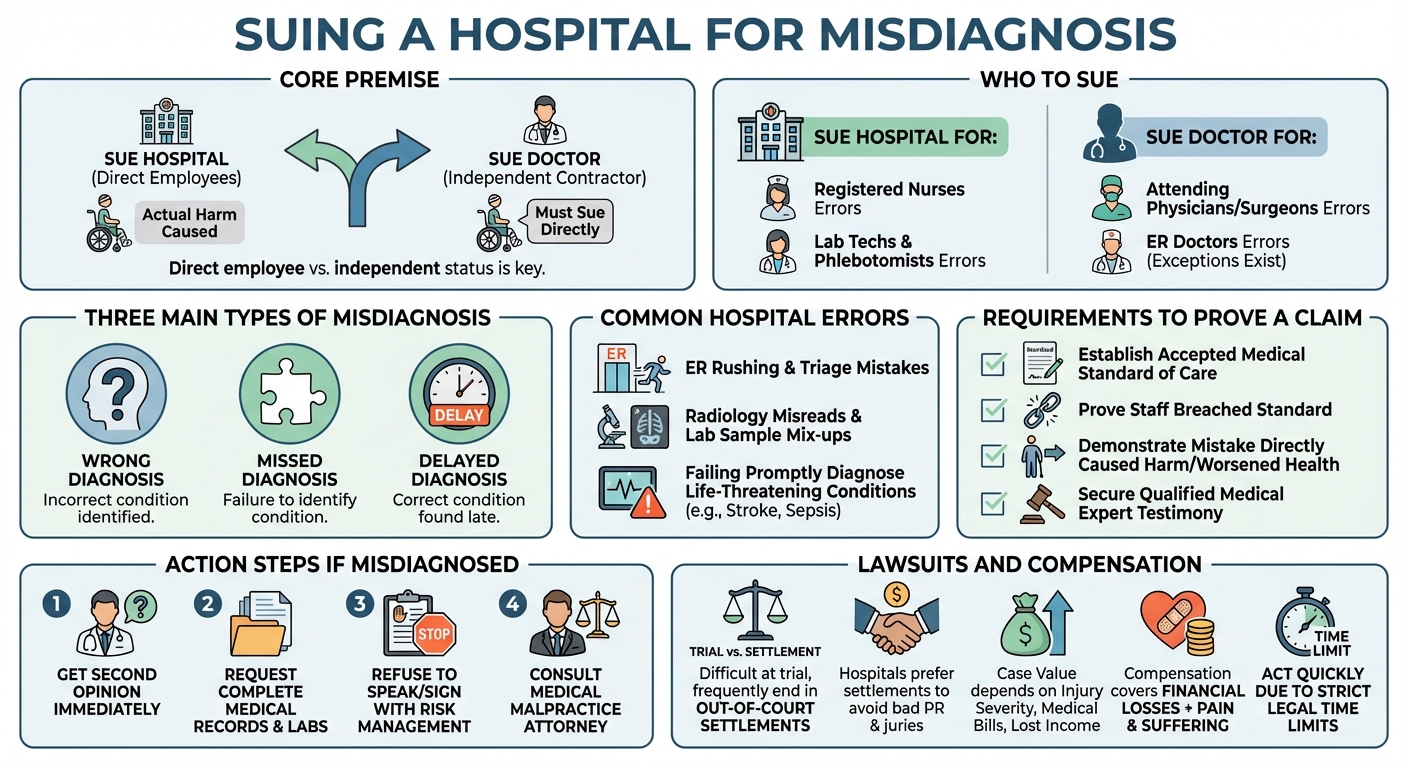
Yes, you can sue a hospital for misdiagnosis if the error was made by a hospital employee, such as a nurse or lab technician, and it resulted in actual harm. However, if the misdiagnosis was made by an independent contractor doctor, you typically must sue the doctor directly.
Can You Sue a Hospital for Misdiagnosis? The Short Answer
Yes, you can sue a hospital for misdiagnosis, but it depends heavily on who made the error and whether their mistake caused you actual harm. If a direct hospital employee—such as a nurse, lab technician, or staff physician—was negligent, the hospital can be held legally responsible. However, if the misdiagnosis was made by a doctor acting as an independent contractor, you typically must sue the doctor directly rather than the hospital.
Hospital Liability vs. Individual Doctor Liability
Understanding who to sue is often the most complex part of a medical malpractice claim. Hospitals are not automatically liable for every medical error that occurs within their walls.
Vicarious Liability: When the Hospital is Responsible
Under the legal doctrine of respondeat superior (vicarious liability), employers are responsible for the negligent acts of their employees. If a hospital employee fails to meet the standard of care and misdiagnoses you, the hospital is liable for the resulting damages.
The Independent Contractor Loophole
Many doctors, including surgeons and emergency room physicians, are not hospital employees. They are independent contractors who simply have admitting privileges. If an independent contractor misdiagnoses you, the hospital is generally shielded from liability. However, exceptions exist—such as if the hospital failed to make it clear that the doctor was not an employee (often an issue in emergency rooms).
Errors by Nurses, Lab Techs, and Hospital Staff
Unlike doctors, nurses, radiologic technologists, and laboratory staff are almost always direct employees of the hospital. If a lab tech mixes up a blood sample or a nurse fails to report critical patient symptoms to the attending physician, the hospital can be sued for the resulting misdiagnosis.
| Medical Professional | Typical Employment Status | Who Do You Sue? |
|---|---|---|
| Attending Physician / Surgeon | Independent Contractor | The Doctor |
| Emergency Room Doctor | Independent Contractor (Usually) | The Doctor (Exceptions Apply) |
| Registered Nurse (RN) | Hospital Employee | The Hospital |
| Lab Technician / Phlebotomist | Hospital Employee | The Hospital |
Common Types of Hospital Misdiagnosis
Misdiagnosis in a hospital setting usually falls into three categories: wrong diagnosis, missed diagnosis, or delayed diagnosis.
Emergency Room Rushing and Triage Errors
Emergency rooms are high-pressure environments. Triage nurses or ER doctors may rush patient evaluations, leading to catastrophic misdiagnoses. For example, discharging a patient with chest pain by diagnosing it as heartburn, only for the patient to suffer a heart attack hours later.
Radiology and Laboratory Mix-Ups
Diagnostic testing is the backbone of modern medicine. If a hospital lab mislabels a biopsy sample, or a radiologist misreads an MRI, the treating physician will base their diagnosis on flawed data. These systemic errors are strong grounds for a hospital lawsuit.
Delayed Diagnosis of Life-Threatening Conditions
A delayed diagnosis occurs when a hospital eventually gets the diagnosis right, but the delay allowed the condition to worsen significantly. This is common with aggressive cancers, strokes, and severe infections like sepsis.
How Do You Prove Misdiagnosis?
To prove misdiagnosis, you must establish the medical standard of care, show that the healthcare provider breached that standard, and demonstrate that this breach directly caused you measurable harm. This process requires gathering comprehensive medical records and securing testimony from qualified medical experts.
Establishing the Standard of Care
The law does not require doctors to be perfect. Instead, it requires them to act as a reasonably competent medical professional would under similar circumstances. This baseline is known as the standard of care.
Proving a Breach of Duty
You must prove that the hospital or its staff deviated from this standard. For instance, if a reasonably competent doctor would have ordered a CT scan for your symptoms, but your doctor failed to do so, that is a breach of duty.
Linking the Misdiagnosis to Actual Harm
A misdiagnosis alone is not enough to win a lawsuit. You must prove “causation”—meaning the misdiagnosis directly caused your condition to worsen, resulted in unnecessary treatments, or caused additional physical and financial suffering.
Gathering Expert Medical Testimony
Medical malpractice cases cannot be won on your word alone. Your attorney will hire independent medical experts in the same specialty to review your records and testify that the hospital’s actions fell below the accepted standard of care.
What Can You Do If a Hospital Misdiagnoses You?
If a hospital misdiagnoses you, immediately seek a second opinion to protect your health. Next, request a complete copy of your medical records and avoid discussing the situation with the hospital’s risk management team. Finally, consult a medical malpractice attorney to evaluate your legal options.
Seek a Second Opinion Immediately
Your health is the top priority. If you suspect a misdiagnosis, go to a different hospital or an independent specialist to get an accurate diagnosis and begin proper treatment.
Request and Secure All Medical Records
Before mentioning a lawsuit, request your complete medical file, including doctor’s notes, lab results, and imaging. These documents are the foundational evidence of your claim.
Avoid Speaking with Hospital Risk Management
Hospital risk managers are employed to protect the hospital’s bottom line. Do not sign any documents, accept early settlement offers, or give recorded statements without an attorney present.
What Are the Odds of Winning a Lawsuit Against a Hospital?
The odds of winning a lawsuit against a hospital depend heavily on the strength of your medical evidence and expert testimony. While medical malpractice cases are notoriously difficult to win at trial, many successful claims are resolved through out-of-court settlements before ever reaching a jury.
Factors That Make or Break Your Case
Your chances of success increase if you have clear-cut evidence of a protocol violation (like a mixed-up lab result), severe and quantifiable damages, and highly credible expert witnesses willing to testify on your behalf.
Why Out-of-Court Settlements Are More Common
Hospitals and their insurance companies prefer to avoid the unpredictable nature of jury trials and the negative public relations that come with them. If your attorney builds an airtight case, the hospital is highly likely to offer a settlement.
How Much Is a Misdiagnosis Worth?
A misdiagnosis lawsuit’s worth depends on the severity of your injuries, resulting medical bills, and lost wages. While minor errors may yield small settlements, severe cases involving permanent disability or wrongful death can result in multi-million dollar payouts. Every case is evaluated on its specific damages.
Calculating Your Damages
Compensation is divided into economic damages (medical bills, lost income, future care costs) and non-economic damages (pain and suffering, loss of quality of life). Your attorney will calculate both to demand maximum compensation.
Average Payouts for Hospital Negligence
Because every case is unique, there is no single “average” payout. However, cases involving catastrophic harm due to hospital negligence frequently settle in the hundreds of thousands to millions of dollars. For a deeper dive into compensation, review our guide on how much you can sue a hospital for negligence.
When to Consult a Medical Malpractice Attorney
Medical malpractice claims are subject to strict statutes of limitations, meaning you only have a limited window of time to file a lawsuit. If you or a loved one has suffered due to a hospital’s misdiagnosis, contact an experienced medical malpractice attorney immediately. They will investigate your claim, identify the liable parties, and fight to secure the compensation you deserve.