
Table of contents
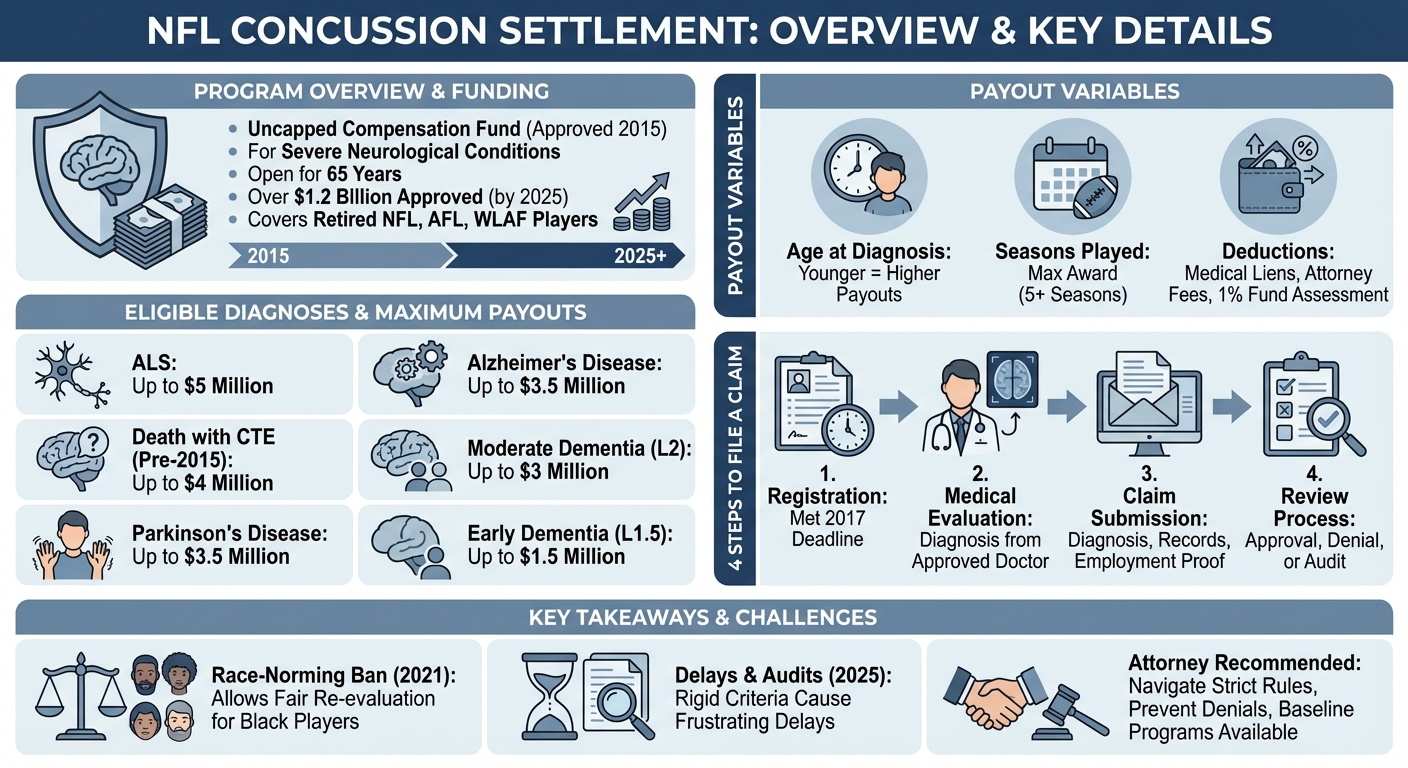
The NFL concussion settlement is an uncapped compensation fund designed to pay retired players suffering from severe neurological conditions. Approved in 2015, it provides payouts of up to $5 million for diagnoses like ALS, Parkinson’s disease, Alzheimer’s, and severe dementia, with claims open for 65 years.
NFL Concussion Settlement: 2025 Updates, Payouts, and Claim Denials
The NFL concussion settlement represents a landmark resolution in sports injury law, designed to compensate retired players suffering from severe neurological conditions. However, despite billions allocated, many former athletes are currently facing frustrating delays and denials. Here is a comprehensive look at the settlement’s history, current status, and how the claims process works.
A Brief History of the NFL Concussion Litigation
The legal battle began when thousands of former players filed lawsuits against the National Football League, alleging the organization concealed the long-term dangers of repeated head trauma and concussions. These cases were consolidated into a multidistrict litigation (MDL No. 2323). In 2013, the NFL reached a tentative agreement with the players, which was finalized and approved by a federal court in 2015.
The $1 Billion Settlement Agreement Explained
Initially estimated at $765 million, the final settlement agreement was approved as an uncapped fund. This means there is no limit to the total amount the NFL might have to pay out over the 65-year lifespan of the agreement. It covers over 18,000 retired players, providing baseline medical exams and monetary awards for specific neurocognitive and neuromuscular diagnoses.
Current Status of the Settlement Fund in 2025
As of 2025, the settlement administrator has approved over $1.2 billion in monetary awards. However, the program is under intense scrutiny. Recent investigations highlight a surprisingly high rate of claim denials, with critics arguing the claims administrator is applying overly strict interpretations of medical records, leaving many impaired players without the support they were promised.
Who is Eligible for Compensation?
Not every former player automatically receives a check. Compensation is strictly tied to specific medical criteria and employment history.
Qualifying Retired NFL Players
To be eligible, an individual must be a retired player who played in the NFL, the American Football League (AFL), or the World League of American Football. Family members or representatives of deceased players who met these criteria may also file derivative claims.
Eligible Medical Diagnoses
The settlement only compensates for specific, severe neurological conditions. These include:
- ALS (Lou Gehrig’s Disease)
- Parkinson’s Disease
- Alzheimer’s Disease
- Level 2 Neurocognitive Impairment (Moderate Dementia)
- Level 1.5 Neurocognitive Impairment (Early Dementia)
- Death with CTE (Only if diagnosed prior to April 22, 2015)
The Role of Baseline Medical Exams (BAP)
The Baseline Assessment Program (BAP) was established to provide eligible retired players with free comprehensive neuropsychological and neurological exams. These exams establish a medical baseline. If a player’s cognitive function declines later in life, this baseline makes it easier to prove the progression of dementia or other qualifying conditions.
NFL Concussion Settlement Payout Tiers
Payouts are highly individualized. The settlement uses a grid system to calculate awards based on the specific diagnosis, the player’s age at the time of diagnosis, and the number of credited seasons played.
Maximum Payouts by Diagnosis (Up to $5 Million)
The maximum possible awards (before any deductions) are capped by the severity of the disease:
| Qualifying Diagnosis | Maximum Potential Award |
|---|---|
| ALS (Lou Gehrig’s Disease) | $5,000,000 |
| Death with CTE (Pre-2015) | $4,000,000 |
| Parkinson’s Disease | $3,500,000 |
| Alzheimer’s Disease | $3,500,000 |
| Level 2 Neurocognitive Impairment | $3,000,000 |
| Level 1.5 Neurocognitive Impairment | $1,500,000 |
How Age and Seasons Played Affect Your Award
To receive the maximum payout for a diagnosis, a player must have five or more eligible seasons in the NFL and be diagnosed at a young age (typically under 45).
- Age: The older a player is at the time of diagnosis, the lower the payout. The settlement assumes that cognitive decline at age 80 is less directly attributable to football than cognitive decline at age 45.
- Seasons: Players with fewer than five credited seasons receive a reduced percentage of the maximum award. For example, a player with only one credited season might receive just 10% of the standard grid amount.
Offsets and Deductions to Be Aware Of
Final payouts are rarely the maximum grid amount. Awards are subject to deductions, including a mandatory 1% assessment for the settlement’s common benefit fund, offsets for failing to participate in the BAP, medical liens (like Medicare/Medicaid), and individual attorney fees.
Navigating Recent Controversies: Claim Denials and Delays
Despite the uncapped nature of the fund, accessing the money has proven difficult for many athletes.
Why Valid Claims Are Being Denied in 2024 and 2025
Recent reports indicate that a large percentage of dementia claims are being denied or sent to an Appeals Advisory Panel (AAP) for audit. The settlement administrator often cites inconsistencies in medical records or failure to meet the highly specific, rigid criteria required by the settlement’s medical manual, even when independent doctors have diagnosed the player with dementia.
The Impact of Race-Norming (and Its Removal)
A major controversy involved “race-norming”—a demographic adjustment in cognitive testing that assumed Black players had a lower baseline cognitive function than white players. This discriminatory practice made it significantly harder for Black players to show cognitive decline and qualify for payouts. Following public outcry and legal action, race-norming was officially banned from the settlement in 2021, and thousands of claims are now eligible for re-evaluation.
What to Do If the Settlement Administrator Delays Your Claim
If your claim is audited or delayed, do not abandon the process. Ensure your evaluating physician strictly adheres to the settlement’s specific diagnostic criteria. Responding to audit requests promptly with comprehensive, certified medical records is critical to moving the claim forward.
How to File a Claim or Appeal a Denial
Filing a successful claim requires precision. A single missing document can trigger a denial.
Step-by-Step Guide to the Claims Process
- Registration: The player must have registered for the settlement by the 2017 deadline (though claims can be filed at any point over the 65-year term).
- Medical Evaluation: Obtain a diagnosis from a Qualified MAF (Monetary Award Fund) Physician or a BAP provider.
- Submit the Claim Package: File the diagnosis, along with all supporting medical records and proof of NFL employment, to the claims administrator (BrownGreer).
- Review Process: The administrator reviews the claim. It may be approved, denied, or sent to an audit panel.
Gathering the Necessary Medical and Employment Records
You must provide irrefutable proof of your NFL tenure (usually verified by the NFL’s records) and comprehensive medical documentation. This includes brain scans, neuropsychological testing data, and detailed physician notes that align perfectly with the settlement’s definitions of impairment.
Why You Need an Attorney for Appeals and Audits
Because the claims administrator is heavily scrutinizing dementia claims, having an attorney experienced in the NFL concussion litigation is vital. If your claim is denied, you have a limited window to file an appeal. A lawyer can help challenge AAP findings, ensure medical experts use the correct legal phrasing, and fight for the compensation you deserve.
Frequently Asked Questions
What is the average settlement for a concussion?
In general personal injury cases (like car accidents), a standard concussion settlement averages between $20,000 and $80,000. However, under the NFL Concussion Settlement, payouts are much higher due to the severity of long-term brain diseases, ranging from hundreds of thousands to up to $5 million based on the diagnosis.
How much is the NFL injury settlement?
The NFL concussion settlement is an uncapped fund, originally estimated at $765 million but now exceeding $1.2 billion in approved payouts. Individual injury payouts within this settlement range from $1.5 million for early dementia up to $5 million for ALS, depending on the player’s age and seasons played.
How much did Colin get from the NFL settlement?
Colin Kaepernick and Eric Reid reached a confidential settlement with the NFL in 2019 regarding their collusion grievance, which is entirely separate from the concussion settlement. While the exact amount remains confidential, reports suggest the combined payout for both players was under $10 million.
What is the most eaten snack in the NFL?
While unrelated to legal settlements, the most eaten snacks at NFL stadiums are classic game-day foods like hot dogs, nachos, soft pretzels, and popcorn. According to stadium concession data, fans consume millions of hot dogs across NFL venues every season.