

Table of contents
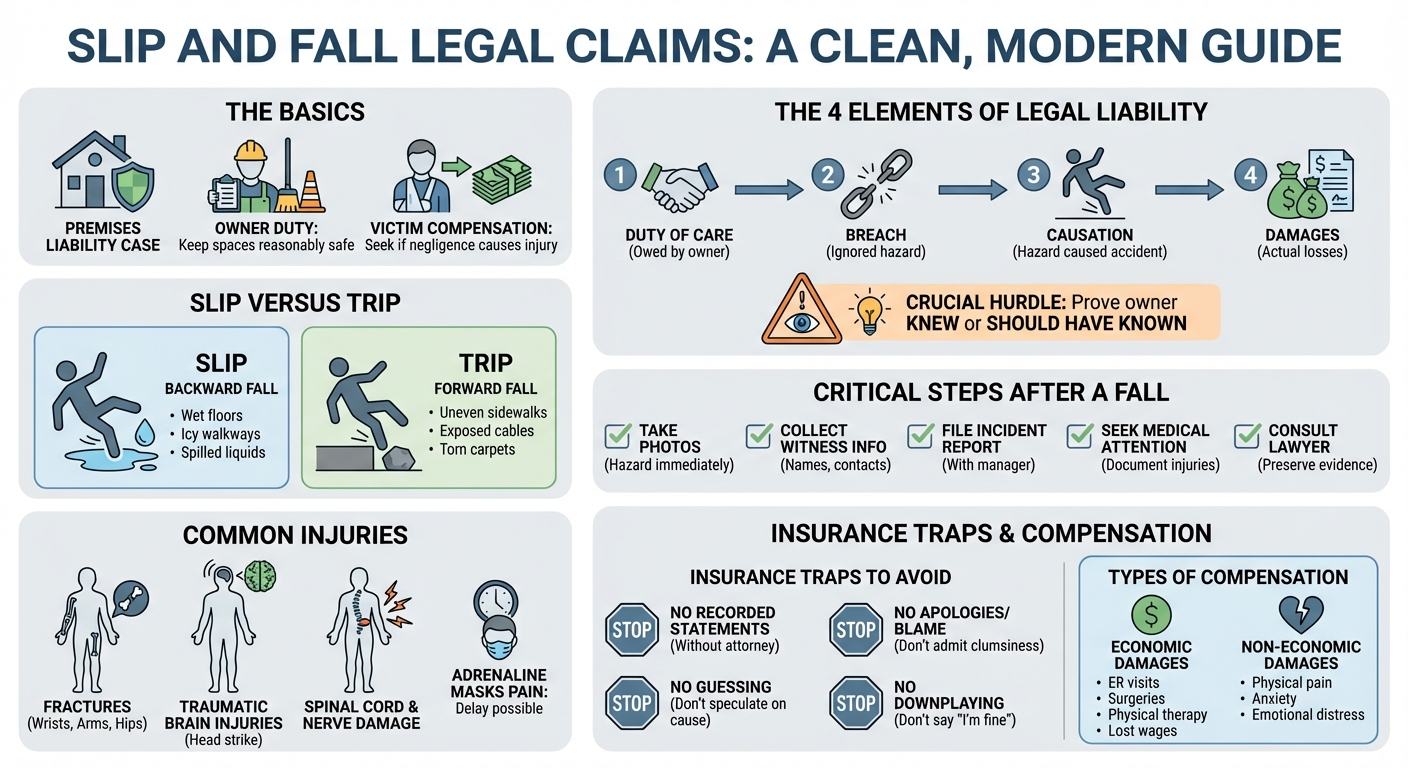
A slip and fall is a type of personal injury claim based on a person slipping, tripping, or falling on someone else’s property. These premises liability cases occur when a property owner’s negligence—such as ignoring wet floors, icy walkways, or broken stairs—creates a dangerous environment that causes an injury.
What is the meaning of slip and fall?
A slip and fall is a type of personal injury case that occurs when a person slips, trips, or falls on someone else’s property and suffers an injury. In the legal world, these incidents fall under a broader category known as premises liability. The core meaning of a slip and fall claim is that a property owner or manager failed to maintain a safe environment, directly resulting in harm to a visitor.
Defining Premises Liability
Premises liability is the legal concept that holds property owners and residents responsible for accidents and injuries that occur on their property. Whether it is a grocery store, a private home, or a public sidewalk, the entity in control of that space has a legal duty to ensure it is reasonably safe and free of hidden hazards.
Slip and Fall vs. Trip and Fall: Key Differences
While often used interchangeably, slips and trips involve different biomechanics and causes. Understanding the difference can be crucial when documenting how your accident occurred.
| Accident Type | Mechanism | Common Causes |
|---|---|---|
| Slip and Fall | A loss of traction between the shoe and the walking surface, usually causing the person to fall backward. | Spilled liquids, recently mopped floors, ice, or highly polished surfaces. |
| Trip and Fall | The foot strikes an object or uneven surface, interrupting momentum and usually causing a forward fall. | Uneven sidewalks, torn carpeting, exposed cables, or cluttered walkways. |
Common Causes of Slip and Fall Accidents
Hazardous conditions can arise in almost any environment. Recognizing these dangers is the first step in both prevention and determining liability after an accident.
Wet and Slippery Surfaces
Liquid spills are the most frequent culprits in retail and dining environments. If a store employee mops a floor but fails to place a “Wet Floor” sign, the business can be held liable for resulting injuries. Leaking refrigeration units and tracked-in mud also create dangerous slip hazards.
Weather-Related Hazards
Property owners must take reasonable steps to clear weather-related dangers. This includes shoveling snow, salting icy walkways, and placing absorbent mats at building entrances during heavy rain to prevent puddles from forming on smooth lobby floors.
Poor Lighting and Negligent Maintenance
When a stairwell is poorly lit, a visitor cannot see hazards like a broken step or a missing handrail. Negligent maintenance—such as ignoring frayed carpets, failing to fix potholes in a parking lot, or leaving debris in walkways—creates an unreasonable risk of injury.
What happens to your body when you slip and fall?
When you slip and fall, your body undergoes a sudden, violent shift in momentum. Because these accidents happen without warning, your muscles do not have time to brace properly, leading to severe impact forces on your bones, joints, and soft tissues.
The Biomechanics of a Sudden Fall
A slip typically causes your feet to fly forward, throwing your center of gravity backward. As you fall, natural reflexes cause you to extend your arms to catch yourself. This transfers the entire weight of your body—multiplied by the force of gravity—directly into your wrists, arms, and shoulders.
Common Injuries: From Fractures to Traumatic Brain Injuries
- Bone Fractures: Wrist, arm, and collarbone fractures are incredibly common due to the instinct to brace for impact. Older adults are particularly vulnerable to devastating hip fractures.
- Traumatic Brain Injuries (TBI): Falling backward often results in the back of the head striking the hard floor, leading to concussions, contusions, or severe TBIs.
- Spinal Cord Damage: Landing hard on the back or tailbone can cause slipped discs, nerve damage, or paralysis.
Hidden Injuries and Delayed Symptoms
Immediately after a fall, your body releases a surge of adrenaline and endorphins. This natural “fight or flight” response can mask severe pain. Soft tissue injuries, whiplash, and internal bleeding may not show symptoms until hours or even days after the incident. This is why immediate medical evaluation is critical.
How Does a Slip and Fall Legal Case Work?
Winning a slip and fall settlement requires more than just proving you were injured on someone’s property. It requires building a compelling case based on negligence.
Understanding the Property Owner’s Duty of Care
The level of responsibility a property owner owes you depends on your status as a visitor. “Invitees” (like retail shoppers) are owed the highest duty of care, meaning owners must actively inspect for and fix hazards. “Licensees” (social guests) must be warned of known dangers. Trespassers are generally owed the lowest duty of care.
Proving Negligence and Liability
To establish liability, your legal team must prove four elements:
- The property owner owed you a duty of care.
- The owner breached that duty by allowing a hazard to exist.
- The hazard directly caused your slip and fall.
- You suffered actual damages (medical bills, lost wages, pain).
Crucial Evidence to Gather at the Scene
Evidence disappears quickly in premises liability cases. If you are physically able, take photos of the hazard (e.g., the puddle, the ice, the broken stair) before it is cleaned up. Collect contact information from eyewitnesses, and insist that the property manager files an official incident report.
Why are slip and fall cases hard to win?
Slip and fall cases are notoriously hard to win because the law does not automatically hold property owners responsible for every accident. Insurance companies fight these claims aggressively, relying on strict legal standards and the victim’s own actions to deny payouts.
The Burden of Proof on the Victim
In a personal injury claim, the burden of proof rests entirely on the injured party. You must provide concrete evidence that the property owner was negligent. If you cannot prove why you fell, or if the hazard was cleaned up before you could document it, the case becomes incredibly difficult to pursue.
Proving Actual or Constructive Notice
A central challenge is proving “notice.” You must show that the property owner either created the hazard, actually knew about it, or should have known about it (constructive notice). If a customer drops a jar of pickles and you slip on it 30 seconds later, the store may not be liable because they did not have a reasonable amount of time to discover and clean the spill.
Comparative Negligence and Blaming the Victim
Defense attorneys frequently use “comparative negligence” to shift the blame. They will argue that the hazard was “open and obvious,” that you were distracted by your phone, or that you were wearing inappropriate footwear. If a jury finds you partially at fault, your compensation can be drastically reduced or eliminated entirely.
What not to tell your insurance company?
After a slip and fall, you will likely be contacted by the property owner’s insurance adjuster. Their goal is to minimize the company’s financial exposure. What you say—or don’t say—can make or break your claim.
The Danger of Recorded Statements
Never agree to give a recorded statement without an attorney present. Adjusters are trained to ask leading questions designed to trap you into admitting fault or contradicting yourself. You are under no legal obligation to provide a recorded statement to the at-fault party’s insurer.
Never Admit Fault or Speculate on Causes
Do not apologize or say things like, “I’m so clumsy,” or “I should have been watching where I was going.” Furthermore, do not guess what caused your fall. If you say, “I think I tripped over my own feet,” but later discover there was a clear patch of ice, your initial speculation will be used to deny your claim.
Why You Should Never Downplay Your Injuries
Avoid polite conversational fillers like, “I’m fine,” or “It’s not that bad.” Insurance adjusters will take these statements literally to argue that you were not seriously hurt. Stick to the facts: you had an accident, you are seeking medical treatment, and your lawyer will handle further communications.
Average Settlements and Compensation in Slip and Fall Claims
Because every case involves unique injuries and circumstances, there is no single “average” settlement. However, compensation is generally divided into two main categories.
Calculating Economic Damages (Medical Bills and Lost Wages)
Economic damages reimburse you for out-of-pocket financial losses. This includes emergency room visits, surgeries, physical therapy, mobility aids, and prescription medications. It also covers lost wages if your injury forced you to miss work, as well as a loss of future earning capacity if you suffer a permanent disability.
Evaluating Non-Economic Damages (Pain and Suffering)
Non-economic damages compensate you for the subjective impact of the injury. This includes physical pain, emotional distress, anxiety, and a diminished quality of life. Because these damages are harder to quantify, insurance companies often fight them, making thorough medical documentation essential.
Next Steps: Protecting Your Rights After a Fall
The actions you take in the immediate aftermath of a slip and fall accident will dictate the strength of your future legal claim.
Seeking Immediate Medical Attention
Your health is the top priority. Go to an emergency room or urgent care center immediately, even if you feel fine. A prompt medical evaluation ensures hidden injuries are diagnosed and creates an official medical record linking your injuries directly to the date and time of the fall.
When to Consult a Personal Injury Lawyer
Premises liability law is complex. If you suffered significant injuries that require ongoing medical care or time away from work, you should consult a personal injury attorney as soon as possible. A lawyer can help preserve security camera footage, handle aggressive insurance adjusters, and build a strong case to secure the compensation you deserve.