

Table of contents
Asbestos-related lung cancer is a malignant tumor that forms inside the lungs after a person inhales microscopic asbestos fibers. These fibers become trapped in lung tissue, causing genetic mutations over decades. It encompasses all major types of lung cancer, including non-small cell and small cell lung carcinoma.
Understanding Asbestos-Related Lung Cancer
Asbestos-related lung cancer is a malignant tumor that forms inside the lungs after a person inhales microscopic asbestos fibers. While smoking is the leading cause of lung cancer, exposure to asbestos significantly multiplies the risk of developing the disease. When combined, smoking and asbestos exposure create a deadly synergistic effect.
How Asbestos Fibers Damage Lung Tissue Over Time
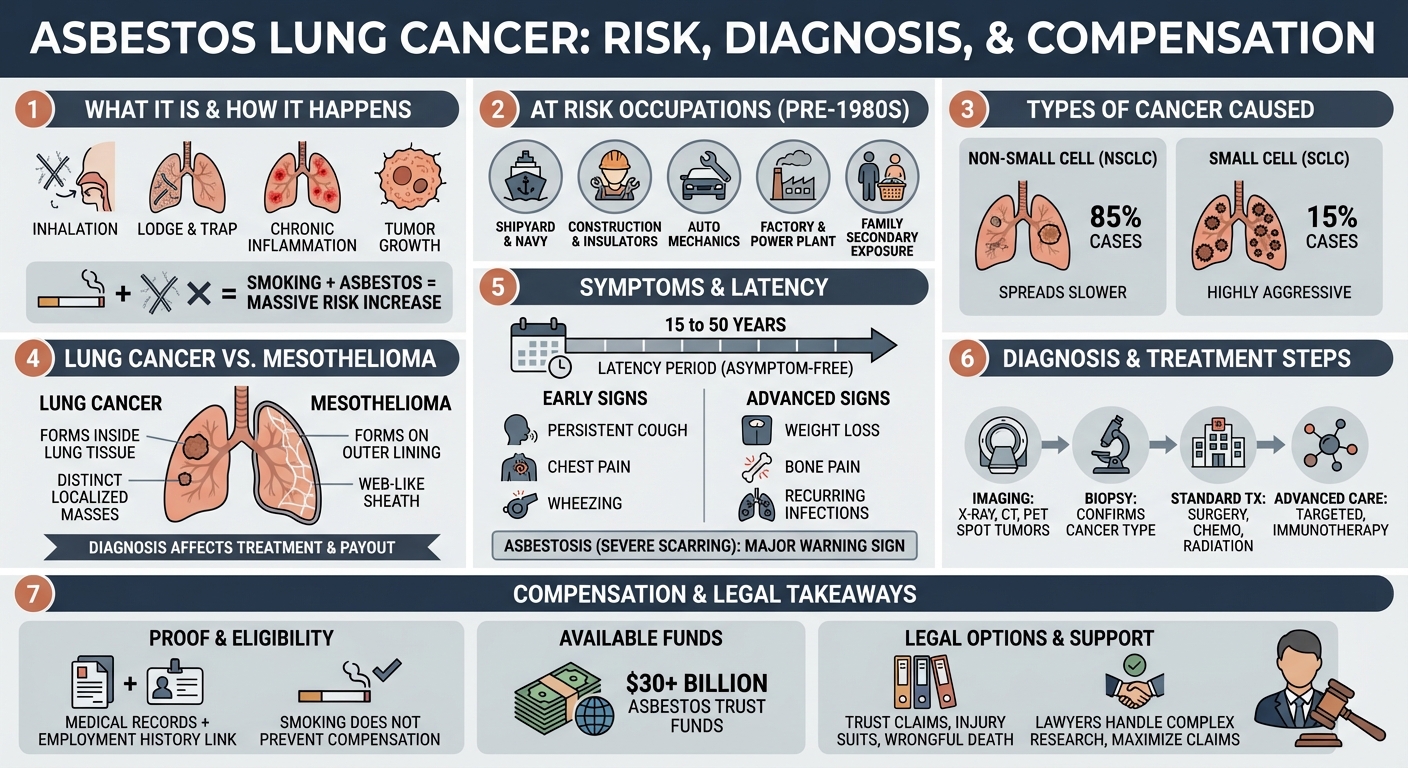
Asbestos fibers are microscopic, durable, and highly toxic. When inhaled, they bypass the body’s natural filtration systems and lodge deep within the lung tissue. Over time, the body’s inability to break down these sharp fibers leads to chronic inflammation, cellular damage, and genetic mutations. Decades after the initial exposure, these mutated cells can multiply uncontrollably, forming cancerous tumors.
High-Risk Occupations and Secondary Exposure
Prior to strict regulations in the 1980s, asbestos was heavily used in thousands of commercial and industrial products. Workers facing the highest risk of exposure included:
- Shipyard workers and Navy veterans
- Construction workers, roofers, and insulators
- Auto mechanics (specifically working with brakes and clutches)
- Power plant and factory workers
Secondary exposure also occurred when workers unknowingly brought asbestos dust home on their clothing, hair, or tools, putting their family members at risk.
Types of Lung Cancer Caused by Asbestos
What type of lung cancer is caused by asbestos?
Exposure to asbestos is associated with all major histological types of lung cancer. The microscopic fibers can trigger the development of both non-small cell lung cancer (NSCLC) and small cell lung cancer (SCLC). The specific type depends on which cells in the lung mutate after prolonged irritation from the trapped asbestos fibers.
Non-Small Cell Lung Cancer (NSCLC) and Asbestos
NSCLC accounts for about 80% to 85% of all lung cancer cases. Asbestos exposure is heavily linked to this category, which includes adenocarcinomas, squamous cell carcinomas, and large cell carcinomas. NSCLC generally grows and spreads more slowly than small cell lung cancer, offering a wider window for surgical intervention if caught early.
Small Cell Lung Cancer (SCLC) and Asbestos
Though less common, making up roughly 10% to 15% of cases, small cell lung cancer is highly aggressive. It spreads rapidly to other parts of the body. While SCLC is most strongly associated with heavy smoking, asbestos exposure acts as a powerful catalyst that dramatically increases the likelihood of developing this fast-spreading cancer.
Asbestos Lung Cancer vs. Mesothelioma: Key Differences
Many people confuse asbestos-related lung cancer with mesothelioma. While both are caused by asbestos, they are distinct diseases with different diagnostic criteria and treatment paths.
Differences in Tumor Location and Progression
| Feature | Asbestos Lung Cancer | Pleural Mesothelioma |
|---|---|---|
| Location | Develops inside the lung tissue (parenchyma). | Develops in the lining of the lungs (pleura). |
| Tumor Growth | Typically forms as distinct, localized nodules or masses. | Grows as a web-like sheath wrapping around the lung. |
| Primary Cause | Smoking, radon, and asbestos exposure. | Almost exclusively caused by asbestos exposure. |
What are 5 signs and symptoms of mesothelioma?
Because mesothelioma affects the lining of the lungs rather than the interior, its presentation differs slightly from traditional lung cancer. Five common signs and symptoms of pleural mesothelioma include: 1) sharp chest pain under the rib cage, 2) painful coughing, 3) unexplained shortness of breath, 4) unusual lumps of tissue under the skin on the chest, and 5) unexplained weight loss.
Why Accurate Diagnosis Matters for Treatment and Legal Claims
Misdiagnosing mesothelioma as lung cancer (or vice versa) can delay life-saving treatments. Furthermore, from a legal standpoint, the compensation structures differ. Asbestos trust funds often have specific payout tiers based on the exact diagnosis, making a precise pathology report critical for maximizing a legal claim.
Recognizing the Symptoms of Asbestos Lung Cancer
Early Warning Signs
In its early stages, asbestos lung cancer may not cause noticeable symptoms. When early warning signs do appear, they often mimic common respiratory infections. Look out for:
- A persistent, chronic cough that worsens over time
- Coughing up blood or rust-colored sputum
- Dull, aching chest pain that worsens with deep breathing
- Unexplained wheezing or hoarseness
Advanced Symptoms and Complications
As the tumor grows and potentially spreads (metastasizes), symptoms become more severe. Advanced indicators include chronic fatigue, significant unexplained weight loss, bone pain, and recurrent respiratory infections like bronchitis or pneumonia that refuse to clear up.
The Latency Period: Why Symptoms Take Decades to Appear
Asbestos diseases are notorious for their long latency periods. It typically takes anywhere from 15 to 50 years after the initial exposure for lung cancer to develop and present symptoms. This long gap often makes it difficult for patients to immediately connect their current illness to a job they held decades ago.
Asbestosis and Your Lung Cancer Risk
The Link Between Asbestosis (Lung Scarring) and Cancer
Asbestosis is a chronic, non-cancerous respiratory disease characterized by severe scarring of the lung tissue. While asbestosis itself is not cancer, having this condition indicates heavy, prolonged asbestos exposure. Consequently, patients with asbestosis have a significantly higher risk of eventually developing lung cancer.
What is the life expectancy of asbestosis patients?
The life expectancy of asbestosis patients varies widely based on the severity of lung scarring and age at diagnosis. Generally, patients can live 10 to 20 years or more after diagnosis. While mild cases may not significantly reduce lifespan, severe asbestosis can lead to fatal complications like heart failure or respiratory failure.
Can a lung transplant cure asbestosis?
There is no medical cure to reverse the lung scarring caused by asbestosis. However, in severe, life-threatening cases, a lung transplant can effectively serve as a cure by replacing the damaged lungs entirely. This is a high-risk, complex procedure reserved only for end-stage patients who meet strict medical criteria.
Diagnosis and Treatment Options
Imaging Tests and Biopsies
Diagnosing asbestos-related lung cancer begins with imaging tests, such as chest X-rays, CT scans, and PET scans, to identify tumors or fluid buildup. To confirm the presence of cancer and determine its type, a doctor must perform a biopsy—extracting a small tissue sample via bronchoscopy or needle biopsy for laboratory analysis.
Standard Treatments: Surgery, Chemotherapy, and Radiation
Treatment depends heavily on the cancer’s stage and the patient’s overall health:
- Surgery: Early-stage tumors may be removed via lobectomy (removing a lobe of the lung) or pneumonectomy (removing the entire lung).
- Chemotherapy: Uses powerful drugs to kill cancer cells throughout the body, often used before surgery to shrink tumors or after to kill remaining cells.
- Radiation: Uses high-energy beams to target and destroy localized cancer cells, often providing palliative relief for pain and breathing issues.
Targeted Therapy and Immunotherapy
Recent advancements have introduced targeted therapies that attack specific genetic mutations within the cancer cells. Immunotherapy drugs, such as Keytruda or Opdivo, help the patient’s own immune system recognize and destroy cancer cells. These are increasingly becoming standard care for advanced lung cancers.
Legal Options and Compensation for Asbestos Victims
How to Prove Your Lung Cancer is Asbestos-Related
To secure compensation, you must legally connect your cancer to asbestos exposure. This requires compiling medical records, pathology reports, detailed employment history, and sometimes co-worker testimonies. A history of smoking does not disqualify you from receiving asbestos compensation, provided asbestos exposure was a contributing factor.
Filing an Asbestos Trust Fund Claim
When major asbestos manufacturers faced thousands of lawsuits, many filed for bankruptcy. Courts forced these companies to establish asbestos trust funds to compensate future victims. Today, there is over $30 billion available in these trusts. Claims can often be resolved without ever going to court.
Personal Injury and Wrongful Death Lawsuits
If the company responsible for your exposure is still in business, you may file a personal injury lawsuit against them. If a loved one has already passed away from asbestos-related lung cancer, surviving family members can file a wrongful death lawsuit to recover medical expenses, lost income, and funeral costs.
Why You Need an Experienced Asbestos Injury Lawyer
Asbestos litigation is highly complex. An experienced asbestos attorney has access to proprietary databases of job sites, asbestos products, and corporate records. They can identify exactly which companies are liable for your exposure, handle all the legal paperwork, and maximize your compensation while you focus on your health and treatment.