

Table of contents
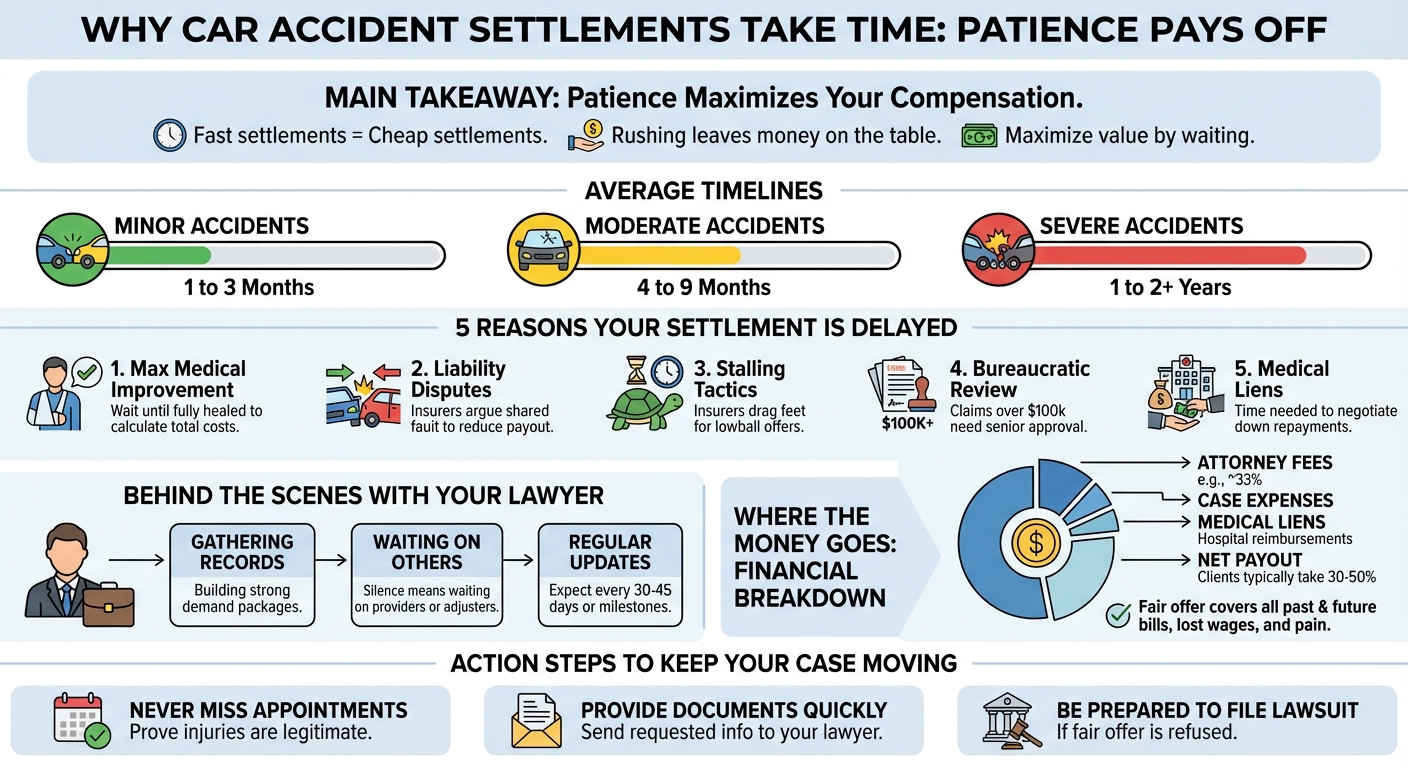
Car accident settlements often take longer than expected because insurance companies will not pay full value until your medical treatment is complete, liability is clearly established, and all medical liens are negotiated. Rushing this process usually results in lower compensation.
Why Is My Car Accident Settlement Taking So Long? (The Short Answer)
If you are wondering why your car accident settlement is taking so long, the short answer is that maximizing your compensation requires patience. Settlements are typically delayed because you are still receiving medical treatment, the insurance company is disputing fault, or your attorney is negotiating complex medical liens.
Insurance companies are in no rush to hand over a check. They frequently use stalling tactics to pressure injured victims into accepting lowball offers. A fast settlement is almost always a cheap settlement. Taking the necessary time ensures that your final payout covers all your past, present, and future damages.
How long should an insurance company take to settle a claim?
An insurance company should ideally settle a straightforward claim within 30 to 45 days after receiving a complete demand package. However, if liability is disputed or injuries are severe, the process can take six months to over a year as insurers investigate and negotiate the final payout.
Statutory Deadlines vs. Reality
Many states have laws requiring insurance companies to acknowledge a claim within 15 days and accept or deny it within a specific timeframe (often 15 to 30 days) after receiving all requested proof of loss. However, “proof of loss” is the catch. Insurers will often claim they need more documentation, medical records, or police reports, which legally pauses the clock and extends the timeline.
Average Timelines for Minor vs. Severe Accidents
- Minor Accidents (Property damage, minor injuries): Often settle in 1 to 3 months.
- Moderate Accidents (Whiplash, broken bones): Typically take 4 to 9 months as treatment concludes.
- Severe Accidents (Surgery, long-term disability): Can take 1 to 2 years, or longer if a lawsuit is filed.
5 Primary Reasons Your Car Accident Settlement Is Delayed
1. You Haven’t Reached Maximum Medical Improvement (MMI)
The biggest factor in a delayed settlement is your health. Attorneys wait until you reach Maximum Medical Improvement (MMI)—the point where you have fully recovered or your condition is stable and will not improve further. Settling before MMI means you might have to pay out-of-pocket for future surgeries or physical therapy.
2. Disputes Over Liability and Shared Fault
If the other driver’s insurance company argues that you were partially at fault, negotiations will stall. They will demand to review police reports, witness statements, and dashcam footage to shift the blame and reduce their financial liability.
3. Insurance Company Stalling Tactics
Insurers know that accident victims are often facing mounting medical bills and lost wages. They may drag their feet, change adjusters frequently, or request redundant paperwork in hopes that your financial desperation will force you to accept a lower offer.
4. High-Value Claims Require Deeper Scrutiny
If your claim is worth $100,000 or more, the insurance adjuster handling your case likely does not have the authority to write the check. High-value claims must be reviewed by senior management or a committee, adding weeks or months of bureaucratic delays.
5. Resolving Complex Medical Liens
Even after an insurance company agrees to a settlement amount, your lawyer must negotiate medical liens. Health insurance providers, Medicare, Medicaid, and hospitals have a legal right to be reimbursed from your settlement. Negotiating these liens down so you keep more money in your pocket takes time.
Why is my lawyer taking so long to settle my case?
Your lawyer is likely taking time to ensure you receive maximum compensation. Rushing a settlement often means leaving money on the table. They are busy gathering comprehensive medical records, negotiating complex health insurance liens, and waiting until the full long-term financial impact of your injuries is clear.
The Hidden Work: Gathering Evidence and Negotiating Liens
Much of a personal injury lawyer’s work happens behind the scenes. Ordering medical records from multiple providers can take months due to hospital administrative delays. Once the records arrive, your attorney must meticulously review them to build an airtight demand letter.
When Silence Means They Are Building Leverage
If you haven’t heard from your lawyer in a few weeks, it doesn’t mean your case is forgotten. Often, they are waiting for the insurance company to respond to a demand or waiting for a medical provider to finalize a billing statement. Silence usually means the ball is in the opponent’s court.
How Often You Should Expect Updates
A good legal team will update you every 30 to 45 days, or whenever a major milestone is reached (such as finishing treatment, sending the demand letter, or receiving an initial offer). If you are ever in doubt, you should feel comfortable calling your attorney’s office for a status check.
Understanding Your Payout: Settlement Financials
How much of a $100K settlement will I get?
From a $100,000 settlement, you can typically expect to take home between $30,000 and $50,000. This final amount is calculated after deducting standard attorney contingency fees, which are usually 33% to 40%, along with case expenses and any outstanding medical liens or hospital bills.
Here is a hypothetical breakdown of a $100,000 settlement:
| Expense Category | Estimated Deduction |
|---|---|
| Gross Settlement | $100,000 |
| Attorney Fees (approx. 33.3%) | -$33,333 |
| Case Expenses (experts, filing fees) | -$3,000 |
| Medical Bills & Liens | -$25,000 |
| Your Net Payout | $38,667 |
What are signs of a good settlement offer?
A good settlement offer fully covers your past and future medical bills, replaces all lost wages, and provides fair compensation for pain and suffering. It should also account for any medical liens, ensuring you are not left paying out-of-pocket expenses after the case is officially closed.
What You Can Do to Keep Your Case Moving Forward
Never Miss a Medical Appointment
Gaps in your medical treatment give the insurance company an excuse to claim you aren’t truly injured. Attend all physical therapy sessions, follow your doctor’s orders, and communicate any new pain or symptoms immediately.
Respond Promptly to Your Legal Team
When your attorney asks for pay stubs, tax returns, or a signature on a medical release form, provide it as quickly as possible. Client delays are one of the most easily preventable reasons a case stalls.
When It Is Time to File a Lawsuit
If the insurance company refuses to offer a fair settlement, your attorney may advise filing a formal lawsuit. While litigation extends the timeline significantly, it forces the insurance company into the discovery process and often prompts a much higher settlement offer before the case ever reaches a jury.