

Table of contents
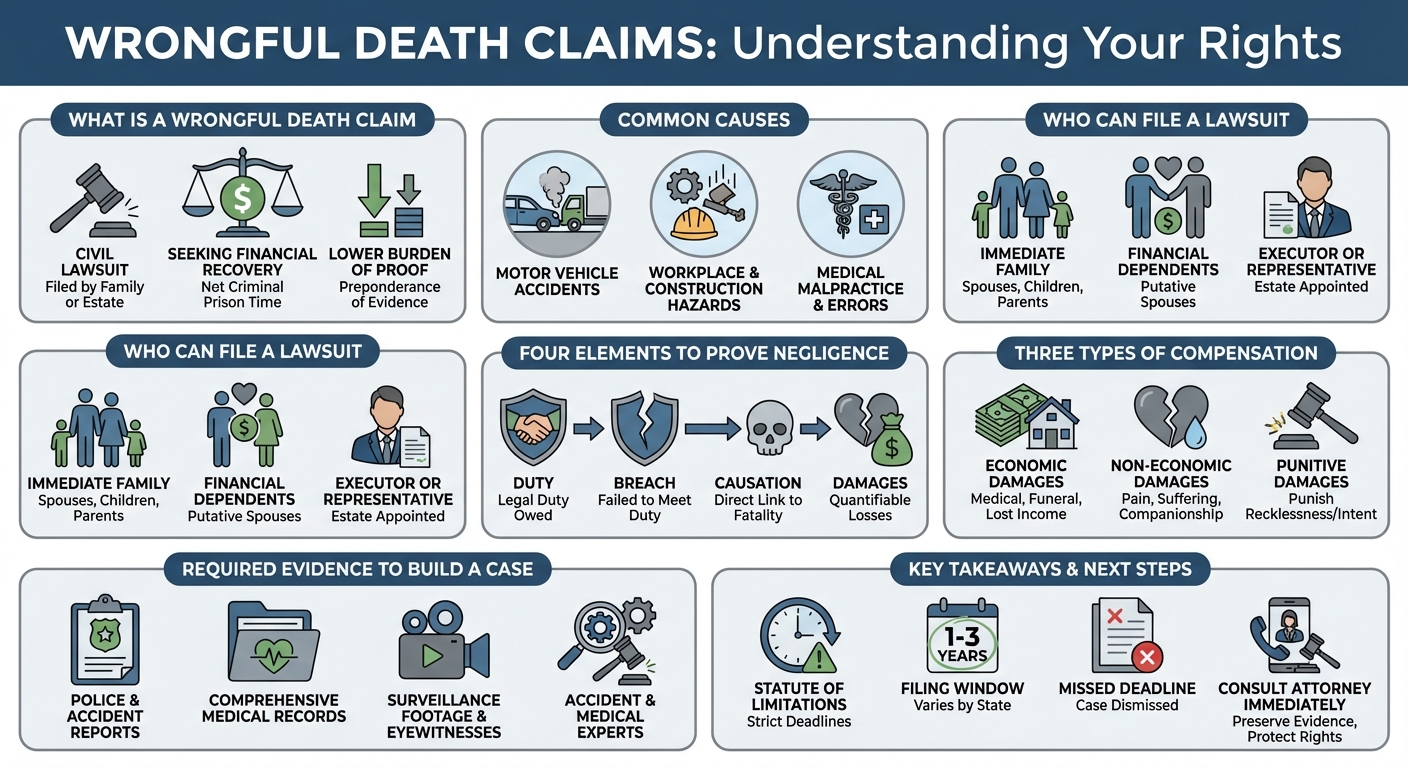
A wrongful death claim is a civil lawsuit brought by surviving family members or the estate of a deceased person. It seeks financial compensation from the individual or entity whose negligent or intentional actions caused the fatal injury, covering losses like funeral expenses and lost income.
What Is a Wrongful Death Claim?
Losing a loved one is a devastating experience, especially when their death could have been prevented. A wrongful death lawsuit is a civil action brought by surviving family members or the deceased’s estate. It seeks financial compensation from the individual, company, or entity whose negligent or intentional actions caused the fatal injury.
Wrongful Death Civil Claims vs. Criminal Homicide Cases
It is important to understand the difference between civil and criminal proceedings. A criminal homicide case is prosecuted by the state, requires proof “beyond a reasonable doubt,” and aims to penalize the defendant with prison time. A wrongful death claim is a civil lawsuit. It carries a lower burden of proof—a “preponderance of the evidence”—and focuses entirely on securing financial compensation for the surviving family, rather than criminal punishment.
What is an example of wrongful death?
An example of a wrongful death is a fatal car accident caused by an intoxicated driver. Other common examples include a patient dying because a surgeon operated on the wrong organ, or a construction worker suffering a fatal fall due to a company’s failure to provide required safety harnesses.
Who Is Eligible to File a Wrongful Death Lawsuit?
State laws dictate exactly who has the legal standing to file a wrongful death lawsuit. While these rules vary by jurisdiction, eligibility generally falls into specific categories of surviving relatives and representatives.
Immediate Family Members
In every state, immediate family members are the primary parties eligible to file a claim. This typically includes the surviving spouse, biological or adopted children, and the parents of an unmarried deceased child.
Financial Dependents and Putative Spouses
Some states extend eligibility to individuals who were financially dependent on the deceased. This can include stepchildren, putative spouses (individuals who believed in good faith they were legally married to the deceased), and sometimes extended family members who relied on the victim for financial support.
The Role of the Deceased Person’s Estate Representative
In many jurisdictions, the family cannot file the lawsuit directly. Instead, the personal representative or executor of the deceased person’s estate must file the wrongful death claim on behalf of the surviving family members. Any settlement or jury award is then distributed to the beneficiaries according to state law or the deceased’s will.
The Legal Elements: How to Prove a Wrongful Death Case
Winning a wrongful death settlement requires more than just showing that a tragedy occurred. You must establish legal liability by proving negligence or intentional harm.
What are the 4 proofs of negligence?
The four proofs of negligence required in a wrongful death claim are: a legal duty of care owed to the deceased, a breach of that duty, direct causation linking the breach to the fatality, and quantifiable damages resulting from the death, such as medical bills and funeral costs.
Gathering Evidence to Support Your Claim
Building a strong case requires comprehensive evidence. Your legal team will typically gather police and accident reports, medical records, eyewitness statements, and video surveillance. Expert witnesses, such as accident reconstructionists or medical professionals, are often brought in to clarify exactly how the breach of duty caused the fatal injury.
Understanding the Burden of Proof in Civil Court
In a civil wrongful death case, the plaintiff must meet the “preponderance of the evidence” standard. This means you must prove that it is more likely than not (greater than a 50% chance) that the defendant’s actions caused the death. This is significantly easier to prove than the strict criminal standard.
Common Causes of Wrongful Death
Wrongful death claims arise from a wide variety of circumstances. Any situation where someone’s negligence leads to a fatality can potentially be grounds for a lawsuit.
Auto Accidents and Commercial Trucking Crashes
Motor vehicle collisions are a leading cause of wrongful death. This includes crashes involving drunk drivers, distracted drivers, and catastrophic collisions with 18-wheelers, where trucking companies may be held liable for violating safety regulations.
Workplace Accidents and Occupational Hazards
While many workplace deaths are handled through workers’ compensation, a wrongful death lawsuit may be filed if a third party’s negligence caused the fatality. This often occurs in construction accidents involving defective equipment or negligent subcontractors.
Medical Malpractice and Fatal Errors
When doctors, nurses, or hospitals fail to meet the standard of care, the results can be fatal. Surgical errors, misdiagnoses, delayed treatments, and fatal medication errors frequently lead to wrongful death claims.
What are the odds of winning a malpractice suit?
The odds of winning a medical malpractice suit at trial are generally low, with plaintiffs winning only about 20% to 30% of cases. However, these statistics do not include the significant number of strong malpractice claims that are successfully settled out of court before ever reaching a jury.
Compensation and Settlements in Wrongful Death Cases
The primary goal of a wrongful death claim is to provide financial stability to the surviving family. Compensation is generally divided into three categories.
Economic Damages
Economic damages compensate the family for quantifiable financial losses. This includes the cost of medical care provided to the deceased prior to their death, funeral and burial expenses, and the loss of the deceased’s expected lifetime income and benefits.
Non-Economic Damages
Non-economic damages address the intangible, emotional losses suffered by the family. This typically includes loss of consortium (companionship), loss of parental guidance for surviving children, and the emotional pain and suffering experienced by the surviving relatives.
Punitive Damages for Gross Negligence
In cases where the defendant’s actions were exceptionally reckless, malicious, or intentional, the court may award punitive damages. These are not meant to compensate the family, but rather to punish the wrongdoer and deter similar behavior in the future.
What is the maximum payout for wrongful death?
There is no universal maximum payout for a wrongful death claim, as compensation depends on the victim’s earning capacity and specific case details. However, several states enforce statutory damage caps on non-economic damages, often limiting pain and suffering compensation to between $250,000 and $500,000 depending on the jurisdiction.
Statute of Limitations and Next Steps
If you are considering a wrongful death lawsuit, time is of the essence. Delaying action can jeopardize your ability to recover compensation.
How Long Do You Have to File a Claim?
Every state has a statute of limitations that sets a strict deadline for filing a wrongful death claim. In most states, this window is between one and three years from the date of the person’s death. If you miss this deadline, the court will likely dismiss your case permanently.
Why Consulting a Wrongful Death Attorney Is Critical
Wrongful death cases are legally complex, heavily contested by insurance companies, and emotionally draining for the family. Consulting an experienced wrongful death attorney ensures that your rights are protected, evidence is preserved, and you have a dedicated advocate fighting for the maximum compensation your family deserves.