

Table of contents
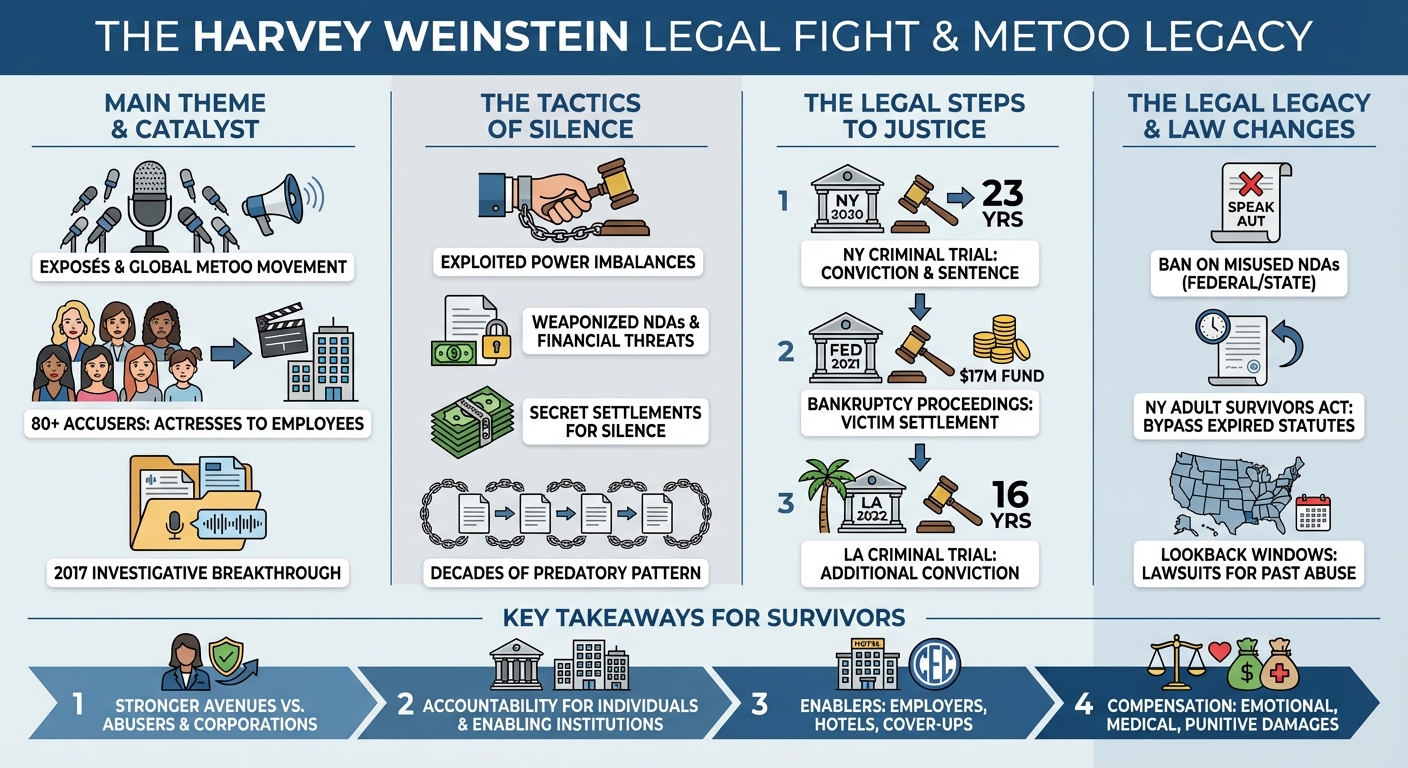
Over 80 women, including prominent actresses like Ashley Judd, Rose McGowan, and Gwyneth Paltrow, as well as former employees and models, have accused Harvey Weinstein of sexual misconduct, harassment, and assault. Their allegations sparked the global #MeToo movement, leading to Weinstein’s criminal convictions and significant changes in sexual abuse laws.
Harvey Weinstein Victims: The Allegations and the Legal Fight for Justice
The allegations against former Hollywood producer Harvey Weinstein represent a watershed moment in modern legal history. When dozens of women came forward to share their stories of sexual harassment, assault, and rape, they did more than expose a single powerful figure—they dismantled a decades-old system of corporate complicity and legal intimidation.
For survivors, the legal fight for justice has spanned criminal courts, bankruptcy proceedings, and civil litigation. Understanding the scope of these cases provides crucial insight into how the legal system handles institutional sexual abuse, the weaponization of non-disclosure agreements (NDAs), and the evolving rights of survivors.
Who Are the Harvey Weinstein Victims? A Timeline of Accusations
More than 80 women have publicly accused Harvey Weinstein of sexual misconduct spanning several decades. The victims include a wide cross-section of women who interacted with Weinstein in various professional capacities.
The 2017 Exposes: The Women Who First Spoke Out
In October 2017, investigative reports by The New York Times and The New Yorker broke the silence surrounding Weinstein’s behavior. These publications detailed on-the-record accounts from women who had been subjected to uninvited sexual advances, coercion, and assault. The meticulous documentation of these claims, backed by audio recordings and internal company memos, provided the evidentiary foundation needed to pursue legal action.
High-Profile Accusers: Ashley Judd, Rose McGowan, and Others
The involvement of prominent actresses brought unprecedented global attention to the case. High-profile victims who shared their experiences included:
- Ashley Judd: One of the first to go on the record, detailing how Weinstein derailed her career after she rejected his advances.
- Rose McGowan: Reached an early settlement in 1997 after an assault at the Sundance Film Festival, later becoming a vocal advocate for survivors.
- Gwyneth Paltrow, Salma Hayek, and Mira Sorvino: Shared harrowing accounts of coercion, threats, and professional retaliation.
Voices Beyond Hollywood: Former Employees and Models
While celebrities dominated the headlines, the majority of Weinstein’s victims were young assistants, executives, and aspiring models. Women like Kaja Sokola, a former teenage model, and numerous Miramax employees faced severe power imbalances. These survivors often lacked the financial resources to fight Weinstein’s aggressive legal team, making them particularly vulnerable to exploitation.
The Legal Shield: How NDAs and Secret Settlements Silenced Survivors
For decades, Weinstein evaded accountability not just through power, but through the strategic use of the legal system. His primary tools were secret settlements and restrictive contracts.
Understanding the Role of Non-Disclosure Agreements (NDAs)
NDAs are legally binding contracts designed to protect trade secrets or confidential business information. However, Weinstein and his corporate enablers weaponized NDAs to silence victims of sexual abuse. Employees were forced to sign broad confidentiality agreements that prohibited them from discussing Weinstein’s personal behavior or the company’s toxic culture, effectively trapping them in silence under the threat of ruinous financial penalties.
The Financial Cost of Silence: Early Civil Settlements
When victims threatened legal action, Weinstein frequently utilized private civil settlements. These payouts, often ranging from tens to hundreds of thousands of dollars, were contingent on strict confidentiality clauses. By settling claims out of court and burying the details, Weinstein prevented a public pattern of predatory behavior from emerging, allowing the abuse to continue unchecked.
Criminal Trials vs. Civil Lawsuits: Breaking Down the Proceedings
The pursuit of justice for Weinstein’s victims required a multi-pronged legal approach, utilizing both the criminal justice system and civil litigation.
| Legal Proceeding | Jurisdiction | Outcome / Status |
|---|---|---|
| Criminal Trial (2020) | New York | Convicted of third-degree rape and criminal sexual act; sentenced to 23 years. (Subject to complex appeals and retrial proceedings). |
| Criminal Trial (2022) | Los Angeles | Convicted of rape and sexual assault; sentenced to an additional 16 years. |
| Bankruptcy / Civil Settlement | Delaware / Federal | $17 million settlement fund established for victims following the bankruptcy of The Weinstein Company. |
The New York Criminal Trials and Convictions
The landmark 2020 New York trial focused on charges brought by a select group of women whose cases fell within the statute of limitations. The trial was notable for its use of “prior bad acts” witnesses—women who testified to establish a clear pattern of predatory behavior, even if their specific assaults were not charged. Weinstein was found guilty, marking a historic victory for the #MeToo movement.
The Los Angeles Trial Outcomes
In 2022, Weinstein faced a second criminal trial in Los Angeles. The jury convicted him of rape and sexual assault against a former model and actress. This conviction ensured that Weinstein would face significant prison time regardless of the appellate outcomes in New York.
The $17 Million Civil Settlement Fund for Victims
Beyond criminal court, victims pursued civil justice against The Weinstein Company. Following the company’s bankruptcy, a federal judge approved a $17 million liquidation plan in 2021. This fund provided financial compensation to dozens of survivors, though several victims opted out of the settlement to preserve their right to pursue independent civil lawsuits against Weinstein and his corporate enablers.
The #MeToo Legal Legacy: How the Weinstein Cases Changed the Law
The courage of the Harvey Weinstein victims catalyzed sweeping legislative changes across the United States, transforming how the legal system handles sexual misconduct.
Banning the Misuse of NDAs in Sexual Misconduct Cases
In response to the scandal, federal and state legislatures enacted laws to prevent the silencing of survivors. The federal Speak Out Act now limits the enforceability of pre-dispute NDAs in cases involving sexual assault and harassment. Several states, including New York and California, have also passed strict laws prohibiting employers from using NDAs to conceal sexual misconduct.
The Adult Survivors Act and Extended Statutes of Limitations
Historically, strict statutes of limitations prevented many adult survivors from seeking justice decades after their abuse. Inspired by the Weinstein victims, New York passed the Adult Survivors Act, which created a one-year “lookback window” allowing survivors to file civil lawsuits regardless of when the abuse occurred. Similar legislation has been adopted in other states, fundamentally shifting the balance of power back to victims.
Seeking Justice: Legal Options for Survivors of Sexual Abuse
The Weinstein cases demonstrate that survivors of sexual abuse have powerful legal avenues available to them, even against well-resourced abusers and institutions.
Holding Abusers and Enabling Institutions Accountable
Civil litigation allows survivors to hold not only the abuser accountable but also the institutions that enabled the behavior. This can include corporations, hotels, employers, or management companies that ignored complaints, failed to provide adequate security, or actively covered up the abuse.
Navigating Civil Claims and Compensation
Filing a civil lawsuit for sexual abuse involves complex legal maneuvering, including navigating statutes of limitations, gathering historical evidence, and negotiating with corporate insurance policies. Survivors seeking justice should consult with experienced legal counsel who specialize in sexual abuse litigation to explore their rights to compensation for medical expenses, emotional distress, and punitive damages.