

Table of contents
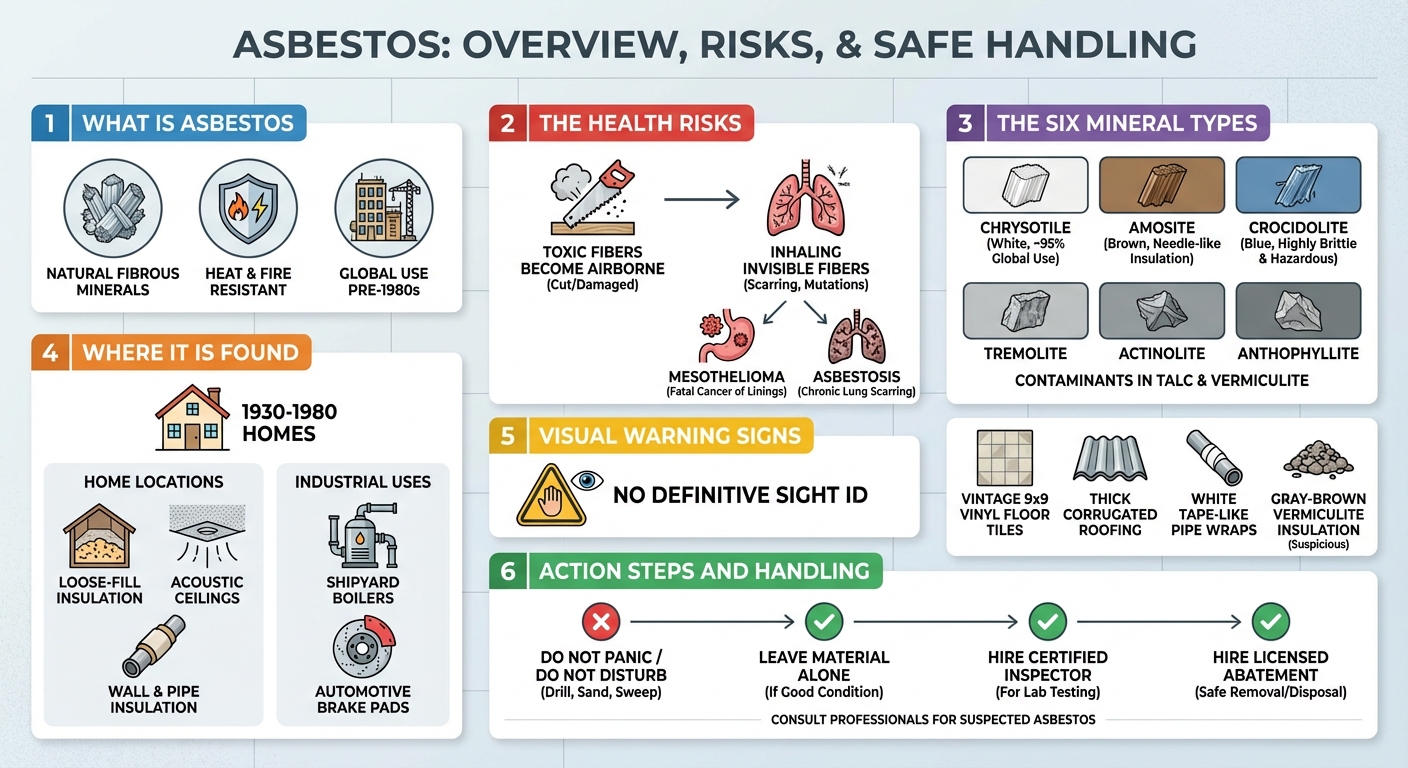
Asbestos is a group of six naturally occurring, fibrous silicate minerals. Because these microscopic fibers are highly resistant to heat, fire, and electricity, asbestos was widely used in construction and manufacturing. However, inhaling asbestos dust is highly toxic and can cause severe respiratory diseases, including mesothelioma and asbestosis.
The Meaning of Asbestos: A Simple Definition
Asbestos is a commercial and legal term that refers to a group of six naturally occurring, fibrous silicate minerals. The meaning of asbestos is rooted in its physical properties: it is composed of millions of microscopic fibers that can easily be separated. Because these fibers are incredibly strong, flexible, and highly resistant to heat, fire, and electricity, asbestos was widely used in construction and manufacturing for decades.
What is asbestos and how is it harmful?
Asbestos is a group of naturally occurring fibrous minerals historically used for their heat and fire resistance. It becomes harmful when its microscopic fibers become airborne. If inhaled, these toxic fibers lodge permanently in the lungs, causing inflammation, scarring, and severe diseases like mesothelioma, lung cancer, and asbestosis.
The Science Behind Asbestos Toxicity
Asbestos fibers are microscopic—often hundreds of times thinner than a human hair. When asbestos-containing materials (ACMs) are damaged, cut, or disturbed, they release these invisible fibers into the air. Once inhaled or swallowed, the human body cannot break them down or expel them. Over decades, the trapped fibers cause genetic mutations and cellular damage.
Long-Term Health Risks (Mesothelioma and Asbestosis)
Exposure to asbestos is directly linked to several fatal conditions. Mesothelioma is a rare, aggressive cancer that forms in the lining of the lungs, abdomen, or heart, almost exclusively caused by asbestos. Asbestosis is a chronic, non-cancerous respiratory disease where the lung tissue becomes heavily scarred, making it increasingly difficult to breathe.
The 6 Types of Asbestos Minerals
The Environmental Protection Agency (EPA) recognizes six distinct types of asbestos, which are divided into two mineral families: serpentine (curly fibers) and amphibole (needle-like fibers).
| Asbestos Type | Common Name | Mineral Family | Historical Uses |
|---|---|---|---|
| Chrysotile | White Asbestos | Serpentine | Roofing, floor tiles, brake linings, cement |
| Amosite | Brown Asbestos | Amphibole | Cement sheets, pipe insulation, thermal products |
| Crocidolite | Blue Asbestos | Amphibole | Steam engine insulation, spray-on coatings, plastics |
| Tremolite | N/A | Amphibole | Often found as a contaminant in talc and vermiculite |
| Actinolite | N/A | Amphibole | Sealants, paints, drywall, insulation |
| Anthophyllite | N/A | Amphibole | Cement, rubber, roofing materials |
Chrysotile (White Asbestos)
Chrysotile is the only serpentine asbestos and accounts for roughly 95% of all asbestos used globally. Its flexible, curly fibers made it ideal for weaving into fabrics and mixing into cement.
Amosite (Brown Asbestos)
Mined primarily in Africa, amosite features strong, needle-like fibers. It was heavily favored for thermal insulation products, ceiling tiles, and cement sheets due to its exceptional heat resistance.
Crocidolite (Blue Asbestos)
Considered the most hazardous type of asbestos, crocidolite has extremely thin, brittle fibers that easily break and become airborne. It was commonly used to insulate steam engines and in specialized spray-on coatings.
Tremolite, Actinolite, and Anthophyllite
These three amphibole minerals were rarely mined for commercial use on their own. Instead, they frequently contaminated other commercial minerals, such as talc and vermiculite, inadvertently making their way into consumer products and attic insulation.
Where is asbestos found?
Asbestos is found naturally in rock and soil deposits worldwide. Commercially, it is found in older buildings, ships, and industrial products. Common locations include attic and wall insulation, vinyl floor tiles, roofing shingles, textured paint, and heat-resistant fabrics manufactured primarily before the 1980s.
Historical Commercial Uses
During the 20th century, asbestos was considered a miracle material. It was woven into protective clothing for firefighters, packed into automotive brake pads, and mixed into thousands of household products. Shipyards also used massive quantities to insulate boilers and steam pipes.
Natural Deposits in Rock and Soil
Because it is a naturally occurring mineral, asbestos can be found in rock and soil deposits across the globe. In some regions, natural weathering or human activities like mining and road construction can release these natural asbestos fibers into the environment.
What causes asbestos in a house?
Asbestos is present in a house because builders intentionally used asbestos-containing materials (ACMs) during construction. Before its health risks were fully understood, manufacturers added asbestos to building products to increase durability, provide thermal insulation, and improve fire resistance, particularly in homes built before 1980.
Fireproofing and Insulation Benefits
Builders favored asbestos because it was cheap, lightweight, and highly effective at preventing fires from spreading. It was routinely sprayed onto steel beams, wrapped around HVAC ducts, and poured into attics as loose-fill insulation.
Common Eras of Asbestos Home Construction
If your home was built or remodeled between 1930 and 1980, it is highly likely to contain some form of asbestos. While the EPA began banning certain asbestos products in the 1970s, existing inventories were still legally installed in homes well into the 1980s.
What are signs of asbestos?
You cannot definitively identify asbestos just by looking at it. However, signs of potential asbestos include older building materials like 9×9-inch vinyl floor tiles, popcorn ceilings, corrugated roofing, or deteriorating pipe insulation in homes built before 1980. The only guaranteed sign is a positive laboratory test.
Visual Cues in Older Building Materials
While you cannot see the microscopic fibers, certain vintage materials are notorious for containing asbestos. Look for:
- 9×9 inch square floor tiles
- Thick, corrugated roofing panels
- White, tape-like wraps on basement pipes
- Textured acoustic ceilings (popcorn ceilings)
- Older vermiculite attic insulation (which often looks like grayish-brown pebbles)
Why Professional Testing is the Only Sure Sign
Because asbestos fibers are mixed into other materials, visual inspection is never enough. To confirm the presence of asbestos, a certified inspector must take a physical sample of the material and analyze it under a polarized light microscope in an accredited laboratory.
Next Steps: How to Handle Suspected Asbestos
Discovering potential asbestos in your home or workplace can be alarming, but immediate panic is unnecessary. The key is proper management.
The Importance of Not Disturbing ACMs
Asbestos is generally only dangerous when it is friable—meaning it can easily be crumbled or reduced to powder by hand pressure. If an asbestos-containing material is in good condition and left completely alone, it poses minimal risk. Never drill, sand, sweep, or vacuum suspected asbestos materials.
Hiring Certified Abatement Professionals
If you plan to remodel, or if the asbestos is damaged and deteriorating, you must hire a licensed asbestos abatement contractor. These professionals use specialized negative-air machines, HEPA vacuums, and protective suits to safely remove and legally dispose of the toxic materials without contaminating the rest of your property.