

Table of contents
Yes, you can sue a nursing home or hospital for bedsores if the injury resulted from negligence. Because bedsores are largely preventable, developing a severe pressure ulcer usually indicates that the facility failed to provide adequate care, such as regularly repositioning the patient or monitoring their skin health.
Can You Sue for Bed Sores? The Short Answer
Yes, you can sue a nursing home, hospital, or assisted living facility for bedsores if the injury was caused by negligence. Bedsores, also known as pressure ulcers, are largely preventable. When a patient develops a severe bedsore, it is often a direct sign that the facility failed to provide an adequate standard of care.
When is a bedsore considered medical malpractice?
A bedsore becomes grounds for a medical malpractice or personal injury lawsuit when healthcare providers fail to follow standard preventative protocols. This includes failing to regularly reposition immobile patients, ignoring signs of skin breakdown, or failing to keep the patient clean and dry. If this breach of duty directly causes the bedsore, you have a valid legal claim.
Suing a nursing home vs. suing a hospital
While the legal premise is similar, the context often differs. Suing a nursing home usually involves proving long-term neglect, chronic understaffing, or systemic failure to monitor residents. Suing a hospital typically involves acute care negligence, such as leaving a patient in the same position for hours during a prolonged emergency room stay or post-surgical recovery.
Can you sue for stage 4 bedsore?
Yes, you can absolutely sue for a Stage 4 bedsore. Because Stage 4 ulcers involve deep tissue damage exposing muscle or bone, they are considered “never events” in healthcare. Developing one strongly indicates severe medical neglect, making it highly actionable for a medical malpractice or nursing home abuse lawsuit.
The 4 Stages of Bedsores
Understanding the severity of the injury is crucial for your case. Here is a quick overview of how bedsores progress:
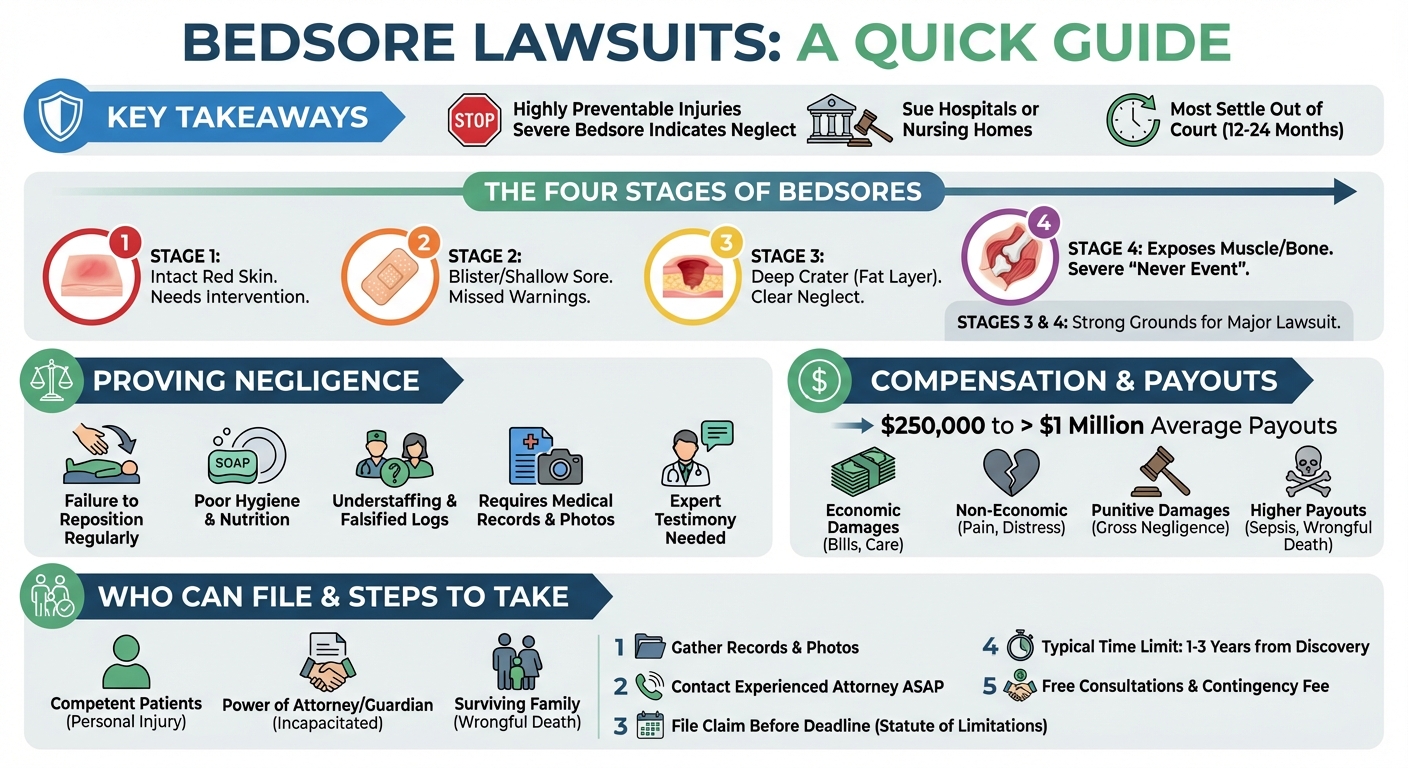
| Stage | Description | Legal Significance |
|---|---|---|
| Stage 1 | Skin is intact but red and does not blanch when pressed. | Warning sign; requires immediate intervention. |
| Stage 2 | Partial skin loss, appearing as a blister or shallow open sore. | Indicates a failure to address initial warning signs. |
| Stage 3 | Full-thickness skin loss; deep crater reaching the fat layer. | Clear evidence of prolonged neglect; highly actionable. |
| Stage 4 | Severe tissue loss exposing muscle, tendon, or bone. | Considered a “never event”; strong grounds for a major lawsuit. |
Why Stage 3 and Stage 4 bedsores indicate severe neglect
It takes time for a bedsore to progress to Stage 3 or 4. Medical professionals are trained to identify and treat Stage 1 and 2 ulcers immediately. When a sore reaches the later stages, it proves that staff ignored the patient’s deteriorating condition for an extended period, representing a gross violation of medical standards.
Life-threatening complications
Advanced bedsores are not just painful; they are deadly. Stage 4 ulcers frequently lead to severe complications such as sepsis (a life-threatening blood infection) and osteomyelitis (bone infection). These complications drastically increase medical costs and are common factors in wrongful death lawsuits.
How much compensation for bed sores?
Compensation for bedsores varies, but victims can recover damages for both financial losses and emotional distress. Settlements typically cover past and future medical bills, rehabilitation costs, and significant non-economic damages for pain and suffering. In cases of extreme neglect, courts may also award punitive damages.
Economic damages
Economic damages reimburse you for out-of-pocket expenses. This includes the cost of hospital transfers, specialized wound care, surgical debridement, ongoing rehabilitation, and any nursing care required to treat the complications caused by the bedsore.
Non-economic damages
Non-economic damages compensate the victim for the physical pain, mental anguish, and loss of quality of life. Because severe bedsores are excruciatingly painful and can take months to heal, non-economic damages often make up the largest portion of a bedsore settlement.
Punitive damages in cases of gross negligence
If the facility’s conduct was intentionally harmful or demonstrated a reckless disregard for human life (such as intentional understaffing to boost profits while ignoring patient cries for help), a judge or jury may award punitive damages to punish the facility and deter future negligence.
What is the average payout for a bedsore lawsuit?
The average payout for a bedsore lawsuit generally ranges from $250,000 to over $1 million. The exact amount depends heavily on the ulcer’s severity, the patient’s age, and whether complications like sepsis occurred. Cases involving wrongful death or Stage 4 bedsores typically result in the highest financial settlements.
Factors that increase the payout amount
- Severity of the injury: Stage 3 and 4 bedsores yield higher payouts than Stage 1 or 2.
- Resulting complications: Infections, amputations, or sepsis significantly increase case value.
- Wrongful death: If the bedsore directly caused the patient’s death, surviving family members can pursue substantial wrongful death compensation.
- Age and health of the patient: The impact on the patient’s remaining years of life is heavily weighed.
Why out-of-court settlements are more common than trial verdicts
Most bedsore lawsuits settle before reaching a courtroom. Nursing homes and hospitals prefer to settle out of court to avoid the negative public relations of a public trial and the unpredictable nature of jury verdicts, which can sometimes result in massive punitive damage awards.
How long does it take to settle a bedsore lawsuit?
It generally takes between 12 and 24 months to settle a bedsore lawsuit. Straightforward cases with undeniable evidence of neglect might resolve in under a year through mediation. However, complex claims involving multiple defendants, severe complications, or wrongful death may take several years if they proceed to trial.
Phases of a bedsore lawsuit
The legal timeline involves several phases. First is the investigation, where your attorney gathers medical records. Next is the discovery phase, where both sides exchange evidence and depose witnesses. Finally, the case moves to mediation or settlement negotiations. If no agreement is reached, the case goes to trial.
Why some cases settle faster than others
Cases settle quickly when the evidence of negligence is overwhelming—such as clear photographic evidence of a Stage 4 bedsore and falsified patient turning logs. Conversely, if the facility argues that the bedsore was “unavoidable” due to the patient’s underlying health conditions, the case will take longer to resolve.
How to Prove Negligence in a Bedsore Case
Winning a bedsore lawsuit requires proving that the facility breached its duty of care. This means demonstrating that a competent healthcare provider in the same situation would have prevented the injury.
Establishing the standard of care
Facilities are legally required to assess a patient’s risk for bedsores upon admission. If a patient is high-risk, the standard of care dictates implementing a strict turning schedule (usually every two hours), using specialized mattresses, and maintaining proper nutrition and hydration.
Common signs of nursing home neglect
- Understaffing: Not enough nurses to physically turn patients on schedule.
- Poor hygiene: Leaving patients in soiled diapers or wet bedsheets, which accelerates skin breakdown.
- Malnutrition and dehydration: Lack of proper nutrients makes skin fragile and unable to heal.
- Falsified records: Staff filling out turning logs without actually moving the patient.
Crucial evidence to gather
To build a strong case, your attorney will need comprehensive medical records, admission assessments, and facility staffing logs. Photographic evidence of the bedsore’s progression is incredibly powerful. Witness statements from visiting family members who noticed poor conditions are also vital.
The role of medical expert testimony
Proving negligence almost always requires a medical expert. An independent doctor or wound care specialist will review the records and testify that the facility’s actions fell below the acceptable standard of care and directly caused the bedsore.
Who Can File a Bedsore Lawsuit?
The right to file a lawsuit depends on the patient’s current health and legal status.
Filing as the injured patient
If the patient is mentally competent, they can file the personal injury lawsuit themselves to seek compensation for their pain, suffering, and medical expenses.
Filing on behalf of an incapacitated loved one
Many bedsore victims suffer from dementia, Alzheimer’s, or are otherwise medically incapacitated. In these cases, a family member with a legally designated Power of Attorney (POA) or a court-appointed guardian can file the lawsuit on the patient’s behalf.
Filing a wrongful death claim
If a loved one passed away due to complications from a bedsore, such as sepsis, the executor of their estate or eligible surviving family members can file a wrongful death lawsuit. This seeks compensation for funeral expenses, loss of companionship, and the pain the deceased suffered before death.
Next Steps: When to Contact a Bedsore Attorney
If you or a loved one has developed a severe bedsore in a medical facility, time is of the essence. You should contact an experienced nursing home abuse or medical malpractice attorney immediately to preserve evidence.
Understanding the statute of limitations in your state
Every state has a strict deadline, known as the statute of limitations, for filing a medical malpractice or personal injury lawsuit. This window is typically between one and three years from the date the injury was discovered. Missing this deadline means losing your right to sue forever.
What to expect during a free legal consultation
Most bedsore attorneys offer free, no-obligation consultations. During this meeting, the lawyer will listen to your story, review any photos or documents you have, and explain your legal options. They work on a contingency fee basis, meaning you pay nothing out of pocket unless they win your case.