

Table of contents
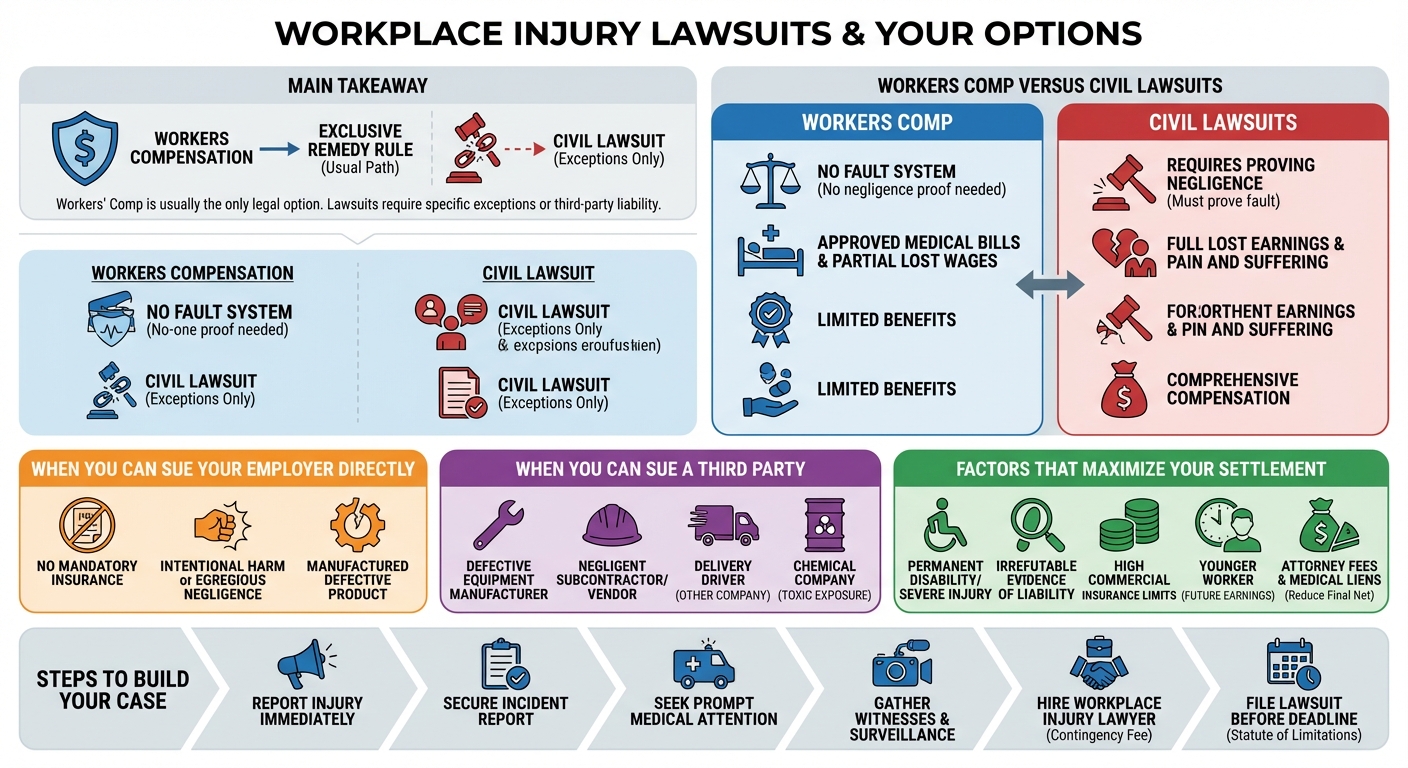
Generally, you cannot sue your employer for a workplace injury due to the exclusive remedy rule of workers’ compensation. However, you can file a workplace injury lawsuit if your employer lacks mandatory insurance, intentionally caused harm, or if a negligent third party, like an equipment manufacturer, caused your injury.
Understanding Workplace Injury Lawsuits: Can You Sue Your Employer?
When you are injured on the job, your first instinct might be to file a lawsuit. However, the legal landscape for occupational injuries is highly specific. In most cases, injured employees are directed through the workers’ compensation system rather than the civil court system.
The Exclusive Remedy Rule Explained
In the United States, workers’ compensation is governed by the exclusive remedy rule. This legal doctrine states that in exchange for guaranteed, no-fault medical and wage benefits, employees forfeit their right to sue their employer for negligence. If you slip on a wet floor or injure your back lifting heavy boxes, workers’ comp is typically your only legal recourse against your direct employer.
When a Lawsuit is Possible Instead of Workers’ Comp
Despite the exclusive remedy rule, civil litigation is still possible in specific scenarios. If your employer violates certain legal obligations, or if a party other than your employer contributed to your injury, you can step outside the workers’ comp system and file a formal workplace injury lawsuit. This opens the door to broader financial compensation.
Workers’ Compensation vs. Personal Injury Lawsuits
Understanding the difference between a workers’ comp claim and a personal injury lawsuit is critical for maximizing your financial recovery.
No-Fault System vs. Proving Negligence
Workers’ compensation is a no-fault system. You do not need to prove that your employer did anything wrong; you only need to prove the injury occurred while performing job duties. In contrast, a personal injury lawsuit is fault-based. You and your attorney must prove that a specific party acted negligently and that their negligence directly caused your injuries.
Differences in Available Damages (Medical Bills vs. Pain and Suffering)
Workers’ compensation strictly limits your payout. It covers approved medical expenses and a percentage of your lost wages (usually two-thirds). It does not compensate you for the physical agony or emotional distress of the accident. A civil lawsuit, however, allows you to claim full lost earning capacity, future medical care, and non-economic damages like pain and suffering.
Comparison Table: Workers’ Comp vs. Civil Lawsuit
| Feature | Workers’ Compensation | Workplace Injury Lawsuit |
|---|---|---|
| Proof of Fault | Not required (No-fault) | Must prove negligence |
| Medical Coverage | Yes (Subject to approval) | Yes (Full past and future costs) |
| Lost Wages | Partial (Usually 66%) | Full loss of earning capacity |
| Pain & Suffering | No | Yes |
| Target Defendant | Employer’s Insurance | Third parties or exempt employers |
Exceptions: When You Can Sue Your Employer Directly
While rare, there are specific exceptions where the exclusive remedy shield is pierced, allowing you to sue your employer directly in civil court.
The Employer Fails to Carry Workers’ Compensation Insurance
State laws mandate that almost all employers carry workers’ compensation insurance. If your employer illegally fails to maintain this coverage, they lose their immunity. You can sue them directly for all damages, including pain and suffering, and they are often barred from using standard legal defenses.
Intentional Harm or Egregious Gross Negligence
If your employer intentionally caused your injury—for example, through a physical assault or by intentionally removing safety guards from heavy machinery with the knowledge that injury was substantially certain—you can file a civil lawsuit. Standard negligence is not enough; the action must be deliberate or egregiously reckless.
Dual Capacity Doctrine (Employer as Manufacturer)
Under the dual capacity doctrine, you may sue your employer if they also manufactured the defective product that injured you. For instance, if you work for a tool manufacturer and are injured by a defective tool made by your company while on the job, they can be held liable as a manufacturer, separate from their role as your employer.
Third-Party Workplace Injury Lawsuits
The most common type of workplace injury lawsuit is a third-party claim. This occurs when someone other than your employer shares the blame for your accident.
Defective Machinery and Product Liability Claims
If a manufacturing defect, design flaw, or lack of warning on heavy machinery, scaffolding, or power tools caused your injury, you can file a product liability lawsuit against the equipment manufacturer or distributor.
Negligent Subcontractors, Vendors, or Drivers
Construction sites and warehouses are filled with workers from various companies. If an employee of a different subcontractor drops materials on you, or a delivery driver strikes you with their vehicle, you can sue their employer for negligence.
Toxic Exposure Claims (e.g., Silicosis and Chemical Lawsuits)
Workers exposed to hazardous materials often have grounds for third-party lawsuits against the chemical manufacturers. For example, workers developing severe lung disease from silica dust can pursue silicosis lawsuits against the manufacturers of the protective gear or the silica-containing products, entirely separate from their workers’ comp claim.
Settlement Amounts and Financial Expectations
Understanding the financial realities of a lawsuit helps set realistic expectations for your recovery.
How much of a $100K settlement will I get?
If you receive a $100,000 settlement, you can typically expect to take home between $30,000 and $50,000. Attorney contingency fees usually consume 33% to 40% of the total. The remaining funds must then cover case expenses, court costs, and any outstanding medical liens before you receive your net payout.
Is it worth suing for pain and suffering?
Yes, it is highly worth suing for pain and suffering if you have a valid third-party claim. Workers’ compensation only covers medical bills and a portion of lost wages. A civil lawsuit allows you to recover non-economic damages, which can significantly increase your overall financial recovery after a severe injury.
How much payout do you get with a 60% impairment?
The exact payout for a 60% impairment rating depends on your state’s specific workers’ compensation schedule and your pre-injury average weekly wage. Generally, a 60% rating qualifies you for substantial Permanent Partial Disability (PPD) benefits, which may pay out two-thirds of your average wage for hundreds of weeks.
Factors That Maximize Your Workplace Injury Settlement
- Severity of Injury: Permanent disabilities yield higher settlements.
- Clear Liability: Irrefutable evidence against a third party increases leverage.
- Insurance Limits: The at-fault party’s commercial insurance policy caps often dictate the maximum realistic settlement.
- Age and Earning Capacity: Younger workers with high wages typically receive larger awards for future lost earnings.
The Legal Process: Filing Your Claim
Filing a workplace injury lawsuit requires strict adherence to legal procedures and deadlines.
Statute of Limitations for Workplace Injury Lawsuits
Every state has a statute of limitations dictating how long you have to file a civil lawsuit, usually ranging from one to three years from the date of the injury. Missing this deadline permanently bars you from recovering compensation. This timeline is entirely separate from the much shorter deadline (often 30 days) required to report an injury for workers’ comp.
What are the odds of winning an employment lawsuit?
The odds of winning an employment or workplace injury lawsuit depend heavily on your evidence. While trial win rates hover around 30% to 40% for plaintiffs, the vast majority of strong cases—often over 90%—are settled out of court before ever reaching a judge or jury.
Gathering Evidence: Accident Reports, Medical Records, and Witnesses
A successful lawsuit is built on documentation. You must immediately report the accident, secure the official incident report, and seek prompt medical attention. Your attorney will gather witness statements, subpoena surveillance footage, and consult occupational safety experts to build a compelling case.
Why You Need a Workplace Injury Lawyer
Handling a severe workplace injury claim alone is a fast track to leaving money on the table.
Navigating the Intersection of Workers’ Comp and Civil Litigation
If you have both a workers’ comp claim and a third-party lawsuit, the workers’ comp insurer may place a lien on your civil settlement to recover the money they spent on your medical care. An experienced attorney knows how to negotiate these subrogation liens down, ensuring you keep more of your settlement money.
Free Consultations and Contingency Fee Agreements
Most reputable workplace injury lawyers operate on a contingency fee basis. This means you pay nothing upfront, and the law firm only collects a fee if they successfully secure a settlement or verdict in your favor. This allows injured workers to access elite legal representation without financial risk.