

Table of contents
To win an at-fault accident dispute, you must immediately gather objective evidence like dashcam footage and witness statements. Next, challenge any factual errors in the police report. Finally, refuse to give a recorded statement to the opposing insurer and hire an attorney to formally appeal the liability determination.
Understanding Fault and Liability in a Car Accident
Being blamed for a car crash you did not cause is incredibly frustrating. When an insurance company wrongly assigns you fault, it threatens your ability to secure compensation for medical bills, lost wages, and property damage. To successfully dispute this determination, you need to understand how liability is established and the specific steps required to reverse an adjuster’s decision.
How Insurance Companies Determine Liability
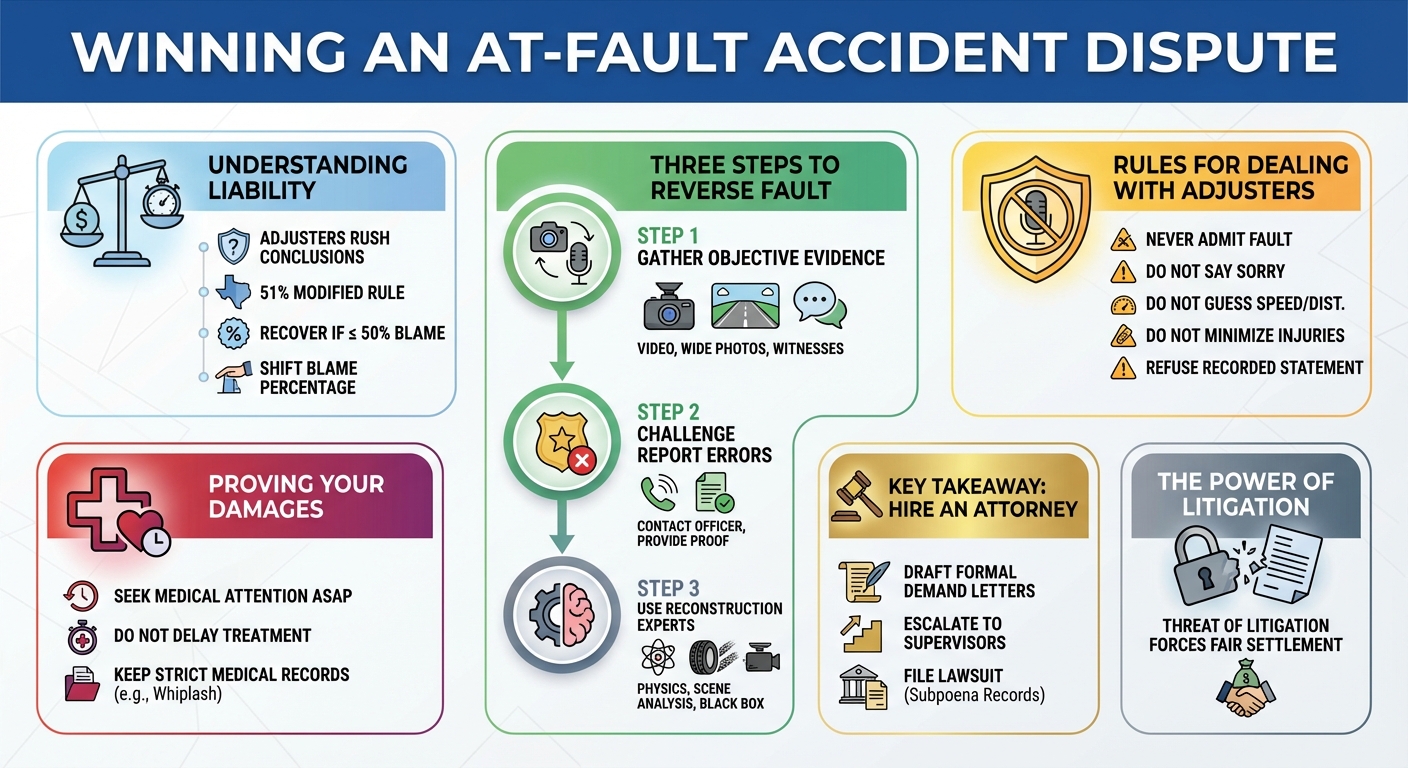
Insurance adjusters do not have the final say on the law, but they do act as the initial gatekeepers for your claim. To determine liability, they review the police report, analyze physical damage to the vehicles, and listen to recorded statements from the drivers involved. However, adjusters are motivated to protect their company’s bottom line. They often rush to conclusions or rely on incomplete information to assign you fault and deny your claim.
The Role of Modified Comparative Negligence in Texas
If your accident occurred in Texas, the state follows a “modified comparative negligence” rule with a 51% bar. This means you can still recover damages even if you are partially at fault, provided your share of the blame is 50% or less. If you are found to be 51% or more responsible, you recover nothing. Disputing an at-fault determination is often about shifting that percentage back onto the truly negligent driver.
How to beat an at-fault accident?
To beat an at-fault accident determination, you must gather irrefutable evidence like dashcam footage and witness statements, formally dispute inaccurate police reports, and refuse to provide a recorded statement to the other driver’s insurance. Hiring an experienced car accident attorney to negotiate or file a lawsuit is often necessary to successfully shift liability.
Step 1: Gather Irrefutable Evidence (Photos, Video, Witnesses)
The strongest weapon against an unfair fault determination is objective evidence. Insurance companies cannot easily argue with hard facts. Focus on securing the following:
- Video footage: Check for nearby traffic cameras, business surveillance systems, or dashcams.
- Photographic evidence: Take wide-angle shots of the entire scene, skid marks, traffic signs, and vehicle debris.
- Witness statements: Independent witnesses carry significant weight because they have no financial stake in the outcome of the claim.
Step 2: Challenge Inaccurate Police Reports
Police officers make mistakes. If the responding officer misunderstood the scene or only listened to the other driver’s version of events, the crash report may incorrectly blame you. You can contact the investigating officer to request an amendment to the report. You will need to provide concrete proof—such as photos of the vehicle damage or a new witness statement—to convince the officer to update the factual narrative.
Step 3: Utilize Accident Reconstruction Experts
When it comes down to your word against theirs, science can tip the scales. Accident reconstruction experts use physics, vehicle data recorders (black boxes), and scene analysis to determine exactly how a crash occurred. They can prove the other driver was speeding, braking too late, or swerving, providing the definitive proof needed to overturn an at-fault decision.
Communicating with the Insurance Company During a Dispute
How you handle communications with the insurance company can make or break your dispute. Adjusters are trained negotiators who look for any excuse to validate their initial fault determination.
Why should you never admit fault?
You should never admit fault because you likely do not have all the facts about how the crash occurred. Admitting fault gives the insurance company immediate grounds to deny your claim, even if an investigation later proves the other driver was actually speeding, distracted, or legally responsible.
What not to say to the insurance adjuster?
When speaking to an insurance adjuster, do not say “I am sorry,” do not guess or estimate speeds or distances, and do not minimize your injuries by saying “I feel fine.” Avoid giving a recorded statement without an attorney, as adjusters will use your words out of context to assign you fault.
Proving Your Damages in a Disputed Claim
Winning the fault dispute is only half the battle; you must also prove that the crash directly caused your injuries and financial losses.
What injuries are hard to prove?
Soft tissue injuries, such as whiplash, concussions, and closed head injuries, are notoriously hard to prove because they do not appear on standard X-rays. Insurance companies often dispute these injuries, claiming they are pre-existing or exaggerated, making comprehensive medical documentation and specialist evaluations absolutely critical for your claim.
Connecting Your Medical Records to the Crash
To prevent the insurance company from claiming your injuries are unrelated to the accident, you must seek medical attention immediately. A delay in treatment gives adjusters ammunition to argue that your injuries were caused by an intervening event. Consistent medical records, diagnostic imaging, and detailed doctor’s notes form the foundation of a successful damage claim.
When to Hire a Car Accident Lawyer to Dispute Fault
Fighting a massive insurance corporation on your own is an uphill battle. If liability is disputed, bringing in legal representation levels the playing field.
Appealing the Insurance Adjuster’s Decision
An attorney can draft a formal demand letter and appeal the adjuster’s decision by presenting a comprehensive evidence package. Lawyers know how to bypass the initial claims adjuster and escalate the dispute to supervisors or the insurance company’s legal department, forcing them to take your evidence seriously.
Filing a Personal Injury Lawsuit to Shift Liability
If the insurance company refuses to budge on their fault determination, your lawyer can file a personal injury lawsuit. The discovery phase of a lawsuit allows your legal team to subpoena phone records, depose the at-fault driver under oath, and force the disclosure of evidence the insurance company tried to hide. Often, the mere threat of litigation is enough to make an insurer reconsider their stance and offer a fair settlement.