

Table of contents
Introduction
Most people associate car accidents with neck and back injuries—whiplash, herniated discs, muscle strains. These are the injuries that get attention in medical treatment and legal claims. But there’s another common injury that’s frequently overlooked by accident victims, doctors, and even attorneys: damage to the temporomandibular joint, commonly called TMJ or TMD (temporomandibular disorder).
The TMJ is the hinge joint that connects your lower jaw to your skull. It’s one of the most complex and frequently used joints in your body—involved in talking, eating, yawning, swallowing, and even breathing. You use your TMJ thousands of times every day without thinking about it. When it’s damaged, the impact on your quality of life can be profound and far-reaching.
Yet TMJ injuries are chronically underdiagnosed and undervalued in personal injury claims. Many accident victims don’t realize their jaw pain, headaches, and ear symptoms are connected to their collision. Many doctors—even emergency room physicians and primary care doctors who see accident patients regularly—don’t think to evaluate for TMJ problems. And insurance companies are happy to ignore injuries that aren’t claimed.
If you’ve been in a Houston car accident and you’re experiencing jaw pain, clicking or popping sounds when you open your mouth, headaches concentrated near your temples, or ear pain without infection, you may have a TMJ injury that deserves compensation. This guide explains what you need to know about these overlooked injuries and how to protect your rights under Texas law.
Understanding the TMJ and How It Gets Injured in Accidents
The temporomandibular joint is a remarkably complex structure located where your lower jaw (mandible) connects to your skull (temporal bone). It’s positioned just in front of your ears on both sides of your head—you can feel it move if you place your fingers there while opening and closing your mouth.
The Joint’s Complexity: Unlike simpler hinge joints like your elbow or knee, the TMJ allows both rotation and sliding movements. When you open your mouth, the lower jaw first rotates and then slides forward, allowing the wide opening needed for eating and yawning. A disc of cartilage cushions the joint surfaces, and multiple muscles, ligaments, and tendons work together in precise coordination to control jaw movement. This complexity makes the TMJ vulnerable to injury—and challenging to treat when damaged.
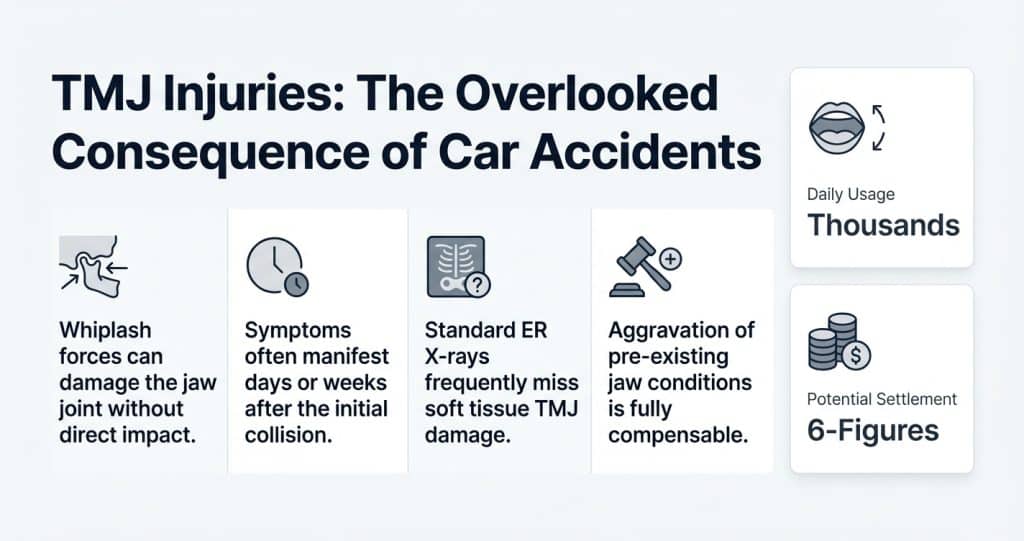
How Car Accidents Cause TMJ Injuries: In a car collision, particularly a rear-end impact, your head is thrown backward and then forward violently—the classic whiplash mechanism. But the same forces that injure your neck can also damage your jaw joint. The rapid movement can strain or tear the muscles and ligaments supporting the TMJ, displace or damage the cartilage disc within the joint, cause your jaw to slam shut forcefully (especially if your mouth was open at the moment of impact), and create misalignment between the jaw and skull that puts abnormal stress on the joint.
Indirect Force Transmission: Importantly, TMJ injuries can occur even without direct impact to the jaw. The same acceleration-deceleration forces that cause cervical spine injuries are transmitted through the head and can damage the delicate structures of the jaw joint. The mechanism that injures your neck often injures your TMJ simultaneously—which is why these injuries commonly occur together but the TMJ component frequently goes undiagnosed.
Delayed Symptom Development: Like many soft tissue injuries, TMJ damage often doesn’t manifest immediately. You might notice jaw problems developing days or weeks after the accident as inflammation builds, damaged tissues try to heal, and compensatory changes in how you use the joint create additional stress. This delay makes it harder to connect the symptoms to the collision—and gives insurance companies ammunition to argue the injury has a different cause.
Recognizing TMJ Injury Symptoms
TMJ injuries produce a range of symptoms that many people don’t associate with their car accident. If you’re experiencing any of the following after a collision, TMJ damage may be the cause.
Jaw Pain and Tenderness: Pain in the jaw joint itself is a hallmark symptom, especially when chewing, talking, or opening your mouth wide. The pain may be on one side or both, and it may worsen throughout the day as you use the joint. You might also experience facial pain that’s difficult to localize precisely.
Clicking, Popping, or Grinding Sounds: Noises when you open or close your mouth—clicking, popping, or grinding sensations—indicate potential disc displacement or joint surface damage. These sounds occur when the disc moves abnormally or when roughened joint surfaces rub against each other. Initially, the clicking may not be painful, but it often becomes painful over time if untreated.
Limited Jaw Movement: Difficulty opening your mouth fully—called limited range of motion—suggests internal joint damage. You may not be able to open wide enough to eat a sandwich or have dental work performed comfortably. In severe cases, the jaw may “lock” in an open or closed position, a frightening experience that sometimes requires medical intervention to resolve.
Headaches: TMJ dysfunction is a significant but underrecognized cause of chronic headaches. The muscles controlling jaw function connect to your skull, and when they’re strained or in spasm, they can cause tension-type headaches that concentrate around the temples and sides of the head. Many accident victims attribute these headaches to their neck injury or to general stress without realizing the TMJ is the primary source.
Ear Symptoms: The TMJ is located very close to the ear canal, and TMJ problems frequently cause ear-related symptoms. These include ear pain without signs of infection, ringing in the ears (tinnitus), feelings of fullness or pressure in the ears, and even hearing difficulties. Many people with TMJ injuries visit ENT doctors for ear problems that actually originate in the jaw joint.
Neck and Shoulder Pain: The muscles connecting the jaw to the neck and shoulders can transmit pain from TMJ injuries into these areas. You may have neck and shoulder tension that persists despite treatment—because the real source (the TMJ) isn’t being addressed.
Changes in Bite Alignment: If your teeth don’t align the way they used to when you close your mouth, or if your bite feels “off,” this may indicate TMJ displacement or structural damage to the joint that has changed how your jaw sits.
Getting Proper Diagnosis and Treatment
Proper evaluation and treatment of TMJ injuries requires seeing the right specialists—which often means looking beyond the emergency room and primary care doctors who initially treat accident victims.
Starting the Diagnostic Process: If you suspect TMJ involvement after your accident, tell your primary care doctor about your jaw symptoms and explicitly connect them to the collision. Don’t assume the doctor will think to ask about jaw problems—many don’t. Request referral to a specialist qualified to evaluate and treat TMJ disorders.
TMJ Specialists: Several types of healthcare providers specialize in TMJ disorders. Oral and maxillofacial surgeons have the most extensive training in TMJ anatomy and treatment. Dentists specializing in TMJ disorders (sometimes called orofacial pain specialists) focus specifically on these conditions. Some ENT doctors have TMJ expertise, particularly when ear symptoms are prominent. Physical therapists trained in TMJ rehabilitation can provide therapeutic treatment once the diagnosis is established.
Diagnostic Evaluation: A thorough TMJ evaluation includes detailed history of your symptoms and their development, physical examination of jaw function including range of motion, joint sounds, muscle tenderness, and bite alignment, imaging studies appropriate to your condition, and assessment of how your symptoms affect daily function.
TMJ Imaging: Proper imaging is crucial for documenting TMJ injuries. Standard dental X-rays may show obvious bony abnormalities but miss soft tissue damage. CT scans provide detailed images of bone structures and can reveal fractures, degenerative changes, and joint abnormalities. MRI is particularly valuable because it shows soft tissue damage—disc displacement, inflammation, muscle injury—that doesn’t appear on X-rays or CT. If your symptoms suggest TMJ injury, insist on appropriate imaging to document the condition.
Treatment Options: TMJ treatment depends on the type and severity of injury. Conservative treatment is usually attempted first and includes pain medication and anti-inflammatories to reduce symptoms, muscle relaxants to address jaw muscle tension, physical therapy focusing on jaw muscles and joint mobilization, occlusal splints or bite guards worn at night to reduce clenching and protect the joint, heat and ice therapy, and dietary modifications such as soft foods to rest the joint.
Advanced Treatment: When conservative treatment fails to resolve symptoms, more aggressive interventions may be recommended. These include corticosteroid or Botox injections into the joint or muscles, arthroscopy to examine and repair damage inside the joint, open joint surgery to repair or replace damaged structures, and orthodontic treatment if bite misalignment is contributing to problems.
Treatment Documentation: Throughout your treatment, make sure all care is thoroughly documented in your medical records. Every symptom you report, every treatment provided, and every specialist visit creates evidence supporting your claim.
The Insurance Company Challenge
Insurance companies routinely undervalue or deny TMJ injury claims. Understanding their tactics helps you build a case that overcomes their resistance.
Pre-Existing Condition Arguments: If you’ve ever had any dental work, mentioned jaw discomfort to any doctor, or sought treatment for headaches, the insurance company will argue your TMJ problems are pre-existing and unrelated to the accident. They’ll comb through years of medical and dental records looking for any mention of jaw or head symptoms.
The Response: Even if you had some prior TMJ issues, the accident may have significantly aggravated your condition—and aggravation of a pre-existing condition is fully compensable under Texas law. The relevant question isn’t whether you ever had jaw problems before, but whether the accident caused your current level of dysfunction.
Causation Disputes: Because TMJ symptoms often develop gradually after an accident, insurance companies argue the connection to the collision isn’t clear. They’ll suggest your symptoms must have been caused by something else—stress, dental work, sleeping position, everyday wear and tear.
The Response: Build strong documentation connecting your symptoms to the accident. Medical records showing that you reported TMJ symptoms shortly after the collision, that you had no significant prior jaw problems, and that your treating physicians believe the accident caused your injury all support causation.
Minimizing Treatment Necessity: Insurance adjusters often characterize TMJ treatment as excessive, unnecessary, or experimental. They may refuse to pay for bite splints, specialized physical therapy, or advanced imaging studies.
The Response: Make sure your treating specialists document why each treatment is medically necessary. Expert opinions about treatment necessity are powerful evidence.
Undervaluing Impact: Even when insurance companies acknowledge TMJ injuries, they undervalue them. Adjusters often don’t appreciate how significantly jaw problems affect daily life—every meal you eat, every conversation you have, every time you yawn involves the TMJ.
The Response: Document thoroughly how your TMJ injury affects your daily functioning. Keep records of foods you can no longer eat, conversations you’ve had to cut short because of pain, sleep disturbances from jaw clenching, and activities you’ve had to modify or abandon.
Documenting Your TMJ Claim
Building a strong TMJ injury claim requires comprehensive documentation from the beginning of your symptoms through your ongoing treatment and recovery.
Symptom Journal: Keep detailed daily records of your TMJ symptoms. Note when symptoms occur and what triggers them, pain levels on a scale of 1-10 at different times of day, foods you have difficulty eating or must avoid, how symptoms affect talking and communication, sleep quality and any nighttime clenching or grinding, headaches including location, severity, and duration, and any medications you take and their effectiveness. This contemporaneous documentation creates a powerful record of your symptoms that’s hard to dispute.
Medical Records: Ensure your medical records clearly document when your TMJ symptoms began and their connection to the accident, the nature and severity of your symptoms at each visit, examination findings including range of motion, joint sounds, and muscle tenderness, diagnostic test results including imaging studies, treatment provided and your response, and your prognosis for recovery.
Pre-Accident Baseline: Gather evidence showing you didn’t have significant TMJ problems before the accident. Prior dental records documenting normal jaw function, previous medical records with no TMJ complaints, and testimony from family members that you never complained of jaw problems before the collision all help establish that the accident caused your current condition.
Functional Impact Evidence: Document how your TMJ injury affects your daily life. Take photos or video of limitations like difficulty opening your mouth wide. Keep receipts for soft foods you’ve had to purchase. Document meals out that you’ve had to decline or leave early. Record conversations you’ve struggled to complete.
Treatment Records and Costs: Maintain complete records of all TMJ treatment including specialist visits, physical therapy sessions, medications and oral devices provided, and imaging studies. Keep all bills and receipts. Under Texas law, you’re entitled to recover reasonable and necessary medical expenses, so complete cost documentation is essential.
TMJ Injury Claim Values Under Texas Law
TMJ injuries can result in significant compensation, depending on the severity of injury and required treatment.
Factors Affecting Claim Value: Several factors influence how much a TMJ injury claim is worth. The severity and duration of symptoms matters significantly—is this a minor strain that resolved in a few months, or a chronic condition causing permanent dysfunction? The extent of treatment required affects both medical expense damages and demonstrates injury severity. Whether surgery was necessary typically increases claim value substantially. The impact on daily activities, work, and quality of life supports pain and suffering damages. The permanence of any limitations affects future damage calculations.
Damage Categories: TMJ injury claims can recover past medical expenses for all treatment to date, future medical expenses for anticipated ongoing care, lost wages if jaw pain has caused you to miss work, lost earning capacity if the injury affects your ability to perform your job, pain and suffering for physical discomfort and emotional distress, and loss of enjoyment of life for activities you can no longer enjoy.
Settlement Ranges: While every case is different, mild TMJ injuries that resolve with conservative treatment within several months may settle for amounts in the thousands to tens of thousands of dollars. Moderate injuries requiring extended treatment, specialist care, and oral appliances with ongoing symptoms can be worth substantially more. Severe TMJ injuries requiring surgery or causing permanent damage resulting in chronic dysfunction can result in six-figure settlements or verdicts.
Future Damages Considerations: If your TMJ injury will require ongoing treatment, periodic replacement of oral appliances, or has caused permanent damage affecting your jaw function for life, your claim should include future medical expenses and compensation for permanent functional limitations. These future damages can significantly increase claim value but require strong medical evidence about prognosis and anticipated needs.
Conclusion: Don’t Overlook Your Jaw
TMJ injuries are common in car accidents but frequently overlooked—by accident victims who don’t realize their symptoms are connected to the collision, by doctors who don’t think to evaluate the jaw joint, and by insurance companies that would rather not pay for injuries that aren’t explicitly claimed.
If you’re experiencing jaw pain, clicking, headaches, ear symptoms, or other TMJ-related problems after a Houston car accident, don’t ignore them—and don’t let the insurance company dismiss them.
Get proper evaluation from a TMJ specialist who can diagnose your condition and recommend appropriate treatment. Document your symptoms thoroughly from the beginning, keeping detailed records of how the injury affects your daily life. Make sure your medical records clearly connect your TMJ problems to the accident. And ensure your personal injury claim includes appropriate compensation for this significant but often overlooked injury.
The TMJ is involved in virtually everything you do throughout the day—eating, talking, laughing, yawning, expressing emotion. When it’s damaged, the impact extends far beyond simple jaw pain. You may find yourself unable to eat foods you love, cutting conversations short, avoiding social situations, and struggling with chronic headaches and facial pain.
These injuries deserve serious attention and fair compensation. If you’ve suffered TMJ damage in a car accident, don’t let anyone—doctors, insurance adjusters, or even well-meaning friends—tell you it’s not a big deal. You know how much you’re suffering. Make sure your claim reflects that reality.

About the Author
Chi Nguyen is a Houston personal injury attorney dedicated to helping accident victims understand their rights and receive fair compensation under Texas law. With extensive experience representing injured Texans, Attorney Nguyen combines legal expertise with a commitment to client education and empowerment.